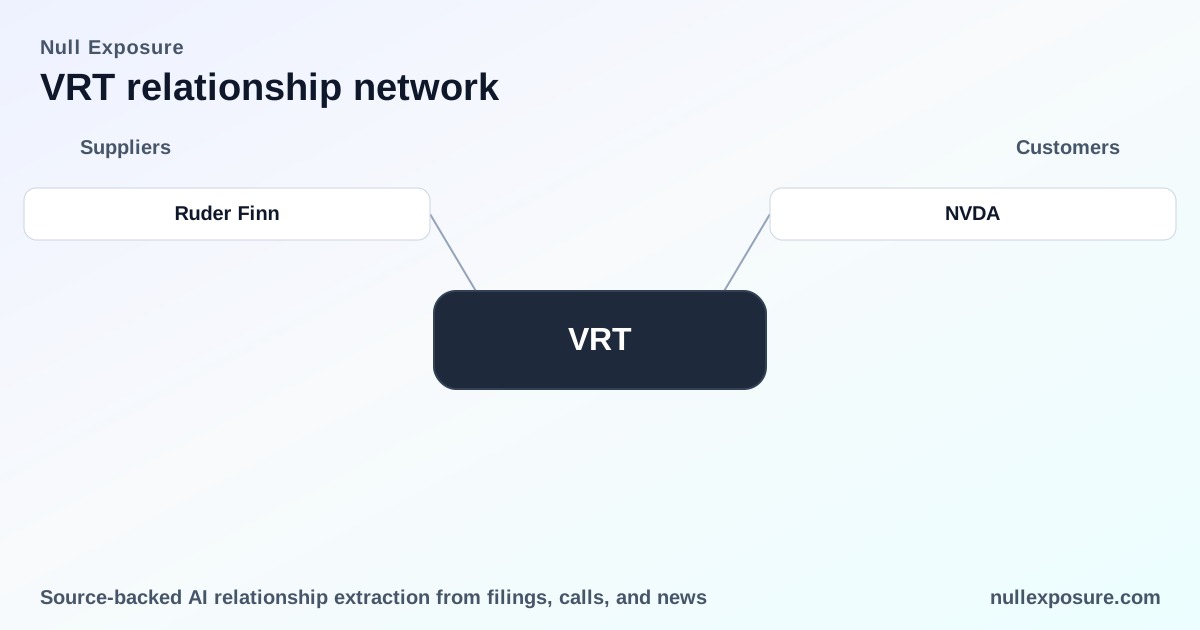
Vertiv (VRT) — supplier footprint, contractual posture, and the public supplier mentions investors should track
Vertiv designs, manufactures and services critical digital infrastructure for data centers, communications networks and industrial customers, and it monetizes through a mix of product sales (power systems, thermal management, IT racks) and recurring lifecycle services and maintenance contracts. The company's revenue and margins are driven by capital equipment cycles plus a growing services annuity book, with a 12-month revenue run rate above $10 billion and EBITDA near $2.2 billion, positioning Vertiv as a large-cap supplier to hyperscale, telco and commercial customers. For regular updates on supplier relationships and supply-chain signals, visit https://nullexposure.com/.
How Vertiv makes money and why suppliers matter
Vertiv’s operating model combines global manufacturing with field services. Product sales provide near-term revenue and services provide recurring gross margin, which together underpin cash flow stability in a cyclical equipment business. The balance sheet and forward earnings are sensitive to three supplier-facing vectors:
- Capital-goods supply and manufacturing footprint — drives lead times, cost pass-through and ability to scale for major customer deployments.
- Services ecosystem — third-party vendors and contractors execute installation, field maintenance and cybersecurity responses, making supplier reliability a direct input to service revenue continuity.
- Financial hedging and treasury arrangements — interest-rate and FX instruments affect financing costs and reported income volatility, which in turn influence supplier payment capacity and contract pricing.
Vertiv’s public metrics — including a price-to-sales ratio and elevated valuation multiples relative to peers — reflect expectations for continued services growth and stable aftermarket demand.
What the supply-side signals tell investors about operating posture
The filings and public disclosures produce a cohesive signal about Vertiv’s supplier relationships and contracting approach:
- Contracting posture blends long-term financial hedges with short-term transactional hedges. The company discloses interest-rate swap agreements tied to its term loan through 2027, showing long-duration risk management at the balance-sheet level, while it uses one-month and sub‑one-year foreign-exchange forwards to manage transactional currency exposure. These choices indicate a stable capital structure strategy paired with nimble operational hedging to protect margins on cross-border procurement (company filings, recent fiscal reports).
- Geographic footprint is explicitly multi-regional and expanding. Vertiv has added manufacturing capacity in APAC — a Pune, India thermal management plant opened in 2024 — while simultaneously expanding U.S. supply and manufacturing capacity to meet domestic demand. That geographic duality reduces single‑region concentration risk and positions Vertiv to service both hyperscale and regional telco customers efficiently (company disclosures, FY2024–FY2025).
- Supplier relationships include critical third‑party service providers. The company’s cybersecurity and risk-management framework explicitly contemplates engaging external vendors and service providers, making certain third parties operationally critical for incident response and compliance work (company disclosure language).
- Maturity and cadence of contracts vary. Financial hedges tied to multi-year debt indicate mature, long-term financial relationships, while FX management via short-term forwards reflects transactional and rapidly changing procurement flows.
Collectively, these signals portray a company that treats financial risk management as strategic (long-term swaps) and operational supply exposure as tactical (short-term FX and facility expansion). For deeper supplier-mapping tools and continuous monitoring, see https://nullexposure.com/.
Public supplier/partner mentions — what’s actually in the record
Vertiv’s supplier/partner mentions in the available results are limited but instructive. Covering every relationship in the provided results:
- Ruder Finn — Ruder Finn is listed as Vertiv’s media contact for investor relations and press communications in a March 10, 2026 news release announcing the company’s investor-conference participation. This indicates Vertiv uses an external communications firm for media and investor outreach rather than handling all PR in‑house (Barchart news item, March 10, 2026; link: https://www.barchart.com/story/news/35523063/vertiv-to-participate-in-upcoming-investor-conference).
This single mention is operationally modest — a communications engagement does not directly impact manufacturing or service delivery — but it flags an outsourced relationship that shapes investor messaging and external perception.
What investors and operators should watch next
Operational and credit investors should monitor the following prioritized list of supplier-related indicators, with emphasis on items where disclosures already show explicit exposure:
- Hedging maturity and counterparty strength. The outstanding interest-rate swap positions tied to the term loan (through 2027) make counterparty creditworthiness and documentation terms material to financing risk. Watch subsequent filings for swap novations or collateral changes (company filings, ongoing).
- Manufacturing footprint expansion and utilization. Capacity additions in Pune and expanded U.S. manufacturing can improve gross margins if utilization ramps; conversely, under-utilization would be a source of cost pressure. Track capex guidance and regional production output.
- Third-party service dependencies. The cybersecurity and field-service model relies on external vendors. Evaluate contractual terms for critical vendors, SLAs, and contingency staffing to assess operational resilience.
- FX transaction flow and short-term exposure. Frequent use of short-term forwards indicates ongoing transactional risk; monitor currency volatility in Euro, CNY and GBP exposures referenced in filings and any change in hedging tenor.
Key takeaway: Vertiv combines long-dated financial hedges with short-tenor operational hedging and a multi-region manufacturing footprint — a mix that reduces single-point failure risk while exposing the company to the quality of third-party service providers and regional capacity utilization.
For continuous supplier intelligence and automated alerts on relationship changes and filing disclosures, explore our platform at https://nullexposure.com/.
Final read: risks, advantages, and an investor checklist
Vertiv’s supplier posture offers both resilience and concentration vectors. Resilience comes from geographic diversification and a services-led revenue mix; concentration risk arises from dependence on third-party service providers for cybersecurity and from the need to ramp manufacturing capacity efficiently. Operational execution — closing the loop between new factory output and service delivery — will determine whether current valuation multiples are justified.
Actionable checklist for investors/operators:
- Confirm the status and counterparty of long-term swaps and any collateral triggers.
- Track throughput and utilization at new India and U.S. facilities against capex forecasts.
- Request detail on critical third-party SLAs for cybersecurity and field maintenance.
- Monitor FX flow disclosures and effective hedging tenors in quarterly filings.
For supplier relationship monitoring and tailored scoring of counterparty criticality, visit https://nullexposure.com/ — sign up for alerts and supplier maps that translate filings and public mentions into operational risk signals.