Vertex Pharmaceuticals (VRTX) — Supplier Relationships and Operational Constraints that Matter to Investors
Vertex earns revenue by discovering, developing and commercializing high-margin genetic medicines, then outsourcing parts of R&D, manufacturing and distribution to external partners. The company's commercial cash flow is driven by a tight portfolio of approved therapies and a growing pipeline; it monetizes through drug sales and milestone/license arrangements while relying on third parties for specialized manufacturing, logistics and certain research services. For investors evaluating supplier risk, Vertex combines a large, profitable commercial base (roughly $12.0B revenue TTM and $118B market cap) with concentrated, mission‑critical third‑party dependencies. Learn more at https://nullexposure.com/.
What the supplier footprint looks like in plain terms
Vertex operates a hybrid model: it retains core internal capabilities in Boston for advanced biologics work while leveraging a worldwide network of third‑party manufacturers, distributors and service providers for components of its supply chain and clinical programs. The company reports reliance on external partners for manufacturing cell culture reagents, gene‑editing components and for clinical trial services, and it uses approved distributors and third‑party logistics to move product globally. Financial disclosures show substantial business development payments: $4.6 billion in AIPR&D‑related payments in 2024 and $527.1 million in 2023, signaling large external spend tied to collaborations and licenses.
- Scale and profitability context: Vertex reported roughly $12.0B in revenue (TTM) with a 32.9% profit margin and $4.87B EBITDA, underlining that supplier failures would have outsized operational consequences despite strong cash generation.
- Geographic footprint: The company explicitly uses third‑party contract manufacturers in APAC, including China, for parts of its manufacturing process — a material geographic exposure for investors to monitor.
For a deeper supplier risk picture, visit https://nullexposure.com/.
Notable supplier relationships you need to know about
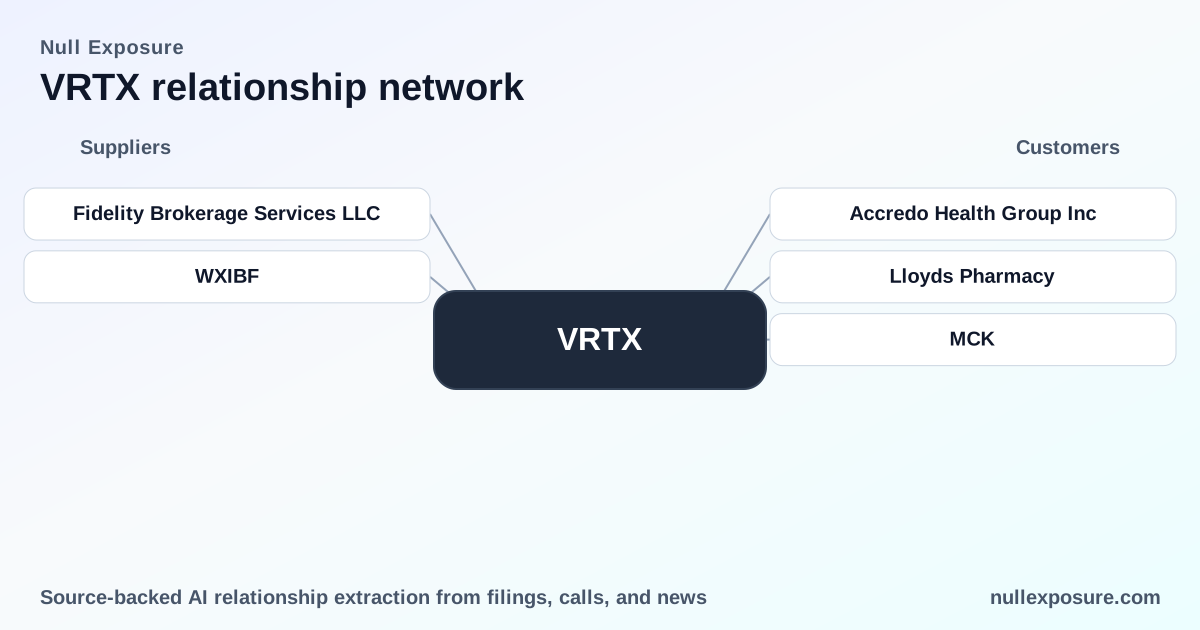
WuXi Biologics — a research and licensing partner for T‑cell engager programs
Vertex entered into a license and research service agreement with WuXi Biologics for a T‑cell engager program, which positions WuXi as both a research collaborator and potential contract manufacturer for program development. According to a March 2026 news report, the agreement covers licensing plus research services to advance Vertex’s T‑cell engager assets. (Source: StockTitan news item on Vertex announcements, March 2026.)
Fidelity Brokerage Services LLC — broker of shareholder resale transactions
A Form 144 filing in FY2026 lists Fidelity Brokerage Services LLC as the broker facilitating proposed resale transactions, signaling institutional trading activity or insider resale execution routed through Fidelity. The filing posted on StockTitan confirms the broker role in a resale notification filed with the SEC in March 2026. (Source: StockTitan copy of Form 144, FY2026.)
How these relationships feed operational and investor risk
Vertex’s supplier posture is not casual procurement — it is strategic and intensive. The company lists multiple relationship roles at scale: manufacturer, distributor and service provider. These are not interchangeable suppliers; they are providers of specialized biological materials, gene‑editing components, clinical services and distribution networks.
- Contracting posture: Vertex uses long‑form collaborations, licenses and milestone structures that generate large upfront and contingent payments; the 2024 AIPR&D line items demonstrate a mix of acquisition and collaboration economics. These contracts are commercially complex and often lock Vertex into high‑value commitments.
- Concentration and criticality: Outsourcing for gene‑editing components and manufacturing of cell‑based products is operationally critical. A disruption at a key third‑party manufacturer would affect clinical supply and commercial fulfillment given Vertex’s concentrated product set.
- Geographic risk: Use of APAC manufacturers, including Chinese facilities, introduces regulatory, logistical and geopolitical vectors that investors must stress‑test in scenario planning.
- Spend and maturity: The spend band signal (> $100M) and the $4.6B AIPR&D item in 2024 show Vertex is operating at enterprise scale with mature, high‑value external partnerships rather than ad‑hoc supplier relationships.
Concrete investor takeaways
- Supplier risk is enterprise‑level and material. Vertex’s combination of high margins, concentrated product revenue and reliance on third‑party manufacturing makes supplier continuity a direct earnings risk.
- Partnerships are strategic and capital‑intensive. The scale of AIPR&D payments shows Vertex prefers deep collaborations and licensed access rather than small, replaceable vendors.
- Geographic and regulatory exposure deserves monitoring. APAC manufacturing gives Vertex flexibility and scale but requires active oversight around quality, export controls and supply chain resilience.
Key operational flags to watch:
- Contract renewal terms and milestone schedules in major collaborations.
- Single‑source manufacturing arrangements for any approved medicine or late‑stage program.
- Changes in partner credit, capacity or regulatory status in APAC facilities.
Quick risk checklist for operators and investors
- Confirm whether critical programs have dual‑sourced manufacturing or qualified back‑up suppliers.
- Review milestone and contingent payment schedules tied to AIPR&D and acquisitions for cash flow timing.
- Monitor partner performance metrics and regulatory filings for supply disruptions or quality events.
For tailored supplier intelligence and scenario analysis, begin here: https://nullexposure.com/.
Closing: what to do next
Vertex combines robust financials with high supplier leverage; that duality is the core investment story for supplier risk. Investors should treat supplier arrangements as operationally critical contracts that influence valuation through cash flow timing and regulatory exposure. Operators should prioritize redundancy and contract clauses that protect supply continuity and intellectual property.
If you want a structured supplier risk brief or monitoring plan for Vertex and comparable biotech suppliers, visit https://nullexposure.com/ for engagement options and further analysis.