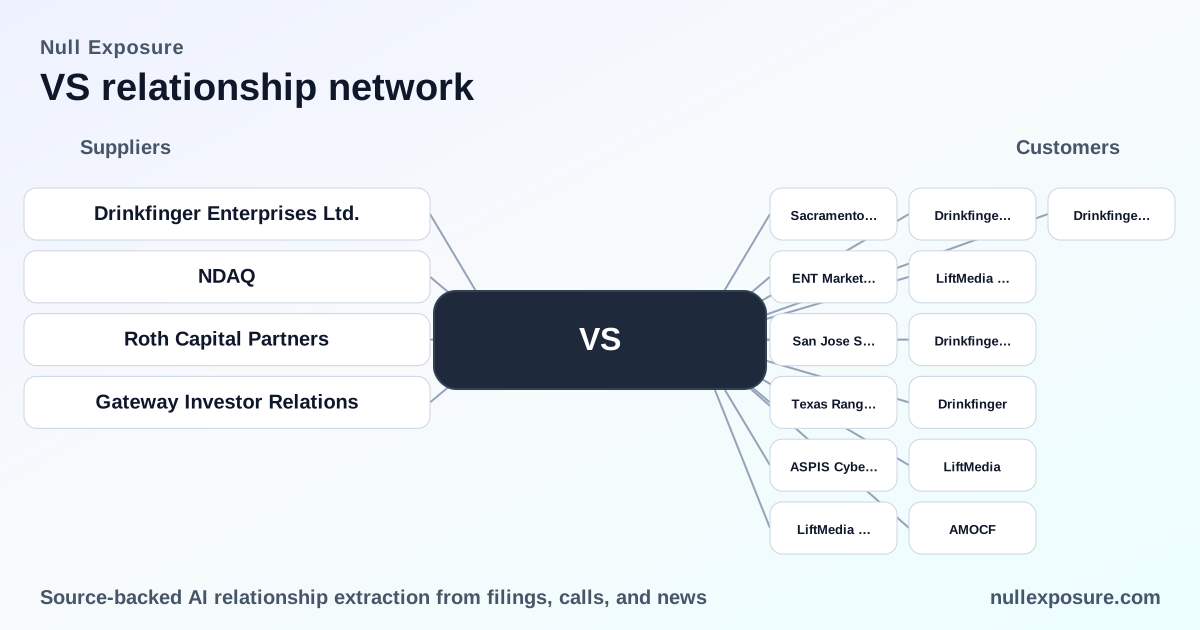
Versus Systems Inc (VS): Supplier relationships and what they signal to investors
Versus Systems operates a B2B software platform that enables video game publishers and developers to deliver prize-based matches and branded engagement campaigns to players in Canada and the United States, monetizing through platform licensing, campaign services, and distribution partnerships. Revenue is concentrated in marketplace and engagement services rather than recurring enterprise SaaS, and the company's public filings and press releases show a small revenue base with negative profitability metrics, high insider ownership, and active capital markets activity.
If you want structured supplier relationship intelligence and consolidated source links for investment due diligence, visit https://nullexposure.com/ for more context and data.
How Versus makes money, in plain terms
Versus sells its engagement technology to content owners and brands who want to run prize-driven promotions inside games and digital channels. Monetization comes from platform fees, campaign execution, and commercial distribution agreements where the company leverages its commercial footprint to place branded promotions and products. The FY2025–2026 disclosures show revenue acceleration year-over-year but continued operating losses, underscoring a growth-at-cost profile rather than a mature cash-generative model.
Operating constraints and what they imply for supplier risk
Versus reports engaging external specialists — cybersecurity assessors, consultants, and auditors — on an ongoing, as-needed basis. That disclosure is a company-level signal that Versus uses outside service providers for risk management and compliance functions rather than internalizing these capabilities. This contracting posture implies lower fixed-cost overhead for specialized functions but increases vendor management complexity and potential third-party operational risk. Given small revenue and concentrated commercial activity, supplier concentration and the criticality of a few commercial partners are key risk vectors for investors.
For more supplier-level context and sourcing, see https://nullexposure.com/.
Relationship-by-relationship review (concise, sourced)
-
Drinkfinger Enterprises Ltd.
Versus executed a definitive agreement to power a global beverage engagement network and will distribute Drinkfinger products where Versus’s commercial footprint is strong; the partnership is presented as a strategic commercialization and distribution play. Source: GlobeNewswire press release (December 23, 2025) and related coverage including Quiver Quant and StockTitan (March 2026 aggregations). -
The Nasdaq Stock Market LLC
Nasdaq notified Versus in November 2022 that the company had regained compliance with the minimum bid price listing requirement under Nasdaq Listing Rule 5550(a)(2), restoring the company’s standing on the Nasdaq Capital Market. Source: FinancialContent / Pasadena Star-News report (November 28, 2022). -
Roth Capital Partners
Roth Capital Partners acted as the exclusive placement agent for a $2.1 million public offering for Versus, indicating active capital markets engagement and reliance on placement agents for equity financing. Source: GlobeNewswire press release (December 7, 2022). -
Gateway Investor Relations
Gateway Investor Relations is listed as Versus’s investor contact in public disclosures, providing investor relations support and acting as the external communications conduit for shareholder relations and press distribution. Source: FinancialContent / Pasadena Star-News report (November 28, 2022).
What these relationships collectively tell an investor
The supplier and partner set shows a company actively managing external commercial, capital markets, and investor relations functions. Key themes are commercialization through brand partnerships, dependence on capital raises, and outsourced investor/IR functions. The Drinkfinger partnership demonstrates how Versus pursues commercial distribution deals to expand monetization opportunities beyond core game publishers. The Roth Capital bridge to public financing and Gateway’s IR role reflect ongoing capital and communications dependency consistent with a small-cap growth company.
Operational and financial constraints that matter
- Contracting posture: Versus relies on external specialists for cybersecurity, compliance, and investor relations, indicating a lean internal operation that outsources critical controls. This reduces fixed cost but elevates vendor oversight requirements.
- Concentration and criticality: The company’s revenue base is small and relationships such as brand distribution agreements are highly material to near-term growth, making individual partner performance influential to results.
- Maturity: Financials show negative profitability, modest revenue (Revenue TTM roughly $2.18M), and active equity financings, signaling an early, capital-consuming stage rather than a mature, cash-flowing enterprise. These are company-level constraints derived from public filings and press releases.
Risk factors highlighted by relationships
- Commercial execution risk: The success of brand distribution agreements like Drinkfinger depends on Versus’s ability to convert its footprint into product placement and measurable engagement revenue. Source: GlobeNewswire (Dec 23, 2025).
- Market-listing and liquidity risk: Historical Nasdaq compliance notices and small public float indicate potential share-price volatility and liquidity constraints. Source: FinancialContent / Pasadena Star-News (Nov 28, 2022).
- Financing dependence: Use of placement agents for equity offerings demonstrates dependency on external financing channels to sustain operations. Source: GlobeNewswire (Dec 7, 2022).
If your diligence requires line-item supplier intelligence or primary-source aggregation, start here: https://nullexposure.com/.
Investment takeaways and actionable view
- Growth strategy is partnership-driven: Versus pursues commercial distribution and brand-engagement agreements to scale revenue rather than relying solely on organic enterprise SaaS adoption. The Drinkfinger agreement is emblematic of that approach.
- Balance sheet and liquidity are limiting factors: Historical use of placement agents and modest market capitalization imply ongoing capital needs; investors should treat future financings as a likely path to sustain growth.
- Operational risk is outsourced but real: Reliance on external cybersecurity and auditor services reduces internal fixed costs but requires strong vendor governance; a single failed or mismanaged third-party relationship could have outsized operational impact.
For more structured supplier risk scoring and consolidated primary sources, visit https://nullexposure.com/ and request the supplier report.
Final thought
Versus Systems is a niche engagement-platform operator that monetizes through branded campaigns and distribution partnerships. Its supplier relationships show a commercial-first scaling strategy supported by external service providers and capital-market intermediaries, which works for rapid go-to-market expansion but raises concentration and financing risks investors must price into valuation and position sizing.