VSECU supplier relationships: what investors and operators need to know
Thesis: VSE Corporation monetizes a two-pronged aftermarket model — distribution of aviation parts and MRO (maintenance, repair and overhaul) services — and funds growth and balance-sheet flexibility through capital-market transactions that include listed tangible equity units. VSE’s supplier and distribution relationships underpin revenue scalability in commercial and government channels and materially affect margin stability and operational risk. For a clear view of counterparty exposure and contractual posture, focus on distribution partners, product-line exclusives, and the company’s reliance on third-party logistics. Learn more at https://nullexposure.com/.
Why supplier links matter for VSECU investors
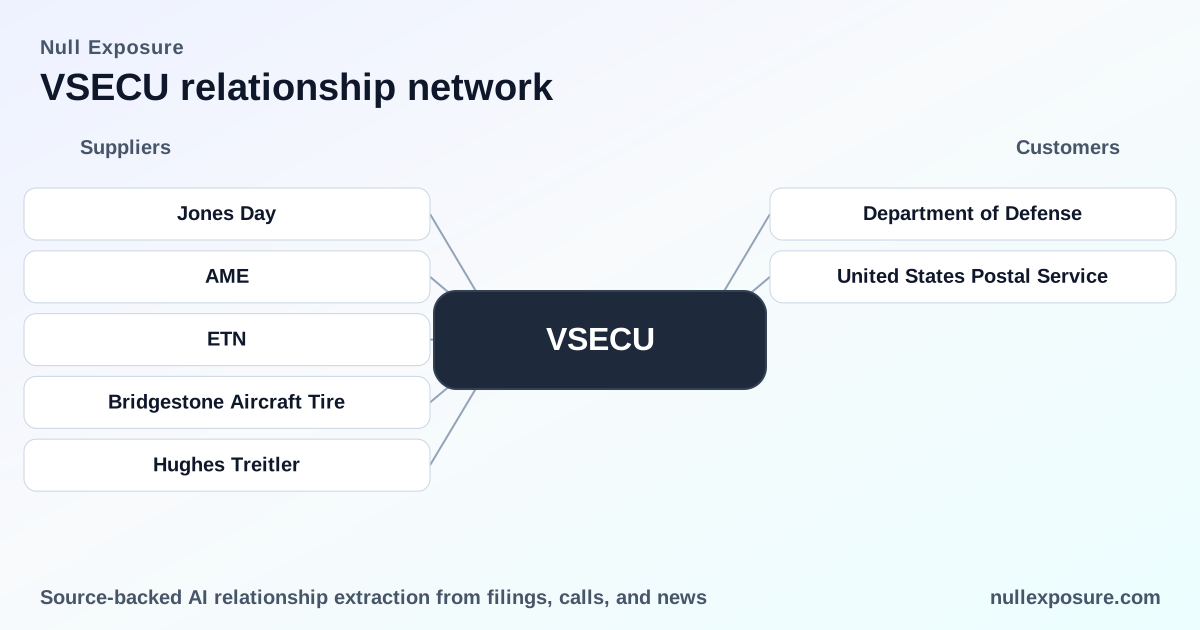
VSE’s economics depend on supply continuity and the commercial reach of its distribution partners. Exclusive distribution agreements and new distribution arrangements drive revenue per share and inventory turns, while legal and capital markets relationships determine access to capital and dilution dynamics. The following relationship map provides a concise picture of counterparties that matter to cash flow stability and execution risk.
If you want a consolidated view of counterparties and contract-level signals, visit https://nullexposure.com/ for full supplier analytics.
The counterparties — concise, actionable summaries
Jones Day — legal counsel for capital raise
Jones Day acted as legal counsel for VSE Corporation in connection with concurrent underwritten public offerings in early 2026, representing the company on an offering that included 3,989,362 common shares priced at $188.00 per share and 8,000,000 5.750% tangible equity units at $50.00 each. This engagement signals active capital-market management and the use of tangible equity units as a financing instrument (Jones Day press release, March 2026: https://www.jonesday.com/en/practices/experience/2026/02/vse-corporation-completes-13-billion-public-offering-of-common-stock-and-tangible-equity-units).
AMETEK (through Kellstrom Aerospace) — extended exclusive global distribution (sensors and fluid management)
VSE extended exclusive global distribution arrangements via Kellstrom Aerospace for AMETEK Sensors and Fluid Management Systems product lines, preserving access to specialized components that support both commercial and defense aftermarket customers. This preserves a differentiated product pipeline and supports aftermarket margin capture (StockTitan summary, FY2020; first seen March 2026: https://www.stocktitan.net/news/VSEC/).
Eaton — new distribution arrangements (electromechanical and fluid controls)
VSE established new distribution arrangements with Eaton, expanding its offerings in electromechanical and fluid control systems critical to aircraft platforms and industrial customers; this broadens the company’s catalog and reduces single-source exposure in certain line items. The arrangement reflects a targeted expansion of supplier relationships to support aftermarket demand (StockTitan summary, FY2020; first seen March 2026: https://www.stocktitan.net/news/VSEC/).
Bridgestone Aircraft Tire — distribution for aircraft tires
VSE added distribution arrangements with Bridgestone Aircraft Tire, a direct tie to a consumable and mission-critical product group that drives recurring replacement cycles across commercial fleets. Tires are a high-frequency aftermarket component and this relationship supports steady revenue lines and predictable replenishment demand (StockTitan summary, FY2020; first seen March 2026: https://www.stocktitan.net/news/VSEC/).
Hughes Treitler (through Kellstrom Aerospace) — extended exclusive global distribution (avionics and related components)
Through Kellstrom Aerospace, VSE extended exclusive distribution for Hughes Treitler product lines, reinforcing supply for avionics and specialty components that feed repair-and-overhaul workflows. This helps VSE maintain product depth and differentiated inventory for maintenance contracts (StockTitan summary, FY2020; first seen March 2026: https://www.stocktitan.net/news/VSEC/).
What these relationships reveal about VSE’s operating model and constraints
The relationship set shows a distribution-centric operating posture supported by exclusive reseller channels and targeted manufacturer arrangements. Several operating-model signals that investors should prioritize:
- Contracting posture — outsourced logistics and third-party dependencies. Company-level disclosures state: "We do not maintain our own delivery networks, and instead rely on third‑party package delivery companies." This is a structural choice to outsource logistics rather than vertically integrate warehousing-to-door delivery, which reduces fixed costs but increases counterparty and service-risk exposure.
- Concentration and criticality — selective exclusives, broad product access. Exclusive distribution deals (AMETEK, Hughes Treitler via Kellstrom) indicate concentrated supplier arrangements for specific product lines, which are critical to maintaining aftermarket differentiation and pricing power. Conversely, new arrangements with broad players like Eaton and Bridgestone suggest diversification where practical.
- Maturity of relationships — established distribution channels. Many named relationships reflect FY2020 arrangements that continued into later filings and press cycles; this is consistent with mature, stable supplier partnerships rather than ad hoc sourcing.
- Capital-market connectivity — legal and underwriting relationships matter. The Jones Day engagement on the 2026 offering shows VSE deploying capital markets (including tangible equity units) as a financing lever, which influences shareholder dilution, leverage profile and covenant flexibility.
Taken together, these characteristics shape risk-return: outsourcing logistics reduces capex but increases operational dependency on couriers; exclusive distribution increases margin potential but raises contract-renegotiation and concentration risk.
Investment implications — focus areas for due diligence
Investors and operators should emphasize the following:
- Counterparty performance metrics: On-time fill rates, lead-time variability, and warranty-backlog exposure for AMETEK, Eaton and Bridgestone product lines.
- Contract terms and exclusivity duration: Evaluate the length and renewal mechanics of exclusive distribution arrangements via Kellstrom Aerospace.
- Logistics concentration: Identify single-carrier dependencies and contingency plans given VSE’s outsourced delivery posture.
- Capital structure impact: Understand how tangible equity units issued in 2026 affect long-term cash servicing and equity dilution.
Key risks and read-throughs summarized:
- Exclusive distribution deals are a competitive advantage but create single-point supplier risk for product lines.
- Outsourced delivery limits fixed-cost burden but raises exposure to carrier disruptions.
- Use of tangible equity units and public offerings indicates active balance-sheet management and potential dilution; legal counsel engagement confirms market sophistication.
If you want a deeper counterparty map and contract-level analysis, start here: https://nullexposure.com/.
Where to go from here
For investors building a supplier-risk model, the next steps are to obtain contract durations, revenue-attributable-to-partner metrics, and delivery KPIs. Operators should prioritize contingency planning around logistics and alternative sourcing for exclusive product lines.
For a consolidated supplier risk assessment and contract intelligence, visit https://nullexposure.com/ for tools and reporting that translate these relationships into investable signals.
Bottom line: VSE’s supplier architecture blends exclusive, high-value distribution agreements with pragmatic logistics outsourcing and active capital-market financing — a configuration that supports aftermarket margins but requires focused counterparty and logistics oversight to protect cash flow resilience.