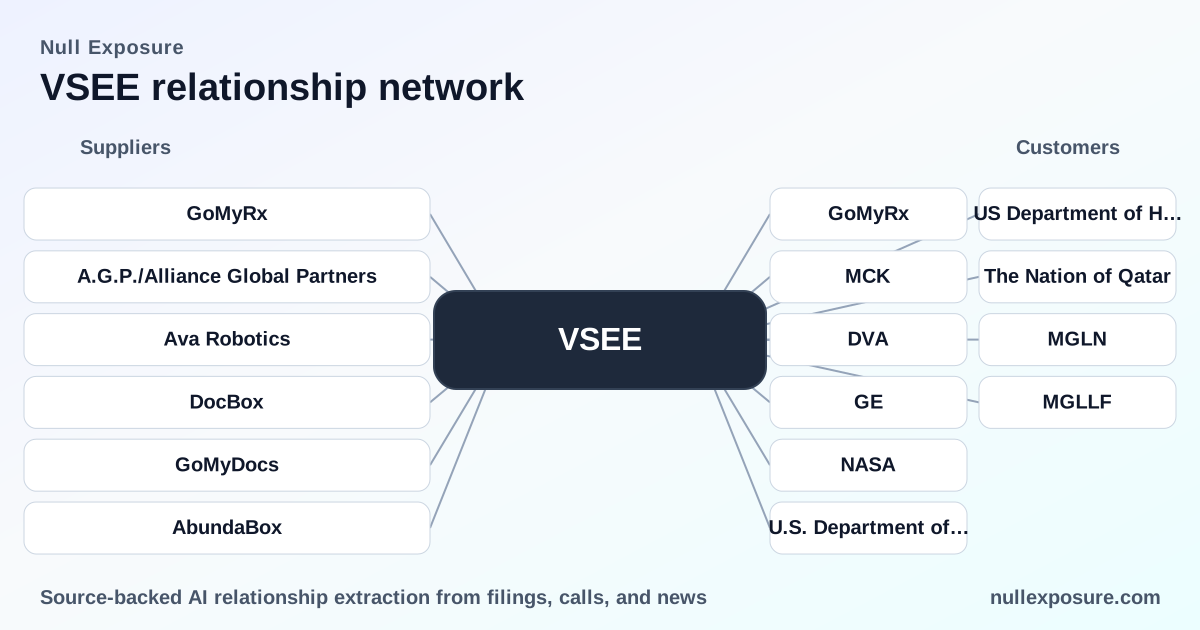
VSee Health: supplier map and what it means for investors
VSee Health sells secure telehealth software and integrated virtual care services to hospitals and provider groups, monetizing primarily through enterprise subscriptions, integration and managed-services arrangements, and strategic partnerships that extend the platform into pharmacy fulfillment and robotic telepresence. Investors should evaluate VSee on the basis of platform stickiness, partner-driven revenue acceleration, and vendor concentration risk arising from an expanding outsourcing model. Learn more at https://nullexposure.com/.
How VSee makes money and what drives value
VSee operates as a healthcare communications platform provider: the core product is a secure video and workflow platform with add-ons for remote patient monitoring, EMR interoperability, and AI-assisted workflows. Revenue flows from enterprise subscriptions, fees for integrations and managed services, and partnerships that bring third‑party fulfillment and hardware into VSee deployments. The company’s margins reflect a software-hosting model where cost of revenues is concentrated in cloud hosting, customer success personnel, and third‑party services, while growth depends on scaling enterprise contracts and cross-selling partner services.
Financial context: VSee reported trailing twelve‑month revenue of roughly $14.4 million with negative operating margins and a small market capitalization (about $11.7 million), signaling an early-stage public company where partner relationships materially influence near-term scale and capital needs.
The partner roster — who VSee is working with and why it matters
Below I cover every reported supplier/partner mention and the source for each claim. These are one-to-two sentence summaries grounded in the cited press reports and filings.
GoMyRx (FY2026)
GoMyRx will serve as VSee’s primary operational integration partner to support prescription workflow coordination, medication fulfillment and direct-to-patient delivery connected to VSee’s enterprise telehealth infrastructure. This is described in press coverage of the managed‑services agreement (OpenPR and SahmCapital, FY2026).
Source: OpenPR press release and SahmCapital exclusive reporting (FY2026).
GoMyDocs (FY2026)
GoMyDocs is integrated into VSee’s platform to provide pharmaceutical compounding and logistics capabilities, linking VSee telehealth visits to fulfillment operations. The arrangement is presented as part of the integrated platform that connects telehealth workflows with GoMyDocs’ compounding and logistics network (OpenPR, FY2026).
Source: OpenPR press release (FY2026).
A.G.P. / Alliance Global Partners (FY2025)
A.G.P./Alliance Global Partners acted as the sole placement agent for VSee’s $6.0 million private placement, indicating an active capital-raising relationship and reliance on placement agents for liquidity events (AccessNewswire, FY2025).
Source: AccessNewswire release announcing the private placement (FY2025).
Ava Robotics (FY2025–FY2026)
VSee is integrating Ava Robotics’ telepresence solutions into inpatient and ICU settings, developing a VSee-powered Ava robot to extend clinician reach and support remote coverage in critical care environments. Press reports describe the partnership as a device‑plus‑software integration with potential to change ICU staffing models (Markets/PRLog and OpenPR, FY2025–FY2026).
Source: Markets/PRLog (FY2025) and OpenPR (FY2026).
DocBox (FY2026)
DocBox supplies vendor-agnostic bedside data infrastructure that powers VSee’s telehealth and AI workflows, enabling hospitals to operationalize real-time structured clinical data across ICU devices and monitors. The relationship positions VSee to deliver richer in-room data integration for critical care customers (OpenPR, FY2026).
Source: OpenPR press release (FY2026).
AbundaBox / AbundaLife (FY2025–FY2026)
VSee has a strategic partnership with AbundaBox to launch AbundaLife™, a health record management platform that extends VSee’s reach into patient records and longitudinal care data. Press reports list AbundaBox as a strategic partner in the platform expansion (Barchart and OpenPR, FY2025–FY2026).
Source: Barchart summary (FY2025) and OpenPR (FY2026).
What the supplier profile tells you about operating constraints and risk
VSee’s supplier and contracting posture leads to several company-level operating signals you should weigh when evaluating the investment.
-
Contracting posture — flexible and service-driven. The company uses managed services agreements and third‑party providers for key functions; evidence notes short‑term office leases and broad use of external service providers for collections, hosting and delivery. This creates operational agility but increases vendor management requirements.
-
Concentration trends — rising vendor concentration over time. The filings show that no single vendor exceeded 10% of accounts payable as of December 31, 2023, yet one vendor represented 22% of payables as of December 31, 2024. That shift signals increasing dependence on a limited set of suppliers.
-
Criticality — several partners are strategically critical. Partners that provide fulfillment (GoMyRx/GoMyDocs), bedside data integration (DocBox), and robotic telepresence (Ava Robotics) are not peripheral; they extend VSee’s product into operational workflows for hospitals and thus materially affect customer retention and implementation success.
-
Maturity and spend profile — mixed. Evidence shows medium-sized commitments: a telepresence purchase commitment in the low‑hundreds of thousands and a commission agreement just over $1.0 million tied to international revenue generation. The telepresence evidence explicitly references Ava-related applications, indicating capitalized hardware integrations in the $100k–$1m band linked to robotic partners, while broader commission and go‑to‑market investments reflect mid‑single‑digit million program commitments at the company level.
-
Supplier role — outsourced service provider model. Cost of revenues is tied to cloud hosting and third‑party service providers; telecom, internet and hosting vendors are functionally critical to service delivery.
If you are modeling downside scenarios, treat partner-driven revenue as both an upside accelerator and a concentration risk: loss or disruption of a single strategic partner could reduce implementation velocity and impair renewals.
Learn more about supplier-driven risks and opportunities at https://nullexposure.com/.
Investment implications and what to watch next
VSee’s growth thesis is partner-enabled scaling of virtual care into the hospital and pharmacy fulfillment stack. Positive catalysts include successful rollouts of Ava-powered telepresence in ICUs, commercial traction from GoMyRx/GoMyDocs pharmacy integrations, and continued capital access via placement agents. Red flags include rising vendor concentration (22% of payables tied to one vendor in 2024), negative operating margins and small market capitalization that limits financing flexibility.
Key near-term monitoring items:
- Contract wins and implementation schedules for Ava Robotics telepresence and DocBox integrations.
- Revenue contribution and margin impact from GoMyRx / GoMyDocs fulfillment services.
- Any disclosures around the vendor representing 22% of payables and whether that is a single strategic partner.
- Follow-on financing activity and placement agent engagement signaling future cash needs.
A pragmatic next step for investors: validate partner contract lengths, SLAs, and revenue attribution in upcoming filings and investor presentations. If you need a structured supplier-risk briefing, visit https://nullexposure.com/ to request deeper analysis.
Bottom line
VSee is a small-cap telehealth operator whose near-term value is heavily influenced by strategic supplier and partner relationships that extend its platform into pharmacy fulfillment, bedside data, and robotic telepresence. The partnership network is a growth lever and a concentration risk simultaneously — investors should underwrite both effects when sizing exposure.