VSee Health (VSEEW) — Supplier relationships and what they signal to investors
VSee Health operates a secure telehealth platform that generates revenue through subscription and integration services, clinical communication solutions, and transaction-related service fees tied to care delivery workflows. Its go-to-market blends direct sales to provider organizations with channel and integration partnerships that embed VSee functionality into clinical and medication fulfillment pathways — a structure that monetizes both recurring software usage and ancillary services tied to patient care.
For a concise vendor-risk view and supplier intelligence on healthcare technology companies, visit NullExposure.
Why supplier relationships matter for VSee's near-term prospects
VSee is in a phase where commercial traction and capital management are equally important. Supplier agreements and placement-agent engagements documented in public disclosures and news filings reveal both how VSee scales operations and how it finances growth. These relationships are driving operational capabilities (medication fulfillment, telepresence hardware) and financing flexibility, which together determine execution risk and margin pressure.
Who VSee is working with and what they do
-
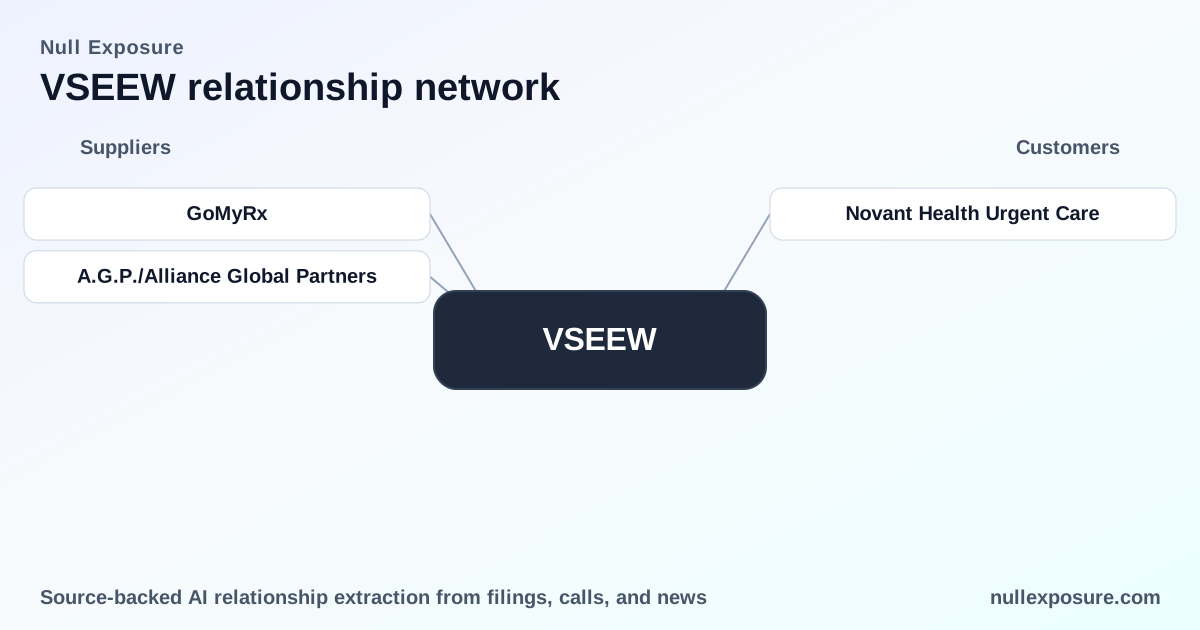
GoMyRx: Under a newly announced agreement, GoMyRx will act as VSee Health’s primary operational integration partner for prescription workflow coordination, medication fulfillment, and direct‑to‑patient delivery, leveraging GoMyRx’s national platform and GoMyDocs’ compounding and logistics network; the announcement was reported on StockTitan on March 10, 2026.
Source: StockTitan news report (March 10, 2026). -
A.G.P./Alliance Global Partners: VSee engaged A.G.P./Alliance Global Partners as sole placement agent to raise net proceeds for working capital and general corporate purposes, indicating active capital markets activity to support operations; this engagement was reported on StockTitan on March 10, 2026.
Source: StockTitan news report (March 10, 2026).
What the documented constraints reveal about VSee’s operating model
The public constraints and filing excerpts offer clear signals about VSee’s contracting posture, spend profile, and operational dependencies:
-
Geography and go‑to‑market: A commission/reseller agreement tied to VSee Lab was executed to generate international revenue opportunities, indicating an explicit reseller channel and a global expansion posture. The contract commitment size (disclosed below) shows that international growth is being pursued through third‑party partners rather than purely direct sales. This is a company-level signal extracted from filings as of December 31, 2024.
-
Contracting posture and vendor role: Multiple excerpts show VSee uses reseller and service‑provider relationships as a routine part of operations — for distribution, collections assistance, and telecommunication dependencies. This means the company is structurally dependent on external vendors for both top-line reach and day‑to‑day service continuity.
-
Spend and commitment bands: Filings disclose an equipment and service purchase commitment of $711,900 for telepresence robots and cloud services (with an unpaid balance of $179,900 as of December 31, 2024), and a separate commission/reseller commitment totaling $1,049,985 with large payments already made (payments of $946,152 as of Dec. 31, 2024). These are material mid‑range vendor commitments consistent with spend bands between $100k–$1m and $1m–$10m. Presenting these as company-level spend signals highlights ongoing capital and operating commitments outside payroll and software development.
-
Operational criticality and maturity: Filings emphasize dependence on telecommunications and internet service providers and the fact that VSee’s services are designed for continuous, 24/7 operation. That requirement elevates availability and vendor SLAs to critical risk factors compared with companies that can tolerate scheduled downtime.
-
Working capital and capital structure posture: The engagement of A.G.P./Alliance Global Partners as sole placement agent signals active reliance on capital markets to support working capital needs, rather than exclusively on internal cash generation. This is a financing strategy signal separate from vendor relationship risk.
If you want structured validation of these supplier linkages for procurement or diligence, check NullExposure.
Operational and financial implications for investors and vendor managers
-
Channel-driven revenue growth: The reseller/commission model lowers direct sales overhead but transfers execution risk to partners; success depends on partner performance and contract enforcement. The disclosed reseller commission commitment demonstrates a meaningful investment in channels rather than direct expansion alone.
-
Mid‑size vendor concentration: Commitments in the $700k–$1m range indicate that a small number of suppliers will materially affect cash flow timing. Vendors supplying telepresence hardware and fulfillment logistics are not immaterial line items for VSee.
-
Availability risk is central: Dependence on telecommunications and internet infrastructure makes third‑party service providers operationally critical; outages or degraded connectivity directly impair VSee’s product functionality and customer satisfaction.
-
Financing-driven runway: Engaging a sole placement agent for capital raises signals that management is actively managing liquidity through markets; investors should treat future financing outcomes as an execution risk that affects supplier payments and investment in growth.
Key takeaways for investors and operator diligence
- GoMyRx partnership is a strategic operational outsourcing play — it converts prescription workflow and distribution into a managed service relationship, reducing VSee’s need to build logistics capabilities in-house (StockTitan, March 10, 2026).
- Reseller/commercial channel is a deliberate growth lever — the commission agreement indicates a push into international markets via partners, with aggregate commitments over $1m disclosed in filings as of December 31, 2024.
- Mid‑size vendor commitments are material to cash flow — the telepresence hardware deal (~$711,900) plus outstanding commitments create working capital pressure and create supplier concentration on hardware and logistics providers.
- Financing reliance is real — the use of a placement agent (A.G.P./Alliance Global Partners) for a capital raise is a clear signal that VSee is augmenting liquidity through external financing (StockTitan, March 10, 2026).
- Operational continuity depends on third parties — telecom and ISP dependencies make service providers critical; vendor SLAs and redundancy planning are essential risk mitigants.
If you need a vendor risk scorecard or to map VSee’s supplier exposure across spend bands and countries, start an analysis with NullExposure.
VSee’s supplier disclosures and the two announced relationships form a coherent picture: growth through channel partnerships and operational outsourcing, supported by targeted vendor investments and market financing. For investors and procurement teams, the priority is to monitor partner performance metrics, vendor payment timing, and upcoming financing milestones — these will determine whether the company converts its channel investments into durable, profitable revenue.