Vishay (VSH) — supplier profile and what its 2025 disclosures mean for partners and investors
Vishay Intertechnology manufactures and sells discrete semiconductors and passive electronic components worldwide, monetizing through broad product sales across industrial, automotive, consumer and communications end markets while capturing margin via scale manufacturing and selective vertical integration. The company supplements organic capacity by contracting with third-party foundries and subcontractors and has pursued targeted acquisitions of niche suppliers and wafer fabrication capacity to secure critical inputs and reduce external bottlenecks. For investors and procurement leaders, Vishay’s model combines manufacturing scale with a cautious shift toward ownership of upstream capabilities to stabilise supply and costs.
Learn more about supplier exposure and relationship intelligence at https://nullexposure.com/
How Vishay runs its supplier relationships: a concise view
Vishay operates in a global, manufacturing-heavy environment where long-term commercial arrangements are a feature of its contracting posture. The company reports long-term purchase and lease commitments and uses a mix of outsourced manufacturing and in-house capacity to service demand across regions. This hybrid model—internal fabs plus third-party foundries and subcontractors—creates both operational flexibility and multi-year contractual exposure.
Key company-level signals from the FY2025 disclosure:
- Contracting posture: Predominantly long-term commitments. Vishay discloses minimum purchase commitments and long-weighted operating lease terms (weighted-average remaining lease term of 8.3 years with a 6.7% discount rate), indicating multi-year obligations to suppliers and landlords.
- Spend scale and maturity: Reported purchase commitments are material in aggregate (purchase commitments reported as 89,145 — reported in thousands), and minimum purchase commitments were enumerated for 2026–2028 as 71,806, 15,563, and 1,766, respectively, reflecting commitments in the $10m–$100m band for core suppliers.
- Flexibility vs. market exposure: Vishay supplements long-term contracts with short-term commodity purchases (for palladium and other metals) to manage price-driven risk—this creates a dynamic mix of committed and opportunistic buys.
- Criticality and concentration: Some raw materials are available only from a limited number of suppliers or face significant price volatility, which Vishay identifies as a material operational risk. The company’s footprint is global, with meaningful operations outside the U.S., underscoring geopolitical and logistical considerations for suppliers.
Acquisitions and supplier relationships: the specific deals referenced in the FY2025 filing
Vishay’s FY2025 Form 10-K lists targeted transactions that illustrate a deliberate push to integrate and secure upstream inputs.
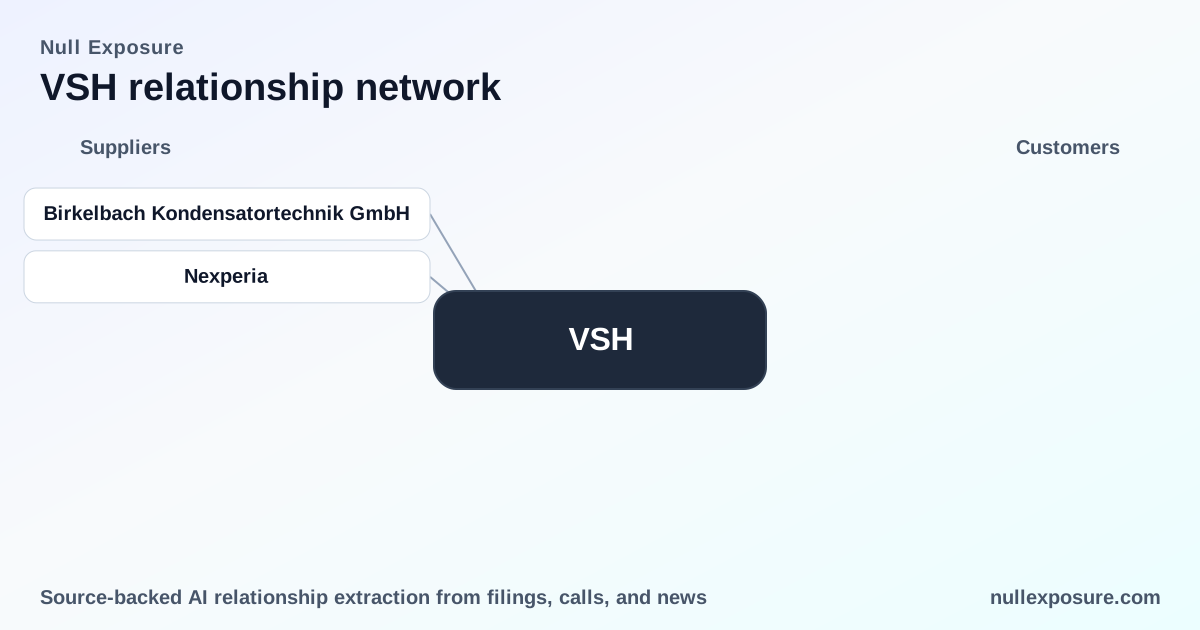
Birkelbach Kondensatortechnik GmbH — vertical integration for niche capacitors
Vishay acquired Birkelbach Kondensatortechnik GmbH in 2024 as a key niche supplier to vertically integrate our supply chain, signaling a strategic move to internalize specialized capacitor production and reduce external dependency. According to Vishay’s FY2025 Form 10‑K, the acquisition is part of the company’s effort to bring niche component capabilities in‑house to strengthen supply continuity and control product quality.
Source: Vishay FY2025 Form 10‑K (vsh-2025-12-31), company disclosure on acquisitions.
Nexperia wafer fabrication facility (Newport, South Wales) — onshoring wafer capacity
In 2024 Vishay acquired Nexperia’s wafer fabrication facility and operations in Newport, South Wales, creating a direct production foothold in silicon wafer fabrication. Vishay’s 2025 filing lists the transaction explicitly and positions the facility as part of its strategy to increase owned wafer capacity and secure supply of the most critical raw material for its semiconductor lines: silicon wafers.
Source: Vishay FY2025 Form 10‑K (vsh-2025-12-31), facility acquisition disclosure.
What these relationships imply for procurement, operations and investors
These two acquisitions together demonstrate a clear strategic tilt toward vertical integration in areas identified as critical or concentrated. For investors and supplier managers the implications are straightforward:
- Reduced supplier risk for niche components and wafers. By owning capacity for specialized capacitors and wafer fabrication, Vishay lowers counterparty risk and reduces exposure to third‑party capacity shortfalls.
- Increased capital and operational intensity. Ownership of production assets shifts risks onto Vishay’s balance sheet (capex, integration risk, workforce, and regional operating complexity).
- Persistent long-term contractual commitments. The company still maintains long-term purchase agreements and minimum commitments with subcontractors and suppliers (reported minimum purchase commitments and multi-year lease obligations), meaning suppliers that remain external are tied into multi-year flows.
- Commodity exposure remains managed but active. Vishay uses short-term commodity purchases to hedge or capture favorable metal prices, leaving some procurement decisions opportunistic and price-sensitive.
Learn more about managing supplier exposure for industrial manufacturers at https://nullexposure.com/
Operational constraints and risk posture — how mature is the supplier program?
Vishay’s disclosures present a supplier program that is mature and structured, not ad hoc:
- Contract length and maturity: Weighted lease terms (8.3 years) and explicit multi-year purchase commitments indicate a stable, long-horizon contracting posture that supports predictable production planning.
- Materiality and concentration risk: The company calls out specific raw materials that are only available from a limited number of sources; this is a company-level risk signal that increases the strategic value of any vertical integration moves.
- Spend concentration: The firm reports commitments in the multi‑million range across sequential years, consistent with a $10m–$100m spend band for core supplier relationships.
- Manufacturing dependency: Vishay both uses third‑party foundries and strategically expands outsourced commodity production, showing a deliberate balance between internal control and external scalability.
None of these constraints explicitly name the acquired partners; they operate as company-level operating characteristics that shape how Vishay sources and secures supply.
Recommended actions for investors and operator partners
- For investors: Stress-test scenarios around raw‑material price spikes and integration costs from the Newport wafer fab acquisition; monitor operating margins and capex guidance as integration progresses.
- For procurement/operations leaders: Map critical suppliers that remain external versus now-owned capacity and reassess contingency plans for materials identified as limited in supply.
- For potential suppliers and service partners: Expect multi-year commitments and structured contracting; prepare to compete against or complement Vishay-owned capacity depending on product niche.
If you want continuous, monitored intelligence on supplier moves and exposure, visit https://nullexposure.com/ to see how this analysis fits into a broader supplier-risk workflow.
Final takeaway
Vishay is transitioning from a pure outsourcing/multi-supplier model toward selective vertical integration in areas it classifies as critical, while maintaining long-term external commitments for broader commodity production. That combination improves supply security but raises capital and integration risk, and it materially affects the bargaining dynamic with remaining external suppliers. Investors and operator partners should treat Vishay’s FY2025 disclosures as proof of a deliberate supply-chain strategy that warrants close monitoring of capex, margin trends, and raw-material sourcing disclosures.