VSOL supplier relationships: who powers VanEck’s Solana ETF and what it means for investors
Thesis: VanEck’s VanEck Solana ETF (ticker VSOL) monetizes through traditional ETF economics—asset-gathering and fee capture—while outsourcing crucial operational functions such as staking and clearing to third-party partners. Revenue will scale with AUM growth, but operational risk and partner execution will drive performance differentials and investor confidence. For analysts and operators evaluating supplier exposure, the initial public reporting identifies a small set of critical counterparties that determine custody, staking revenue flow, and launch readiness.
Explore supplier risk and concentration across a broader set of ETFs at https://nullexposure.com/.
Market context and monetization VanEck’s model for a spot Solana ETF is straightforward: attract investor inflows into a pooled vehicle holding Solana, collect management fees, and crystallize additional economic value through staking arrangements where permitted. The sponsor captures base management fees while outsourcing staking operations to specialized partners, creating a layered revenue model that depends on both distribution and operational uptime. Clearing and custody relationships complete the chain; these are not cosmetic—settlement capability and DTCC status materially affect tradability and secondary market liquidity.
How VanEck monetizes VSOL:
- Management-fee revenue tied directly to AUM and fee waivers or introductory pricing decisions.
- Staking-derived income that accrues through a partner agreement and is shared with the ETF economics.
- Operational leverage from using established clearing and custody networks to accelerate market adoption and reduce settlement frictions.
A practical primer for sourcing counterparty intelligence is available at https://nullexposure.com/.
What the disclosed relationships show (one-by-one) This section lists every relationship surfaced in public reporting and explains the role each counterparty will play.
-
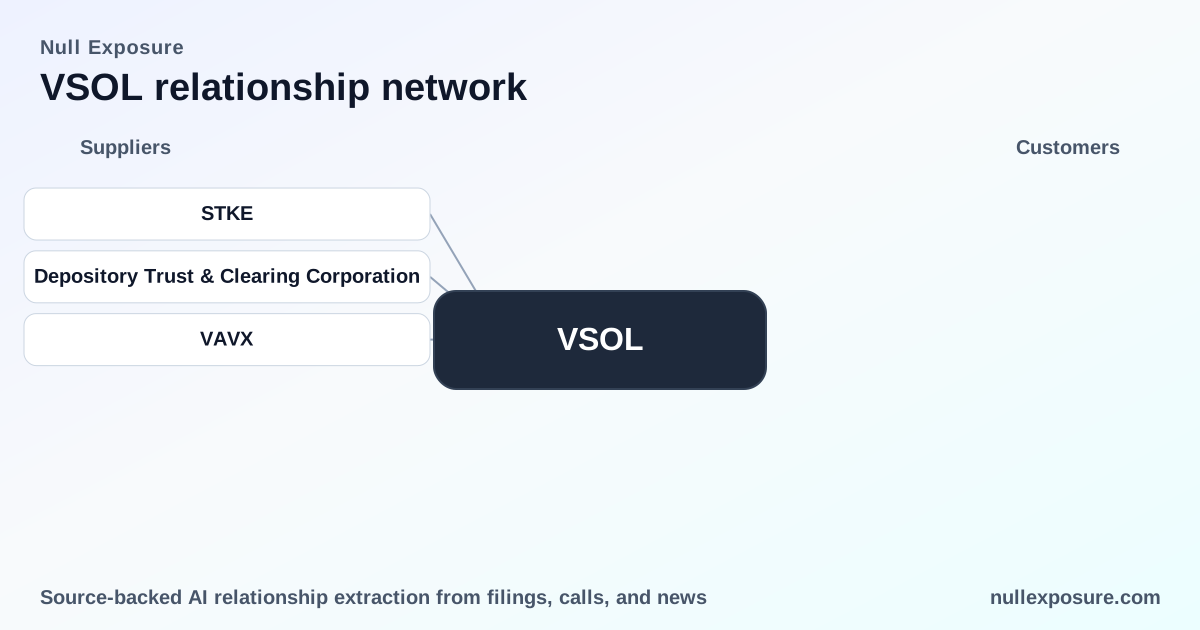
Solana Strategies (inferred symbol STKE)
- VanEck named Solana Strategies as its partner for staking operations for the VSOL launch; this partner will handle validator staking responsibilities that generate staking yields for the vehicle. Staking is a revenue vector and an operational dependency. Source: StockTwits news article reporting the VanEck launch announcement (March 10, 2026).
-
Depository Trust & Clearing Corporation (DTCC)
- DTCC added the proposed VSOL listing to its roster of “active and pre-launch” securities, signifying the product has completed certain back-office registration steps that enable institutional clearing and custody readiness. DTCC listing materially reduces settlement friction and supports institutional distribution. Source: The Defiant reporting on DTCC listing (March 10, 2026).
-
VanEck (sponsor; inferred symbol VAVX)
- VanEck is the ETF sponsor and issuer that will manage investment strategy, pricing, and distribution; the firm’s decision to launch VSOL determines fee structure, launch timing, and promotional economics (including any introductory fee waivers). Sponsor decisions drive long-term economics and investor access. Source: The Defiant coverage of the VSOL filing and listing activity (March 10, 2026).
Operational constraints and company-level signals No explicit contractual constraints were disclosed in the collected results. In the absence of enumerated constraints, company-level signals still indicate how the operating model will behave:
-
Contracting posture: VanEck is using third-party specialists for non-core operational capabilities (staking, custody/clearing), indicating a preference for outsourcing specialized crypto infrastructure rather than vertically integrating those functions. This reduces CapEx and time-to-market but increases counterparty operational reliance.
-
Concentration: The publicly reported supplier set is compact—staking handled by a named partner and clearing via DTCC—implying high concentration of critical functions. Small counterparty sets accelerate decision-making but amplify single-point-of-failure risk.
-
Criticality: Staking and DTCC clearing are mission-critical to VSOL’s value proposition. Staking affects net yield to investors and requires continuous validator reliability; DTCC status affects tradability and institutional uptake.
-
Maturity and governance: The use of established institutional plumbing (DTCC) signals governance maturity oriented to institutional adoption rather than retail-only distribution. Sponsor selection of an experienced staking partner indicates professionalization of operations versus ad-hoc custody models.
Risk and upside drivers investors should prioritize
-
Counterparty operational risk: With staking outsourced, VSOL’s earnings and investor returns depend on the staking partner’s validator uptime, slashing policy, and software resilience. Operational failures directly compress net returns.
-
Regulatory and clearance risk: DTCC pre-launch inclusion accelerates distribution, but any regulatory action that affects settlement rules or custody of native tokens would materially affect liquidity and valuation.
-
Concentration risk: A narrow set of suppliers means a faster rollout but higher systemic exposure—investors should stress-test scenarios where one counterparty fails or changes economics.
-
Distribution and AUM sensitivity: As a fee-driven product, VSOL’s profitability scales with AUM growth; promotional fee waivers (noted in launch communications for initial AUM bands) will influence early measured yield and market share capture.
Strategic implications for investors and operators For buy-side allocators, evaluate counterparty SLAs, staking revenue share mechanics, and operational governance when modeling net returns. For ETF operators and potential suppliers, the VSOL structure shows a template: sponsor-led distribution, staking outsourced to a specialist, and settlement routed through DTCC to secure institutional rails.
Mid-article reminder: for deeper counterparty mapping and supplier analytics, visit https://nullexposure.com/.
Fast takeaways and actionable next steps
- Key conviction: Sponsor economics plus staking yield are the levers that will determine realized investor returns; operational execution by the staking partner and DTCC readiness determine time-to-market and liquidity profile.
- Demand diligence on the staking partner’s track record—validator performance, penalties, and recovery processes—and secure verification of the share of staking revenue that flows to the fund.
- Monitor regulatory filings and DTCC notices for any changes to clearance status or settlement instructions; these are high-signal events for tradability.
Closing CTA and final view VSOL’s early disclosures show a focused supplier ecosystem aimed at rapid institutional adoption: sponsor control of distribution, outsourced staking expertise, and DTCC-enabled settlement. That structure optimizes speed-to-market but concentrates critical operational risk—sophisticated investors must price both AUM sensitivity and supplier reliability into forecasts.
For a comprehensive view of supplier exposure across ETFs and structured products, see https://nullexposure.com/.