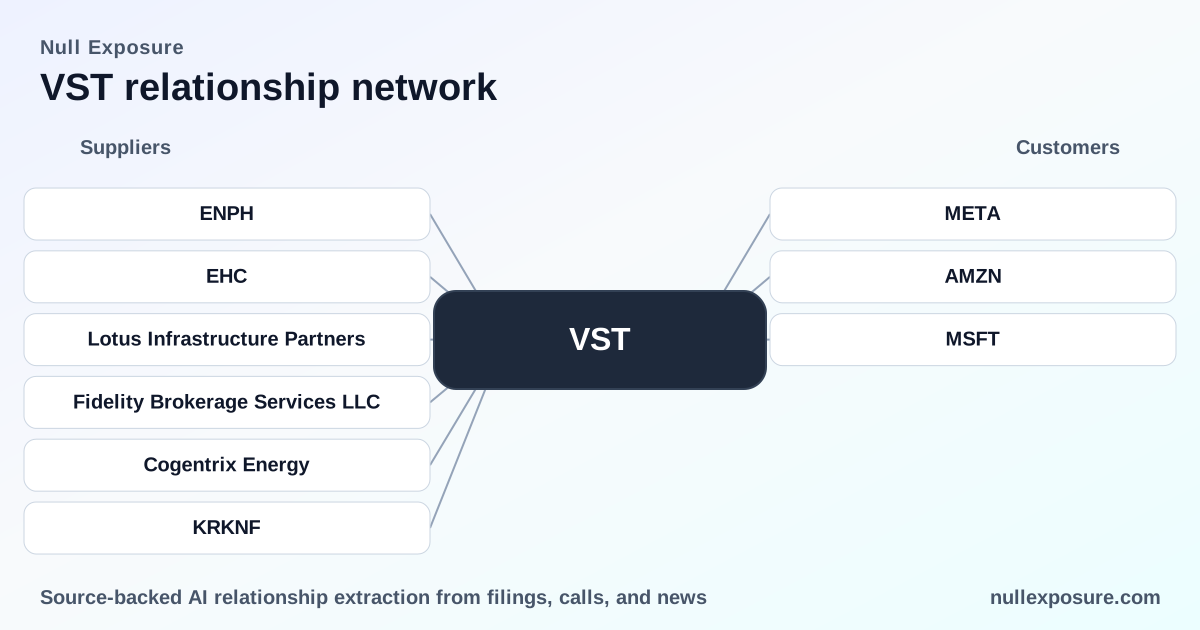
Vistra (VST) — supplier relationships that shape cash flow and operational risk
Vistra monetizes a vertically integrated power platform by owning generation, selling retail power, and aggregating distributed batteries into virtual power plants (VPPs). The company generates cash from merchant generation, contracted forward power sales and retail customers while extracting optionality via capacity and ancillary markets; recently it has accelerated inorganic growth through bolt‑on acquisitions and expanded behind‑the‑meter aggregation to capture distributed resilience value. For investors evaluating supplier and counterparty risk, the combination of large procurement obligations, concentrated collateral needs, and fast‑moving technology partners is the defining lens.
Explore deeper supplier signals at https://nullexposure.com/.
How Vistra’s supply chain earns and spends cash
Vistra’s core economic model is straightforward: own fuel‑fired and nuclear assets to sell power, hedge future sales with forwards, and operate retail contracts that depend on stable fuel and financial counterparties. Revenue is driven by generation output and retail margins; margins and cash flow are sensitive to fuel procurement and collateral requirements. The company’s FY2025 figures (roughly $17.7B revenue, $5.2B EBITDA) underline that procurement is a large line item, not an ancillary operational detail.
From a contracting posture perspective Vistra runs a blended playbook:
- Long‑dated forward sales and fuel hedges to lock in price certainty for expected power sales.
- Spot and short‑term purchases to balance real‑time dispatch and volatility.
- Large collateral and letter‑of‑credit exposure to support commodity trading and REP obligations, signaling significant counterparty credit and liquidity sensitivity.
These structural elements convert supplier and broker relationships into material financial risk — and potential sources of upside when aggregation and scale reduce per‑MW costs.
The supplier and partner roll call — who matters now
Enphase Energy — scaling the residential VPP
Vistra expanded its residential battery aggregation program to include Enphase’s IQ® Batteries, broadening device coverage in its Texas VPP and improving the pool of dispatchable behind‑the‑meter capacity. According to a PR Newswire release in March 2026, this integration is intended to strengthen grid reliability and scale Vistra’s residential aggregation footprint. (PR Newswire, Mar 2026)
Kraken — AI coordination for real‑time dispatch
Vistra’s VPP expansion uses Kraken’s AI platform to coordinate participating home batteries in real time, shifting load and preserving backup power during outages to bolster grid reliability during peak demand. PR Newswire and secondary news outlets reported Kraken’s role in automatic responses during high‑demand periods. (PR Newswire, Mar 2026)
Energy Harbor — nuclear platform scale via acquisition
The acquisition of Energy Harbor meaningfully enlarged Vistra’s nuclear portfolio, delivering a step‑change in low‑carbon baseload capacity and enhancing the company’s ability to meet demand for reliable, low‑carbon electricity. Media coverage tied this deal directly to Vistra’s strategic scale gains in FY2026. (Finviz coverage of FY2026 commentary)
Lotus Infrastructure Partners — bolt‑on gas capacity
Vistra closed the purchase of seven modern natural gas plants — roughly 2,600 MW — from Lotus Infrastructure Partners, adding flexible thermal capacity that supports system reliability and merchant optionality. The transaction was referenced on the company’s Q4 2025 earnings call transcript. (Earnings call transcript, reported Mar 2026)
Cogentrix Energy — acquisition to bulk up thermal fleet
Vistra announced an agreement to acquire Cogentrix Energy’s portfolio of ten modern gas generation facilities (~5,500 MW), including low heat‑rate plants, to further strengthen its merchant generation footprint and margin profile. Management highlighted this in the Q4 2025 earnings call materials. (Earnings call transcript, reported Mar 2026)
Fidelity Brokerage Services LLC — broker of record on SEC filing
A recent SEC filing names Fidelity Brokerage Services LLC as the broker associated with a March 3, 2026 filing, indicating institutional placement and broker relations supporting capital markets activity. (SEC filing reported via StockTitan, Mar 2026)
Constraints and what they signal about operational risk
Vistra’s public disclosures and filings reveal a multi‑dimensional contracting stance that informs supplier risk:
-
Contract mix: The company uses a combination of long‑term forwards to hedge price risk and short‑term/spot purchases for fuel and balancing needs; Vistra explicitly states it sells forward a substantial portion of expected power sales and still buys significant fuel on the spot market. This creates a hybrid exposure where hedged revenue sits alongside volatile input costs.
-
Short‑term repo usage with named counterparties: A filing cites repo transactions with one‑month terms (for example, involving TXU Energy), showing that short‑term secured funding and collateral turnover are part of working capital mechanics. According to a company filing, repo trades have expected one‑month terms unless terminated on demand. (Company filing excerpt, 2025–2026 period)
-
Counterparty and collateral concentration: Vistra reported nearly $2.56 billion of letters of credit supporting commodity and collateral requirements, with additional credit support for development projects and retail obligations — a clear signal that counterparty credit and liquidity demands are large and concentrated.
-
Procurement scale and buyer posture: The company expects roughly $3.27 billion of purchase/service obligations in 2025 (nuclear fuel, natural gas take‑or‑pay, capacity, outsourcing), which positions Vistra as a large corporate buyer whose procurement decisions materially affect cash flow and require robust supplier management.
Together these constraints describe a mature, capital‑intensive merchant operator that runs disciplined hedging while remaining exposed to spot fuel volatility and collateral shocks. Concentration of collateral and large, known future purchase obligations are the principal operational risks.
For a deeper supplier risk profile and counterparty mapping, visit https://nullexposure.com/.
Investment implications and recommended next steps
Vistra’s strategy of combining merchant generation scale with retail and VPP aggregation creates diversified revenue levers, but investor returns are tied to execution on integration, fuel cost control, and collateral management. Key takeaways: acquisitions enlarge earnings capacity but increase integration risk; VPP and Enphase/Kraken partnerships add new, less‑capital‑intensive revenue streams; and large letters of credit link market volatility directly to liquidity needs.
Actionable next steps for investors and operators:
- Audit counterparty concentration and collateral waterfall under stress scenarios.
- Track VPP enrollment and device penetration metrics as leading indicators of distributed revenue growth.
- Monitor integration milestones for Lotus, Cogentrix and Energy Harbor assets for realized synergies.
For a supplier‑focused risk assessment and customized monitoring, start here: https://nullexposure.com/.
Vistra is operating at the intersection of traditional thermal generation and fast‑evolving distributed energy services — that duality delivers upside but requires active oversight of procurement strategy and collateral exposure to protect value.