Vestand Inc. (VSTD): supplier relationships and operating constraints that matter for investors
Vestand Inc. operates and monetizes a chain of Japanese restaurants in California through dine‑in, takeout, and third‑party delivery, supplemented by long‑term real estate leases and occasional strategic investments to expand into adjacent markets. Revenue comes from restaurant sales and delivery channels; the company carries material fixed costs tied to multi‑year leases and is pursuing non‑core initiatives that change its risk profile. For a deeper supplier and partner map, visit https://nullexposure.com/.
A compact financial snapshot that frames supplier exposure
Vestand is a small, loss‑making public operator: TTM revenue $13.9M, gross profit $1.703M, and negative EBITDA (reported -$2.82M). Market capitalization is approximately $4.7M, shares outstanding ~14.1M, with insider ownership ~15% and institutional ownership ~2%. Operating margin and profitability are under pressure, while lease liabilities total roughly $8.3M with a weighted‑average remaining lease term of 6.6 years—a structural cost that anchors supplier and cash‑flow risk.
These characteristics position suppliers and partners to be critical counterparties where fixed obligations and cash timing matter more than unit economics alone.
What really drives supplier and partner economics for Vestand
Vestand’s supplier and partner footprint is a mix of traditional distributors, platform service providers, and occasional strategic counterparties. Key operating model features:
- Contracting posture: long‑term fixed commitments. Store leases commonly run for 10 years with typical extension options; the company reports a weighted‑average remaining lease life of 6.6 years and lease liabilities of $8.3M, creating predictable fixed outflows and higher operating leverage.
- Usage‑based service exposure. Delivery platforms such as Uber Eats, DoorDash and Grubhub impose per‑order fees charged to Vestand, creating a variable cost layer that scales with revenue and affects margin volatility.
- Supplier role and maturity. Vestand sources through Japanese‑focused distributors; supplier relationships function as ongoing distribution agreements rather than one‑off purchases.
- Spend scale. Lease expense puts the company in a $1M–$10M annual spend band for property costs (operating lease expense reported ~$1.27M), which is material to cash flow but not on the scale of large national restaurant chains.
- Historic supply chain resilience. Vestand reports that global supply chain disruptions have not been material to its operations as of December 31, 2024, indicating current supplier criticality is manageable.
These are company‑level signals: they define how vendors contract, the relative criticality of relationships, and where concentration and maturity create operational sensitivity.
Supplier and partner relationships you should track now
Below are the relationships found in public reporting and press activity. Each entry is a concise, plain‑English summary with source context.
-
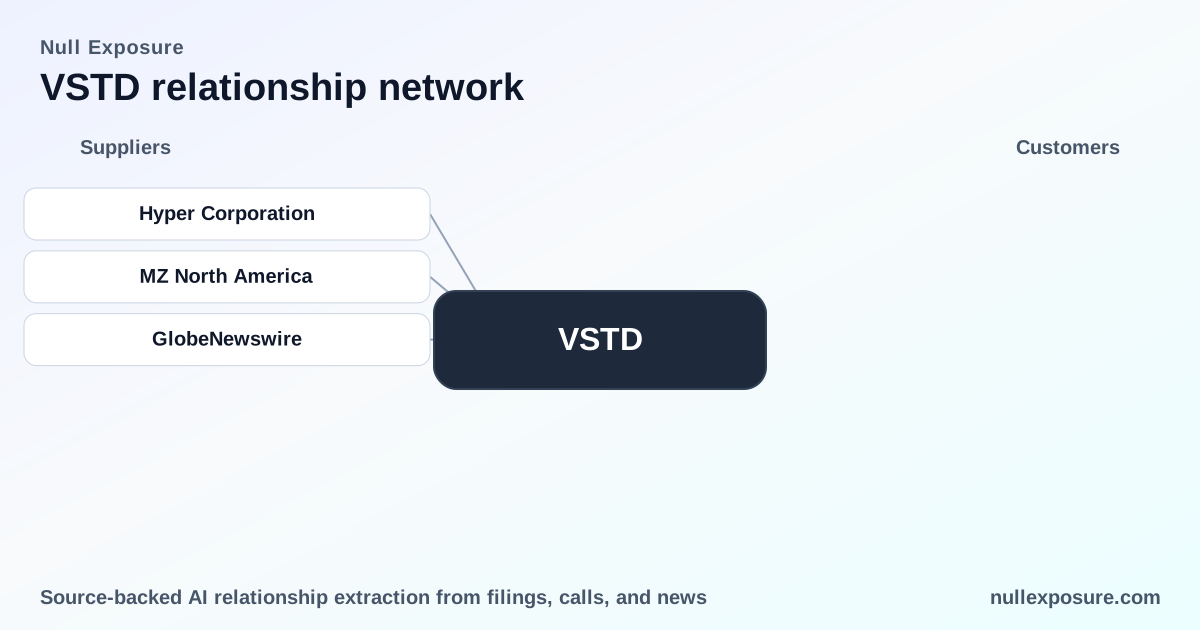
Hyper Corporation — Vestand used its South Korea subsidiary to acquire 21,000 shares of AI Mindbot from Hyper Corporation for roughly KRW 8,499,981 (about USD $6.44M), signaling a strategic pivot into crypto treasury and Korean market exposure. This was reported by Quiver Quant on March 10, 2026.
Source: Quiver Quant news, March 10, 2026. -
MZ North America — MZ North America is listed as the investor relations contact for Vestand (Larry W. Holub, Director), and the firm was referenced in Vestand’s Nasdaq notice regarding late 10‑Q filing and continued listing requirements. The investor relations detail appears in a GlobeNewswire press release and was republished by Quiver Quant (GlobeNewswire release dated December 2, 2025; Quiver Quant repost March 10, 2026).
Sources: GlobeNewswire press release (Dec 2, 2025); Quiver Quant repost (Mar 10, 2026). -
GlobeNewswire — A GlobeNewswire distribution of Vestand’s Nasdaq notice was republished by other outlets; Quiver Quant’s repost includes a line indicating the summary was AI‑generated from the GlobeNewswire release, which is relevant for provenance and investor communications quality. The repost noting the AI‑generated summary was published March 10, 2026.
Source: Quiver Quant news referencing GlobeNewswire (Mar 10, 2026).
Each relationship above has straightforward implications: Hyper Corporation reflects strategic non‑restaurant investment activity; MZ North America is the tap for investor communications during regulatory notices; GlobeNewswire is the conduit for formal disclosures and press distribution.
If you want a mapped supplier exposure report tailored to VSTD’s partner list and contractual terms, start here: https://nullexposure.com/.
What these relationships and constraints mean for investors and operators
Interpretation of the signals leads to actionable conclusions:
- Fixed‑cost leverage is the dominant operational risk. Long‑term leases and lease liabilities concentrate downside if sales weaken; monthly cash coverage is the immediate monitoring metric.
- Variable delivery fees compress margins as volume shifts to third‑party channels. Usage‑based charges from delivery platforms create a pass‑through that reduces gross margins when off‑premise demand rises.
- Strategic investments change counterparty risk. The AI Mindbot acquisition from Hyper Corporation through the Korea subsidiary reallocates capital from core restaurant operations into tech/crypto exposures—this alters both liquidity and governance oversight requirements.
- Communications and compliance are active risk vectors. The Nasdaq notice and the way disclosures are distributed (GlobeNewswire, IR firm MZ North America) increase the need for timely filings and credible investor relations.
Practical checks for diligence teams
Operators and investors should prioritize:
- Monitoring monthly cash flow against lease payments and interest on bank notes payables.
- Tracking gross margin trends with increasing delivery penetration and changing third‑party fee schedules.
- Reviewing governance and disclosure cadence after the Nasdaq non‑compliance notice and noting investor relations contact chains.
- Evaluating strategic investment rationale and funding source for the Hyper/AI Mindbot transaction.
For a deeper counterparty risk assessment and to subscribe to curated supplier intelligence for small caps like Vestand, visit https://nullexposure.com/.
Bottom line: posture for risk and opportunity
Vestand is a small, lease‑heavy restaurant operator that is simultaneously pursuing strategic investments outside its core geography and verticals. Key risks are lease fixed costs, delivery fee pressure, and governance/compliance execution; the Hyper Corporation transaction signals management is diversifying capital deployment beyond in‑store operations. Investors should treat supplier and partner relationships as both operational levers and strategic signalers—monitor lease cadence, delivery fee evolution, and disclosure channels closely.
If you want structured supplier relationship profiles and periodic alerts for VSTD and similar issuers, start here: https://nullexposure.com/.