Verastem (VSTM) supplier map: what investors should know about partner risk and delivery
Verastem is a developing-stage oncology company that monetizes through licensing, collaborations, and eventual product sales contingent on regulatory approvals. The firm outsources critical development and manufacturing work to third parties and funds development through milestone receipts, collaboration payments, and capital markets; its financial profile shows modest revenue (roughly $31M trailing twelve months) against sustained R&D losses and a market capitalization in the low hundreds of millions. For investors evaluating supplier exposure, the key takeaway is simple: Verastem’s value is levered to partner performance and to a small set of high-impact supplier and collaboration contracts. Learn more about supplier intelligence at https://nullexposure.com/.
How Verastem’s operating model puts suppliers in the driver’s seat
Verastem operates as an innovation-led drug developer that outsources manufacturing, formulation, and clinical trial execution rather than building large internal production capacity. That posture creates several predictable characteristics:
- Framework contracting is in place for large service relationships: the company has a standing commitment under an IQVIA Master Services Agreement that it expects to spend approximately $60 million over three to four years, indicating reliance on large, continuing vendor relationships rather than one-off buys.
- Global footprint of suppliers: Verastem contracts with CROs and contract manufacturers worldwide, with attendant currency and cross-border execution risks.
- Supplier-critical operations: Third-party providers have access to sensitive systems and handle material development work; failures by these vendors directly threaten regulatory milestones and time-to-market.
- Moderate spend concentration: The documented committed spend band sits in the $10M–$100M range, signaling meaningful contractual spend but not the scale of top global pharma.
- Active relationships: The company currently obtains its development and commercial supplies from third parties and expects that to continue.
These characteristics function together: a lean internal manufacturing footprint increases capital efficiency but concentrates operational risk in a small number of external partners.
Supplier relationships disclosed in filings and press coverage
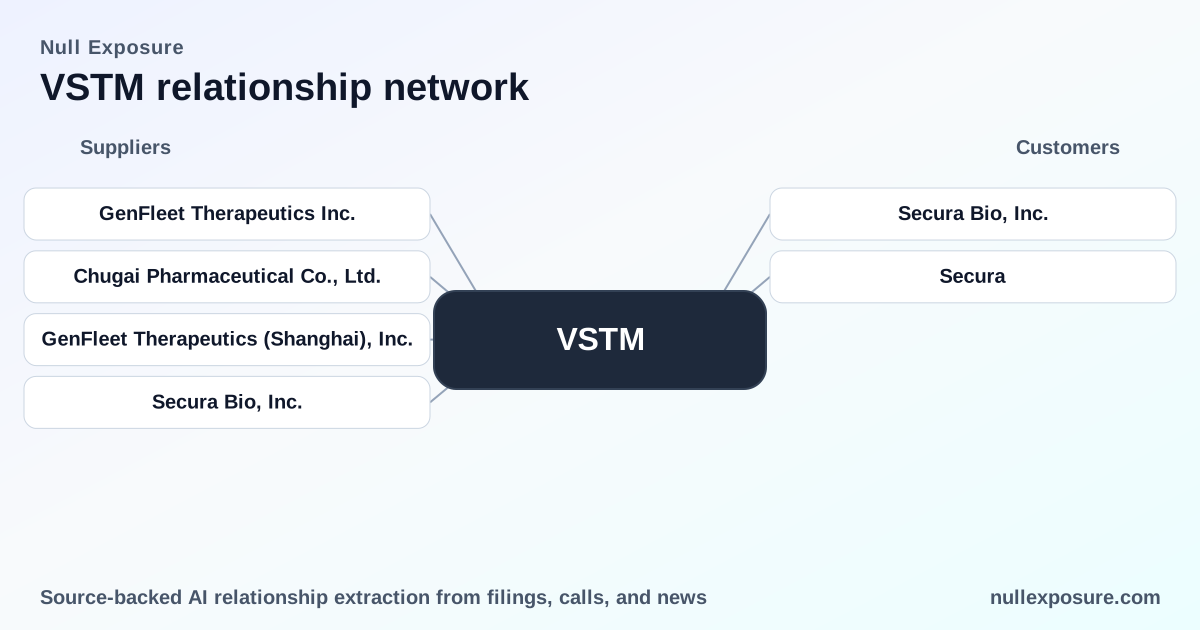
GenFleet Therapeutics Inc. — a supply agreement for development materials
Verastem disclosed in its 2024 Form 10‑K that in January 2025 it entered a supply agreement with GenFleet Therapeutics Inc., under which GenFleet will provide compound and licensed product for development use. This is a supplier relationship intended to secure material inputs for clinical programs. According to Verastem’s 2024 Form 10‑K filing, the supply agreement is in force for development supply (FY2024 filing language).
GenFleet Therapeutics (Shanghai), Inc. — collaboration option and investment exposure
Verastem’s public statements warn that payments made under a collaboration and option agreement with GenFleet Therapeutics (Shanghai) could fail to produce a return if GenFleet does not perform, signaling both financial and program risk tied to the Shanghai affiliate. A BioSpace press release summarizing the company’s regulatory update also references this collaboration and the contingent nature of the related payments (press coverage, March 2026).
Chugai Pharmaceutical Co., Ltd. — license agreement for avutometinib
Verastem disclosed contractual linkage with Chugai around the tuot of avutometinib: the company and Chugai are parties to a license agreement for avutometinib, and Verastem’s filings explicitly note execution risk under that license agreement. The contractual performance of Chugai is material to program advancement, as described in a BioSpace press release on the NDA acceptance and priority review for avutometinib (press coverage, March 2026).
Secura Bio, Inc. — asset purchase agreement with milestone obligations
Verastem also identified an asset purchase agreement with Secura Bio that includes milestone payments, and the company’s disclosures highlight the risk that either party could fail to fully perform in connection with those payments. This relationship and its milestone structure are discussed in BioSpace coverage of Verastem’s regulatory filing and program status (press coverage, March 2026).
What these relationships imply for investors: concentration, criticality, and execution risk
Across the relationships disclosed, several investment-relevant signals are clear and actionable:
- Criticality of third parties is high: Filings emphasize that third-party service providers have access to Verastem’s systems and are essential to clinical and regulatory progress; vendor failures will delay or prevent approvals.
- Contracting posture is durable: The IQVIA master services commitment and multiple active supplier agreements indicate that Verastem uses longer-term framework contracts to secure development and operational capacity rather than opportunistic spot purchases.
- Global exposure increases operational vectors: Multiple mentions of global CROs/CMOs and a named Shanghai affiliate show cross-border dependencies that introduce regulatory, logistics, and currency considerations.
- Financial leverage to partner milestones: The company’s current revenue base is small relative to its market cap and losses; program value is therefore highly leveraged to successful execution by suppliers and collaborators.
- Maturity profile: These are active development-stage collaborations and supply contracts rather than post-commercial supply chains; success depends on clinical outcomes and license execution more than routine scale manufacturing today.
A mid-cycle investor action: review partnership timelines and milestone triggers, and monitor vendor performance disclosures. For a deeper look at supplier exposure across biopharma portfolios, visit https://nullexposure.com/.
Active monitoring checklist for the next 12 months
Investors should watch the following risk and value inflection points closely:
- Regulatory milestones for avutometinib (priority review timelines and any partner-driven delays announced through Chugai or Verastem).
- Delivery and quality milestones under the GenFleet supply agreement, since clinical material availability will influence program timelines.
- Milestone payments and performance in the Secura asset purchase: missed milestones can create cash flow and program setbacks.
- Vendor continuity under the IQVIA Master Services Agreement and any disclosure of renegotiation or scope change that would alter the $60M committed spend profile.
Key items to track will be partner performance updates in Verastem’s quarterly filings and any press releases from Chugai, GenFleet, or Secura. For ongoing supplier intelligence and tracking, check https://nullexposure.com/.
Bottom line for investors
Verastem is a small-cap oncology developer whose commercial prospects are tightly coupled to a short list of external suppliers and collaboration partners. The company has structured some relationships as multi-year framework commitments, but its development program value is fundamentally contingent on partner execution, regulatory outcomes, and milestone realization. Investment upside will come from successful regulatory events and partner delivery; downside is concentrated around partner non-performance and the operational risks that follow.
For investors and operators evaluating counterparty risk, the practical step is to prioritize transparency on partner timelines and to stress-test scenarios where a single supplier slip delays a pivotal filing or trial. Explore further supplier intelligence and relationship mapping at https://nullexposure.com/.