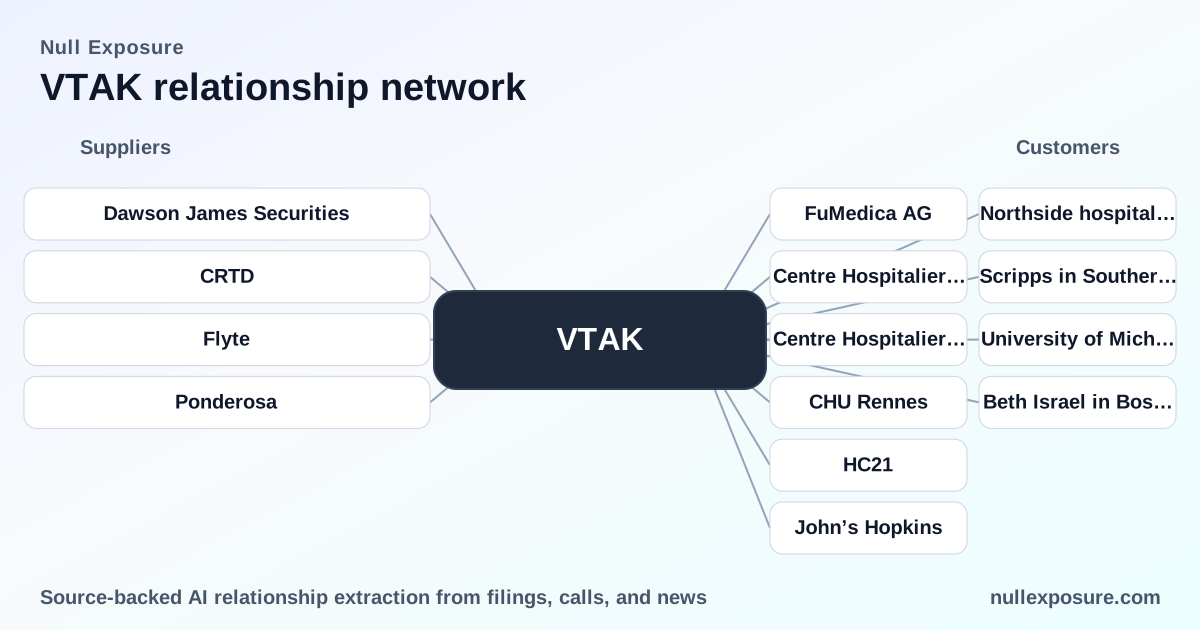
Catheter Precision (VTAK): Supplier relationships reshape a small medtech’s capital and M&A posture
Catheter Precision develops electrophysiology products for cardiac arrhythmia treatment and monetizes through product sales and strategic acquisitions funded by a mix of cash, structured securities, and placement-agency arrangements. The company is executing an acquisition-led growth move (Flyte and Ponderosa) while simultaneously levering investor placement and preferred-stock instruments to fund the deals, which materially changes supplier and capital relationships for investors and operators evaluating VTAK as a counterparty or vendor partner. Learn more about relationship intelligence and supplier impact at https://nullexposure.com/.
Quick financial snapshot investors need to keep top of mind
Catheter Precision is a micro-cap device company with market capitalization roughly $3.05 million and trailing revenue of $600,000, while reporting negative EBITDA (~-$10.08M)—an operating profile that drives reliance on external financing, asset deals, and third‑party service arrangements. Insider and institutional ownership are both low (insiders ~3.56%, institutions ~5.43%), which amplifies the influence of placement agents and strategic counterparties on liquidity and shareholder outcomes.
Recent announced counterparties — what each relationship means
Below I cover every counterparty referenced in public reporting of the March 2026 transaction suite. Each entry is concise and sourced to the market coverage.
-
Dawson James Securities — Catheter Precision engaged Dawson James as an exclusive placement agent to support the financing associated with its transaction slate and granted resale registration rights and an overallotment structure that creates contingent fees above a $3.85 million threshold. According to TradingView coverage of the company’s March 10, 2026 announcements, Dawson James is central to underwriting and placement economics for the deals. (TradingView, March 10, 2026)
-
Creatd (CRTD) — Catheter Precision announced that it will acquire 80.02% of Flyte and 100% of Ponderosa from Creatd in a transaction valued at $11.55 million, payable through cash, a zero-percent note, and issuance of Series D preferred stock. TradingView’s March 10, 2026 summary highlights Creatd as the seller and a structural counterparty in the acquisition. (TradingView, March 10, 2026)
-
Flyte — Catheter Precision will acquire a controlling 80.02% stake in Flyte as part of the Creatd asset purchase; Flyte becomes an owned operating asset and supplier target for integration and fulfillment post-close. The deal terms were disclosed in the company’s March 2026 announcement and reported by TradingView. (TradingView, March 10, 2026)
-
Ponderosa — Catheter Precision announced acquisition of 100% of Ponderosa from Creatd as part of the same transaction package, converting Ponderosa into a fully owned operating unit and likely internal supplier or customer-facing division after integration. This transaction was disclosed in the March 10, 2026 reporting summarized by TradingView. (TradingView, March 10, 2026)
What the relationship map implies for contracting posture and supplier risk
The disclosed contracts and deal mechanics paint a clear operating-model picture:
-
Contracting posture: short-term, opportunistic, and financing-driven. Company filings show multiple short-term related-party promissory notes that matured on August 30, 2024 with 8% interest, signaling a history of short-maturity funding and liquidity workarounds rather than long-term supply contracts. This is a company-level signal drawn from filed disclosures.
-
Counterparty mix includes individuals and licensing arrangements. Filings identify an additional royalty agreement with Auston Locke (an individual), where royalties for the LockeT device are structured at 5% up to $1 million in cumulative royalties, then 2% post-patent until $10 million cumulative—a licensor-type obligation that introduces a royalty-bearing cost line. This is documented in the company’s public filing language.
-
Outsourced manufacturing and fulfillment for specific products. LockeT manufacturing, inventory, and product fulfillment have been subcontracted to the original R&D provider, indicating reliance on third-party manufacturing partners and potential single-vendor concentration for that product line.
-
Service-provider stance in commercial markets. European sales are routed through distributors supported by a single contracted full‑time sales consultant, and underwriting arrangements include a 45‑day overallotment option in public offerings—both signs of a lean, outsourced commercial model with limited internal scale.
Taken together, these signals point to high supplier and financing concentration, short contract maturities, and operational criticality of a small set of external partners—items operators must model when evaluating credit and continuity risk.
Operational and investor implications
-
Counterparty concentration risk: With manufacturing subcontracted to the R&D provider for key products and European sales routed through a single contracted consultant, Catheter Precision’s supply chain and revenue continuity are fragile relative to larger medtech peers.
-
Financing-driven supplier choices: The use of Series D preferred stock and structured purchase consideration (cash + 0% note + preferred) to acquire Flyte and Ponderosa indicates management is trading equity-like claims for strategic assets rather than preserving cash—this dilutes future equity value and alters counterparty claims on cash flow.
-
Regulatory and royalty liabilities: The LockeT royalty structure creates an escalating cost profile tied to commercialization milestones and patent outcomes, which is material to long‑term margin projections.
-
Governance and liquidity considerations: Low institutional ownership and reliance on placement agents (Dawson James) increases the influence of placement economics and resale-registration mechanisms on shareholder liquidity and future financing windows.
Investors and supplier-relationship managers should incorporate these dynamics into any counterparty scoring or commercial negotiation—price for short-term funding dependency, counterparty concentration, and outsized placement-agent influence.
If you want a deeper supplier impact assessment tailored to your portfolio or procurement function, start here: https://nullexposure.com/.
Practical next steps for counterparties and investors
- Require backstop commitments or staggered delivery terms when negotiating supply or service contracts, given the company’s short-term financing posture.
- Insist on inventory or escrow protections for high-value manufactured products like LockeT, because manufacturing is outsourced to a single R&D provider.
- Monitor placement-agent filings and registration-rights clauses tied to the Series D preferred issuance; these determine resale velocity and can precipitate volume pressure on the float.
For a customized analysis of VTAK’s supplier network and exposure modeling, visit https://nullexposure.com/ to engage with our relationship-intelligence services.
Bottom line
Catheter Precision is executing an acquisition-driven strategy funded through creative securities and placement arrangements that materially change supplier claims and counterparty risk profiles. Small market cap, limited revenues, and negative operating profitability make supplier and financing relationships critical to continuity—operators should demand contractual protections and investors should price in concentration and financing risk when valuing VTAK.