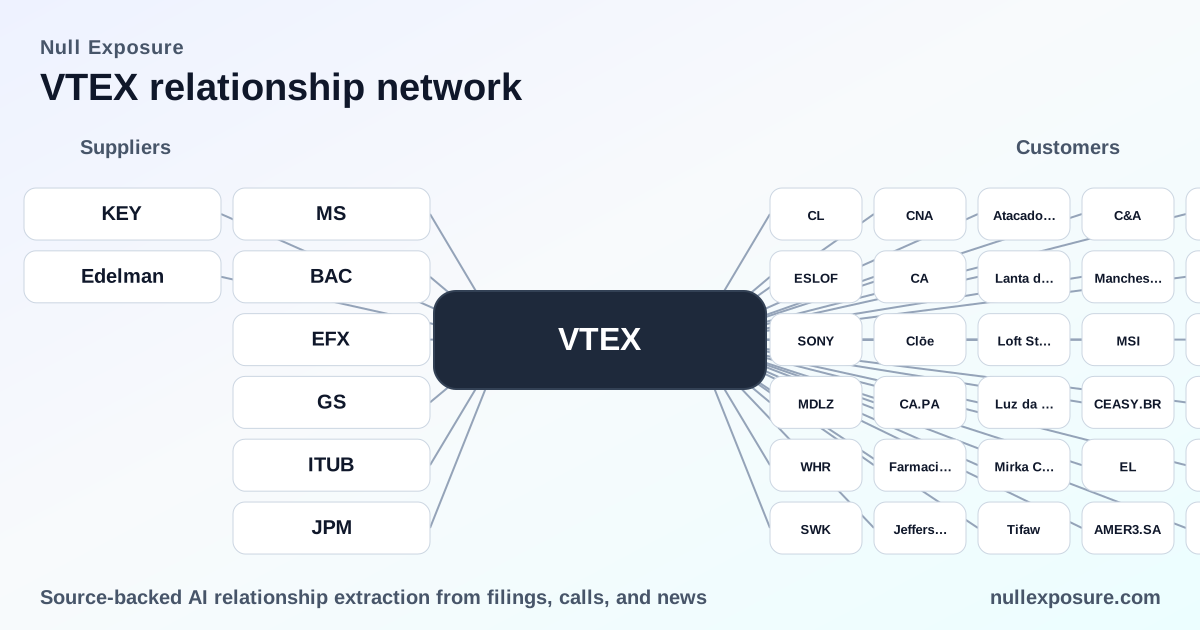
VTEX: Supplier Relationships That Shape a Commerce SaaS Investment Case
VTEX operates a cloud-native digital commerce platform for brands and retailers and monetizes that platform through recurring SaaS subscriptions, platform usage fees, and professional services such as integrations and implementation. Its economics combine high gross margins from software (Gross Profit TTМ $186.3M on Revenue TTМ $240.5M) with operating leverage potential; investors should view revenue stickiness, partner-driven distribution, and capital-markets access as the three structural drivers of value. For a concise, relationship-focused intelligence view on VTEX, visit https://nullexposure.com/.
Why supplier and advisor relationships matter for VTEX investors
VTEX is not a stand-alone product — its commercial trajectory depends on advisory partners for capital markets activity, third-party vendors for risk and fraud controls, and communications firms for market positioning. High-profile bankers and a fraud-protection alliance signal an institutional pathway to scale and risk mitigation, while retained PR support indicates disciplined external messaging around liquidity events and market-entry efforts.
If you want a consolidated view of counterparties and what they imply for GTM, capital access, and operational resilience, see https://nullexposure.com/.
Supplier and advisor roster — who VTEX is working with
Below are every relationship identified in the available results, with plain-English summaries and source pointers.
- J.P. Morgan — global coordinator for VTEX's IPO process. J.P. Morgan served as one of the global coordinators named in VTEX’s IPO announcement, positioning the bank as a primary capital-markets advisor during the company’s public offering process (PR Newswire, March 2026).
- Goldman Sachs & Co. LLC — global coordinator for VTEX's IPO process. Goldman Sachs was listed alongside J.P. Morgan and BofA Securities as a global coordinator on VTEX’s public-offering announcement, reflecting top-tier investment-banking support for the transaction (PR Newswire, March 2026).
- BofA Securities — global coordinator for VTEX's IPO process. BofA Securities was named a global coordinator in the IPO release, underscoring multi-bank syndication for market execution and distribution (PR Newswire, March 2026).
- KeyBanc Capital Markets — joint bookrunner on the offering. KeyBanc Capital Markets was designated a joint bookrunner in VTEX’s offering materials, indicating a role in bookbuilding and investor placement (PR Newswire, March 2026).
- Morgan Stanley — joint bookrunner on the offering. Morgan Stanley was named a joint bookrunner for the public offering, contributing underwriting capacity and institutional distribution (PR Newswire, March 2026).
- Itaú BBA — joint bookrunner on the offering. Itaú BBA was also listed among the joint bookrunners, signaling VTEX’s engagement with Latin American banking capability relevant to its regional client base (PR Newswire, March 2026).
- Equifax — commercial partner for fraud protection (Kount). VTEX and Equifax announced a collaboration to integrate Equifax’s Kount payment-fraud solution into the VTEX platform, enhancing merchant fraud detection and chargeback risk controls for customers globally (MarketScreener, March 2026).
- Edelman — retained PR contact for VTEX communications. Edelman was listed as a media contact in the company’s IPO announcement, indicating the use of a global communications firm to manage investor and public messaging (PR Newswire, March 2026).
What these relationships collectively reveal
- Capital-markets readiness and distribution breadth. The presence of multiple global coordinators (J.P. Morgan, Goldman Sachs, BofA) plus joint bookrunners (KeyBanc, Morgan Stanley, Itaú BBA) demonstrates a deliberate, syndicated underwriting approach to maximize distribution and pricing leverage in public markets. This reduces single-bank execution risk and improves access to institutional investors.
- Product risk mitigation via embedded services. The Equifax partnership is a functional enhancement to VTEX’s product stack: integrating a third-party fraud engine raises the platform’s value to enterprise merchants by reducing payment risk and operational costs. That partnership increases platform criticality for customers by addressing a core operational pain point.
- Reputational and message control. Engagement with Edelman indicates VTEX is actively managing narrative and investor communications, which is material during liquidity events and growth milestones.
If you want to track how these relationships evolve and which partners influence operating metrics, explore https://nullexposure.com/.
Constraints and company-level operating signals
There are no specific supplier constraint excerpts provided in the materials, which itself is a signal: no documented procurement or contractual constraints were captured in this tranche of reporting. At the company level, VTEX’s operating model shows these characteristics:
- Contracting posture: SaaS subscription and services mix, implying multi-year revenue profiles but ongoing service delivery obligations.
- Concentration: Partner-driven distribution, especially for capital markets and enterprise sales, reduces single-channel concentration but creates dependency on banking syndication for large capital events.
- Criticality: Product partnerships like Equifax’s Kount are functionally critical to merchant risk infrastructure, raising the platform’s sticky value to customers.
- Maturity: The mix of top-tier investment banks and established vendor partners signals a maturing corporate structure aligned with public-company governance and market communications norms.
Investment implications and risk considerations
- Catalyst alignment: The underwriting syndicate and PR support suggest VTEX positioned itself for a broad public-market entry with institutional distribution. This is a positive catalyst for liquidity and valuation discovery.
- Product differentiation: The Equifax partnership strengthens product defensibility against merchant churn due to fraud exposure; security features translate into pricing power for enterprise customers.
- Execution dependencies: Reliance on external banks for capital events and vendors for core functions creates operational interdependence; execution failure in underwriting or partner integration could materially affect valuation momentum.
- Financial profile: VTEX’s margins and growth profile (Revenue TTM $240.5M; Operating Margin TTM 15.8%) indicate healthy software economics but also require continued top-line acceleration to justify a premium multiple (Trailing P/E ~34.8).
Bottom line and next steps for investors
VTEX demonstrates a coordinated approach to capital markets, product hardening, and external communications — three pillars that support a scalable SaaS business. The syndication of banks reduces financing execution risk, while the Equifax tie-in materially improves product-market fit for enterprise merchants. For investors and operators evaluating supplier exposure, these relationships are both strategic and operationally relevant.
For ongoing monitoring, audit the evolution of these partnerships in press releases and filings and follow changes in bank syndicate roles or third-party integrations. For an updated, consolidated supplier intelligence brief, visit https://nullexposure.com/.