VTIX: Supplier Map, Strategic Risks, and an Investor Playbook
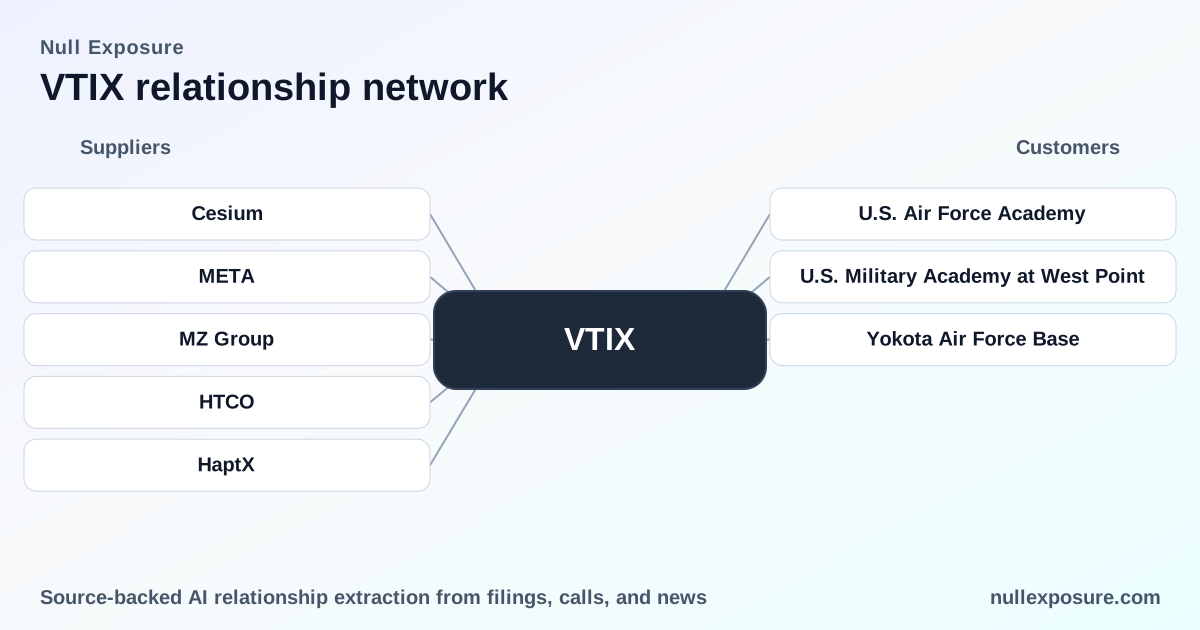
Virtuix Holdings Inc. builds and sells full-body virtual reality hardware—most notably the Omni One Enterprise treadmill—and monetizes through direct hardware sales, enterprise integrations, and partner-enabled platform deals. The company leverages partner relationships to extend distribution, add sensor and haptics compatibility, and enter specialized markets such as defense training; investors should evaluate these partner ties as commercial enablers rather than core revenue engines given Virtuix’s modest revenue base and negative profitability. For a faster view of partner exposures and supplier analysis, visit https://nullexposure.com/.
How Virtuix operates and where the economics come from
Virtuix is a hardware-first technology company headquartered in Austin, Texas, that develops immersive locomotion systems for gaming and enterprise customers. Financially, the company is a small-cap, loss-making hardware OEM: Market capitalization roughly $222 million against TTM revenue of $4.46 million, a gross profit of about $1.0 million, and negative EBITDA and EPS, indicating the company is in a growth-investment phase rather than generating cash from operations. Price-to-sales and EV multiples (PriceToSalesTTM ~49.8, EV/Revenue ~50.9) reflect investor expectations priced for substantial growth rather than current fundamentals.
Key operating signals:
- Capital and concentration: High insider ownership (~37%) and effectively zero institutional ownership indicate founder/insider control and limited institutional sell-side coverage.
- Maturity and scale: Low revenue base and negative margins position Virtuix as an early-stage hardware play that depends on partner distribution and enterprise integration to scale.
- Contracting posture: Public announcements and integrations indicate a partnership-first commercial model—Virtuix uses alliances to broaden use cases and access enterprise channels rather than large direct B2B contracts disclosed in filings.
Supplier and partner relationships that change the risk-reward
Below are every partner and supplier relationship called out in recent company communications, summarized in plain English with source notes.
Cesium
- Virtuix demonstrated a terrain-reconstruction proof-of-concept using Cesium’s geospatial technology to build geo-specific, physically navigable virtual environments for training applications; the collaboration was shown at I/ITSEC in December. Source: Sahm Capital press release, February 3, 2026.
Meta Platforms, Inc. (META)
- Virtuix announced it joined Meta’s “Made for Meta” program, signaling hardware compatibility and a strategic alignment with Meta’s VR/AR ecosystem that can materially widen addressable platforms for Omni devices. Source: Sahm Capital press release, February 17, 2026.
HTC (HTCO)
- At the same I/ITSEC proof-of-concept demonstration, Virtuix showcased integration with HTC immersive VR hardware, indicating device-level compatibility with a major headset vendor for enterprise simulation use cases. Source: Sahm Capital press release, February 3, 2026.
HaptX
- Virtuix integrated HaptX Gloves G1 with its Omni One Enterprise treadmill under the NX1 product construct, delivering tactile and force feedback that addresses enterprise demands for higher-fidelity haptics. Source: Sahm Capital press release, February 25, 2026.
MZ Group
- MZ Group is Virtuix’s investor relations and PR contact across multiple releases, handling media and investor outreach for events such as the Nasdaq closing-bell appearance and the UCF humanoid-robot demo. This is a communications relationship rather than a technology supplier. Source: Sahm Capital press releases, February 19 & February 25, 2026.
What those relationships mean for investors
Each partnership plays a distinct commercial role: Meta and HTC increase platform reach and distribution credibility; Cesium targets specialized defense and simulation workflows with geospatial fidelity; HaptX upgrades the product for enterprise haptics; MZ Group handles investor communications and deal flow visibility. Together they form a mosaic of channel, technology, and market-entry enablers rather than large contracted revenue sources.
Mid-deal considerations:
- Enterprise integrations (HaptX, Cesium) are value-enhancing but long sales-cycle, often requiring pilots and customization before meaningful bookings.
- Platform alignment (Meta, HTC) is highly strategic for software compatibility and reach, but does not on its own guarantee volume sales without supporting distribution and marketing investments.
- PR and IR support (MZ Group) is important for visibility in a small-cap name that lacks institutional holders.
For more partner-level intelligence and to map supplier concentration against revenue, go to https://nullexposure.com/.
Constraints and company-level operating signals
The dataset of formal constraints provides no explicit contractual limits or vendor-specific clauses for Virtuix. As a company-level observation:
- No disclosed supplier constraints means investor focus should be on market execution risk rather than known supply-side lockups.
- Virtuix’s business model shows dependency on partner-led go-to-market strategies, which implies execution risk if partnerships do not convert to scalable sales.
- Concentration risk is elevated by the company’s low revenue base, insider-heavy ownership, and lack of institutional investors—operational setbacks or a failed partner pilot would materially affect near-term financial performance.
Investment implications — upside and principal risks
Upside drivers
- Platform partnerships expand addressable market and create optionality for consumer and enterprise channels.
- Enterprise integrations (haptics, geospatial training) position Virtuix to win higher-margin, specialized contracts with defense and industrial customers.
Principal risks
- Execution and commercialization: Hardware adoption depends on distribution, partnerships converting to orders, and long enterprise sales cycles.
- Financial runway: Negative EBITDA and limited revenue traction mean scaling requires capital or profitable enterprise contract wins.
- Valuation disconnect: High price-to-sales and EV multiples reflect growth priced in; failure to deliver accelerated sales will pressure the equity.
What investors should monitor next
- Pilot-to-contract conversions with Cesium and defense customers following the I/ITSEC demos.
- Sales or OEM announcements tied to Meta/HTC co-marketing under the Made for Meta program and headset compatibility rollouts.
- Enterprise deployments with HaptX and resultant booking disclosures that would validate higher-margin use cases.
- Capital raises and insider share dynamics given high insider ownership and zero institutional stake.
For an organized supplier-risk dashboard and ongoing updates on partner conversions, see https://nullexposure.com/.
Bold final takeaway: Virtuix is a partnership-driven hardware growth story with strategic platform alignments and enterprise integrations that de-risk product-market fit, but the company remains financially early-stage and dependent on partner conversions to justify current valuation.