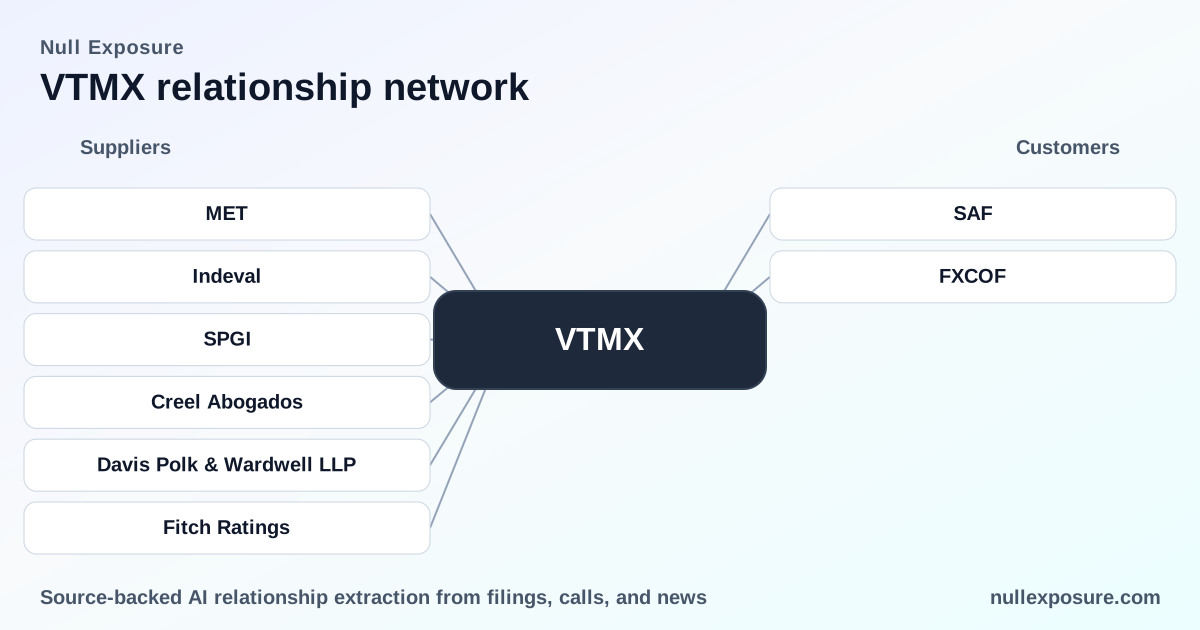
Vesta (VTMX) supplier relationships: who matters, what investors should price in
Corporación Inmobiliaria Vesta (VTMX) operates as a Mexican industrial REIT that acquires, develops, manages and leases logistics and warehouse space; it monetizes through rental cash flows, asset rotation and capital markets issuance. The company’s operating leverage is driven by long-term tenant cashflows and periodic access to institutional capital (bank loans, bond markets, and specialized custodial/payment infrastructure). For investors and counterparties, the practical question is not whether Vesta runs a property business, but how its external relationships — lenders, ratings agencies, custodians and legal counsel — shape liquidity, cost of capital and execution risk.
For a deeper supplier-risk profile and ongoing monitoring, visit the NullExposure homepage: https://nullexposure.com/.
How Vesta makes money and why suppliers matter
Vesta’s cash generation is rental income from industrial parks and distribution centers across Mexico, complemented by recurring fees and periodic securities issuance. Capital partners and service suppliers are therefore critical: lenders and bond investors supply leverage, ratings agencies calibrate borrowing costs, custodians and depositories enable dividend mechanics, and law firms ensure deal execution and cross-border compliance. That combination defines Vesta’s contracting posture: relationship-driven, capital-market dependent, and reliant on established legal and custodial intermediaries to execute cross-border financing.
Who Vesta is doing business with — the supplier map
Below are the supplier and service relationships identified in public reporting. Each relationship is summarized in plain English with the cited source.
-
Metropolitan Life Insurance Company (MetLife) — LexLatin reports that Vesta extended a previously agreed cross-border loan with MetLife by USD 26 million, bringing the facility to USD 176 million; the arrangement reflects Vesta’s use of institutional insurance capital for structured financing (reported with reference to a FY2018 operation). (LexLatin, reported March 10, 2026; original deal referenced FY2018)
-
Indeval (Mexican securities depository) — A Business Wire release carried by The Globe and Mail noted that Vesta will pay a dividend installment (US$17.38 million total, ~US$0.02034 per eligible share) in Mexican pesos through Indeval using the Bank of Mexico exchange rate, highlighting Indeval’s role in dividend settlement and FX conversion mechanics for shareholders (press release, FY2026).
-
S&P Global Ratings — In coverage of Vesta’s bond issuance, S&P Global provided a BBB-/Positive credit rating for a US$500 million bond transaction, a rating that directly influences Vesta’s borrowing cost and investor demand in the international debt market (Business Wire/The Globe and Mail, FY2025).
-
Fitch Ratings — Alongside S&P, Fitch assigned a BBB-/Positive rating to the same US$500 million issuance, reinforcing market perception and setting a joint external benchmark for pricing Vesta’s debt issuance (Business Wire/The Globe and Mail, FY2025).
-
Creel Abogados — LexLatin reported that Creel Abogados acted as Mexican counsel to Vesta on the MetLife credit extension, indicating the use of top-tier domestic counsel for negotiating local law aspects of cross-border finance (LexLatin, reported March 10, 2026; referenced FY2018 transaction).
-
Davis Polk & Wardwell LLP — The same LexLatin report notes that Davis Polk & Wardwell represented Vesta in São Paulo and New York alongside in-house counsel, showing Vesta’s practice of pairing international law firms with domestic counsel on cross-border financings and demonstrating the premium legal support used for capital markets work (LexLatin, reported March 10, 2026; referenced FY2018).
What these relationships tell investors about operating risk and execution
These counterparties collectively map a conservative, market-oriented capital strategy: insurance capital and international bond markets supplement operational cashflow; major ratings agencies set the cost of debt; custodial infrastructure governs shareholder payouts; and elite law firms manage cross-border legal complexity. From an investor standpoint, that implies:
-
Contracting posture: Vesta uses standard institutional counterparties rather than bilateral boutique lenders, which increases predictability of execution but ties Vesta to market cycles and rating sentiment.
-
Concentration and criticality: Ratings and capital markets relationships (S&P, Fitch, MetLife, major bond investors) are critical; a change in rating or a withdrawal of insurance capital would have outsize impact on cost of capital and refinancing windows.
-
Maturity and sophistication: Engaging both Creel and Davis Polk indicates mature transaction governance and access to global capital structures; this reduces legal execution risk but increases sensitivity to global credit-market conditions.
-
Operational interfaces: Indeval’s role in dividend settlement shows Vesta’s reliance on Mexican market infrastructure for shareholder cash flows; domestic custody and FX processes are critical for dividend predictability.
For ongoing monitoring, track rating actions from S&P and Fitch, any amendments to major financing facilities (such as the MetLife arrangement), and Indeval settlement notices for payout mechanics. For a live supplier risk dashboard and historical relationship context, visit https://nullexposure.com/.
Investor implications: risk, return, and decision framework
-
Cost of capital is externally governed. The BBB-/Positive ratings from both S&P and Fitch anchor Vesta’s debt pricing and refinancing windows; investors should price expected refinancing spreads into cashflow models and scenario-test rating drift.
-
Legal and structural execution is robust. Use of Creel and Davis Polk signals strong transaction-level governance, reducing structural legal risk on complex financings.
-
Dividend mechanics are operationally simple but FX-exposed. Paying through Indeval in pesos using the Bank of Mexico exchange rate creates a defined mechanistic path for distributions while exposing shareholders to currency translation timing.
-
Alternative capital sources are present. Relationship with MetLife historically shows Vesta’s ability to tap insurance balance sheets for long-tenor financing — useful for duration matching and lock-in against short-term market volatility.
Actionable takeaways for investors and operators
- Monitor rating commentary from S&P and Fitch ahead of any refinancing; a one-notch change would materially affect interest expense assumptions.
- Treat Indeval settlement notices as operational dates: dividend timing and FX methodology are non-negotiable execution events that affect shareholders and custodians.
- Track any amendments or enlargements of bank/insurance facilities; institutional lenders like MetLife are strategic partners that can alter liquidity profiles.
For team-level diligence and supplier scoring tools that integrate these relationships into counterparty risk, see NullExposure at https://nullexposure.com/.
Bottom line
Vesta’s external supplier map is dominated by capital providers (insurance and bond markets), ratings agencies, domestic custody infrastructure, and top-tier legal counsel — a configuration that supports scale but concentrates sensitivity in capital markets and ratings outcomes. Investors should incorporate this structure into interest-rate, refinancing and liquidity stress scenarios rather than treating Vesta as a pure property operator divorced from capital markets dynamics.
Sources referenced above: LexLatin coverage of the MetLife transaction and legal counsel roles (reported March 10, 2026 referencing FY2018), and a Business Wire press release carried by The Globe and Mail on Vesta’s dividend mechanics (FY2026) and on the US$500 million bond transaction and ratings (FY2025).