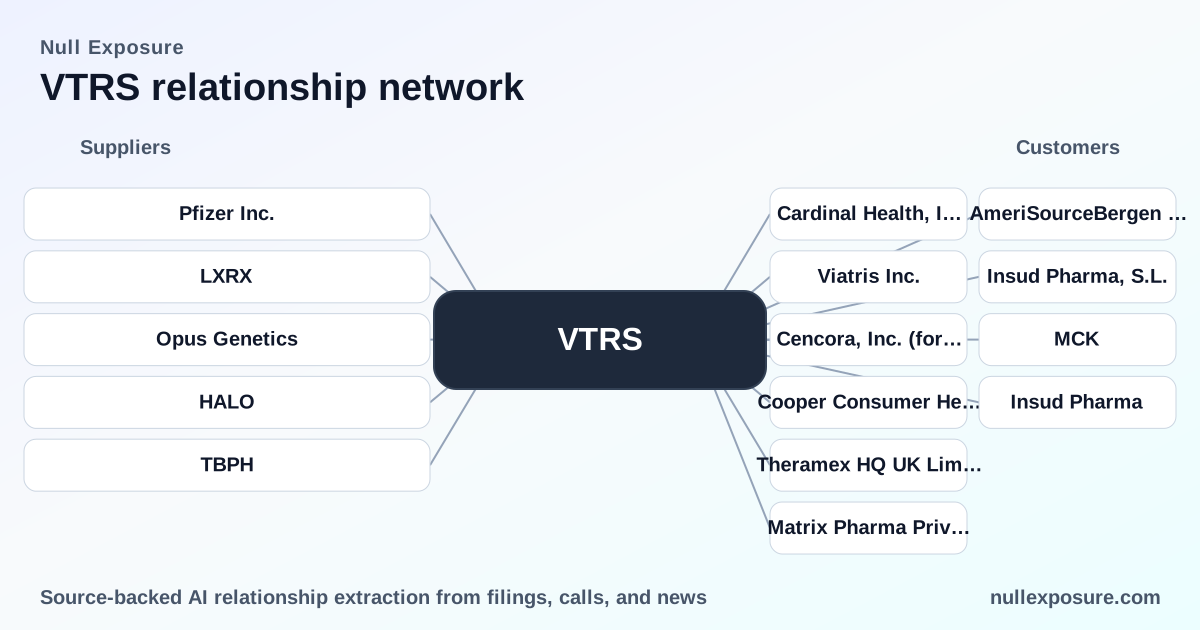
Viatris (VTRS) — supplier map and what it means for investors
Viatris operates as a global pharmaceutical manufacturer and commercializer that monetizes through three principal channels: sale of generic and specialty finished doses, manufacturing and supply agreements with other pharma companies, and licensing / milestone payments tied to product commercialization. The company runs a mixed internal-external manufacturing footprint, contracts both as a buyer for APIs and raw materials and as a manufacturer/supplier for finished products, and realizes near-term cash inflections from licensing milestones and product launches. For investors assessing counterparty risk and supplier concentration, the combination of critical third‑party manufacturing, active licensing deals and meaningful supply‑chain finance exposure is central—read on for the counterparty roll call and the commercial implications.
Visit NullExposure for deeper counterparty analytics: https://nullexposure.com/
How Viatris’s supplier relationships shape revenue and risk
Viatris’s business model is built on third‑party interdependence and licensing-led commercialization. The company explicitly contracts both to buy significant volumes of API and to manufacture and supply finished products to partners and customers; these dual roles amplify both revenue optionality and operational risk. The firm discloses that a disruption at internal or third‑party manufacturing sites could materially impair its ability to deliver products, which elevates supplier criticality as an investment consideration (FY2024 filing).
Key operating characteristics for investors:
- Contracting posture: Viatris holds long‑form manufacturing and supply agreements on both sides of the ledger—both as buyer of APIs and as manufacturer/supplier for partners—creating multilateral counterparty exposures.
- Concentration: The company attributes a substantial portion of its production to a limited number of facilities and third‑party suppliers, generating single‑point operational concentration risk in manufacturing.
- Criticality: Viatris labels supply disruptions as critical to ongoing sales and regulatory performance; operational issues can lead to customer claims and lost market access.
- Maturity and spend: Viatris’s disclosed supply‑chain finance balances of $41.9 million (2024) and $65.1 million (2023) indicate meaningful financed payables and a middle‑market supplier spend posture consistent with the $10–100 million spend band signal.
These characteristics mean counterparty diligence should prioritize manufacturing continuity, intellectual property and regulatory handoffs, and the fiscal health of large suppliers. For tailored counterparty risk views, see NullExposure’s supplier intelligence hub: https://nullexposure.com/
Counterparty map — who Viatris contracts with and why it matters
Pfizer Inc. — Viatris is the named customer under a Manufacturing and Supply Agreement dated November 16, 2020, which reflects a commercial manufacturing relationship where Pfizer acts as manufacturer and Viatris as the purchasing counterparty; the arrangement is cited directly in Viatris’s FY2024 10‑K. According to the FY2024 10‑K, this agreement codifies supply and manufacturing responsibilities between the two firms.
Lexicon Pharmaceuticals / Lexicon Pharmaceuticals, Inc. (LXRX) — Lexicon supports Viatris as a licensee relationship for sotagliflozin outside the U.S. and Europe, with Viatris executing regulatory filings and commercial strategy in those territories, and Lexicon documented an upfront license payment of $25 million tied to the agreement; news reports in March 2026 noted the first commercial shipment to the UAE and that Lexicon recognized the $25 million upfront on its financial statements. (Bitget news coverage, March 2026; earnings transcript reporting via The Globe and Mail, March 2026.)
Opus Genetics — Viatris holds exclusive U.S. commercialization rights for a presbyopia treatment under a global licensing agreement with Opus Genetics, with press coverage noting the FDA accepted a supplemental NDA and that Viatris has exclusive U.S. commercialization rights; the licensing language is described in March 2026 coverage. (Finviz coverage and aijourn report, March 2026.)
Halozyme Therapeutics, Inc. (HALO) — Halozyme reported signing a commercial licensing and supply agreement with Viatris for a small‑volume auto‑injector, indicating Viatris will be a commercial partner for device‑enabled drug delivery and a counterparty for supply chain execution. (Halozyme earnings/press transcript, reported via InsiderMonkey, March 2026.)
Theravance Biopharma, Inc. (TBPH) — Theravance disclosed receiving a $25 million U.S. sales milestone from Viatris in January 2026 related to YUPELRI® sales, reflecting Viatris’s role as a commercial partner that triggers milestone payments under license or distribution economics. (PR Newswire release, January 2026.)
What each relationship implies for cash flow and risk
These counterparties illustrate two revenue drivers: commercial licensing/milestone income (Lexicon, Theravance) and manufacturing/supply agreements that either supply Viatris or grant Viatris commercialization rights (Pfizer, Opus, Halozyme). Licensing deals deliver discrete cash flow events—Lexicon’s $25 million upfront and Theravance’s $25 million milestone are explicit examples—while manufacturing contracts underpin recurring product supply and cost of goods sold dynamics. The dual role of Viatris as both buyer of API and manufacturer of finished doses increases counterparty complexity and operational dependency.
Investors should note:
- Licensing milestones are tangible, short‑term cash inflections and can materially affect near‑term free cash flow when realized. (Lexicon and Theravance disclosures, 2025–2026 reporting.)
- Manufacturing partner stability is a core operational risk because Viatris relies on a limited number of facilities and third‑party suppliers for both API and finished products (FY2024 filing).
- Supply‑chain finance balances show active working capital management and expose the company to financing counterparties and payable concentrations ($41.9m at 12/31/2024).
For further counterparty detail and analyst‑grade supplier scoring, consult NullExposure’s platform: https://nullexposure.com/
Due diligence checklist and investment stance
For analysts and operators evaluating VTRS supplier relationships, prioritize three actions:
- Validate contractual terms and termination rights on major manufacturing agreements (e.g., Pfizer, Halozyme) to quantify replacement cost and time to recover lost capacity.
- Monitor milestone‑linked revenue recognition and geographic launch progression (Lexicon/Opus/Theravance) to forecast cash timing and market uptake.
- Stress test working capital under supply‑chain disruption scenarios given the company’s disclosed concentration and supply‑chain finance exposure (noted balances at year‑end 2023 and 2024).
Bottom line: Viatris’s commerciality depends equally on its counterparty execution and its own manufacturing resilience. Licensing deals offer upside and clear cash bumps; concentrated supplier footprints and financed payables create operational and liquidity sensitivities that warrant active monitoring by investors.
For a deeper view of each counterparty’s contractual footprint and an investor‑oriented risk scorecard, visit NullExposure’s supplier intelligence center: https://nullexposure.com/