Vitesse Energy (VTS): Supplier relationships that shape operations and valuation
Vitesse Energy is an upstream oil & gas E&P company that monetizes by producing and selling hydrocarbons from onshore U.S. assets and by acquiring and optimizing non-core positions operated by larger producers. Revenue derives from current production, development of undeveloped locations, and strategic asset consolidation—while operating margins are influenced by partner-operated wells and third‑party services that support Vitesse’s field and IT infrastructure.
For a concise vendor-risk view and actionable signals for portfolio decisions, see Null Exposure: https://nullexposure.com/
How Vitesse makes money and why supplier ties matter
Vitesse runs a classic E&P operating model: acquire or farm into acreage, realize lift from operators’ development programs, and collect production cash flow. The company’s trailing twelve‑month revenue is about $250.6m with EBITDA of $169.9m, and a market capitalization near $768m, yielding valuation multiples (EV/EBITDA ≈ 5.15) that reflect both commodity exposure and operational leverage. Vitesse distributes capital to shareholders (stated dividend per share $2.25, dividend yield 11.6% as reported) while funding growth through disciplined capital allocation.
Supplier relationships matter because a significant portion of Vitesse’s production and upside is produced on wells operated by larger partners, and its technology and IT stack rely on licensed and third‑party services. Those two dynamics—operator dependency and vendor reliance—are central to investment due diligence.
The partner list every investor needs to know
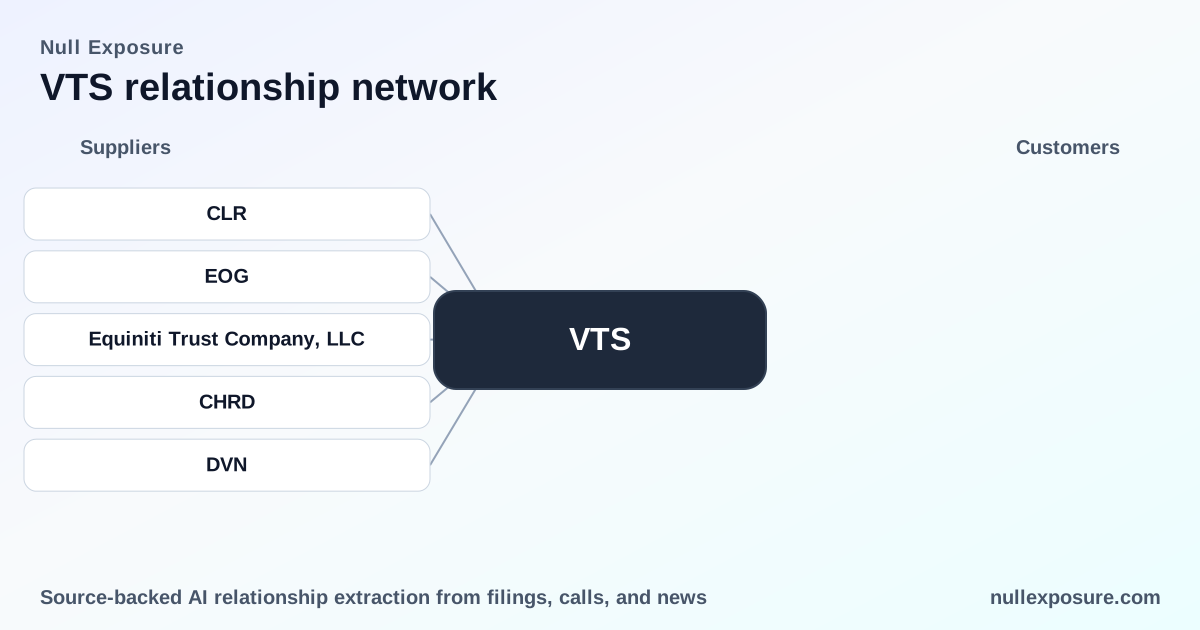
Below is a concise, relationship‑by‑relationship readout drawn from Vitesse public communications and press coverage.
Continental Resources (CLR)
Vitesse disclosed that its acquired assets include acreage and undeveloped locations that are expected to produce an average of ~1,400 net BOE/day in 2026, with Continental Resources serving as one of the primary operators of those assets. This positions Continental as an operationally critical counterparty for near‑term production and development performance. According to Vitesse’s 2025 Q4 earnings call (first noted March 7, 2026).
EOG Resources (EOG)
EOG is identified alongside Continental as a primary operator of the same acreage pool, meaning a portion of Vitesse’s 2026 production profile is contingent on EOG’s field execution and timing of drilling/completions. This was stated on Vitesse’s 2025 Q4 earnings call (March 7, 2026).
Equiniti Trust Company, LLC
In connection with Vitesse’s acquisition activity (the Lucero transaction), Equiniti acted as the depositary handling transmittal and shareholder documentation, indicating a transactional banking/transfer role in the company’s M&A process. This was referenced in a Boereport notice covering the completion of the Lucero acquisition (reported for FY2025).
Chord Energy (CHRD)
Public reporting indicates Vitesse holds interests in wells operated by larger companies, including Chord Energy, which implies additional operator exposure beyond EOG and Continental and diversifies counterparty concentration across major basin operators. This relationship is noted in a press release and coverage in The Globe and Mail (FY2026 coverage).
Devon Energy (DVN)
Devon is listed among the large operators running wells in which Vitesse has interests, reinforcing the pattern that Vitesse’s cash flow and development optionality are materially dependent on external operators’ activity and capex schedules. This mention is included in The Globe and Mail press coverage (FY2026).
What the disclosures say about vendor posture and constraints
Public excerpts from Vitesse filings and communications surface three operational constraints that shape supplier risk and contracting posture:
- Licensing: Vitesse references licensed third‑party software as part of its technology stack, signaling a contracting posture that includes intellectual property and software license obligations.
- Service provider relationships: The company explicitly notes agreements for hardware, software, telecommunications and IT services, which indicates operational dependency on external service providers for core communications and systems.
- Mature vendor stage: Vitesse describes its vendor relationships as established and governed by standard controls, yet it acknowledges the risk that interruptions or breaches could significantly disrupt operations.
These are company‑level signals about the nature and maturity of Vitesse’s supplier footprint rather than ties to any single vendor. The practical implication: operational continuity, cyber risk management, and contract terms on software/infrastructure are investment‑relevant.
Risk profile and investor implications
- Counterparty concentration: A material portion of production is on wells operated by a small set of large producers (Continental, EOG, Devon, Chord). That creates execution risk tied to operators’ capex and schedules—a higher‑probability source of volatility in near‑term production and cash flow.
- Service dependency: Licensed software and third‑party IT/hardware arrangements expose the company to contractual and cyber continuity risk; the company’s own disclosures flag disruption as capable of materially affecting operations.
- Valuation resilience: Financials (EV/EBITDA ≈ 5.15, trailing revenue and EBITDA levels) reflect a market pricing that rewards current cash flow but prices in operator and service dependencies. If operators advance development on schedule, upside is straightforward; if not, production shortfalls will pressure cash return metrics and dividend sustainability.
For deeper, supplier‑level risk scoring and counterparty tracing, consult Null Exposure: https://nullexposure.com/
Actionable takeaways for investors and operators
- Monitor operator activity calendars and capital programs from Continental, EOG, Devon, and Chord—these are the operational levers for Vitesse’s production growth.
- Treat IT and licensing contracts as second‑order but material risks; verify contractual terms and continuity provisions during diligence.
- Use valuation multiples vs. peers as a function of counterparty execution risk—Vitesse’s attractive EV/EBITDA reflects both current cash flow and concentrated operator exposure.
For primary source tracking and vendor risk dashboards, visit Null Exposure: https://nullexposure.com/
Bottom line
Vitesse offers a clear upstream investment case: asset-derived cash flows combined with the upside of undeveloped locations, but the company’s near-term performance is tightly coupled to external operators and to the integrity of licensed and third‑party IT services. Investors should balance the company’s attractive operational cash profile and dividend policy with the execution risk embedded in operator relationships and vendor continuity.