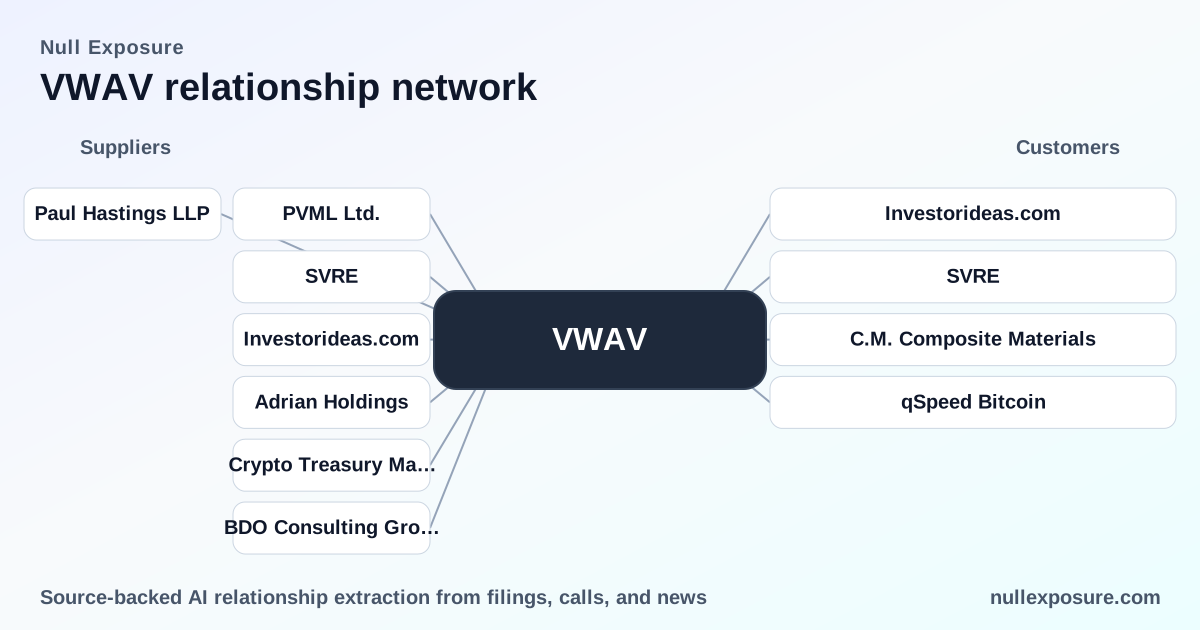
VisionWave Holdings (VWAV): supplier posture, partner map, and what it means for investors
VisionWave is positioning itself as an integrator of AI-driven autonomy across air, ground and sea platforms, monetizing through technology sales, intellectual property transactions and strategic equity stakes in manufacturing and platform ventures. The company currently shows no material trailing revenue but pursues growth through asset acquisitions, supplier integrations and targeted financings that support productization and go-to-market. For investors, risk and upside hinge on execution of supplier integrations, IP transfers and the firm’s ability to convert strategic collaborations into contract revenues. Learn more about our supplier coverage at https://nullexposure.com/.
Why supplier relationships matter for a defense AI developer
VisionWave is an early-stage aerospace & defense operator with no reported trailing revenue (RevenueTTM = 0) and a negative EPS (DilutedEPSTTM = -0.8). That profile makes supplier and advisory partnerships operationally critical: they supply components, specialized sensing and IP, underpin go-to-market demonstrations, and provide legal and financial scaffolding while the company scales. Key operating model signals from the filings and press coverage show:
- A tangible APAC supply exposure: VisionWave expects components sourced from vendors in China when production begins, which shapes procurement risk and lead times.
- A shareholder-backed funding posture: a funding support commitment from the principal shareholder (Stanley Hills) funds working capital through late 2026, indicating dependency on affiliate financing rather than broad institutional liquidity.
- Low single-vendor spend overall in historical payables — a vendor balance of $87,500 at one reporting date — implying current supplier engagements are modest in scale while capability-building continues.
These constraints imply a contracting posture that is supplier-dependent but financially constrained and immature, with concentration of control inside management/insiders (68% insider ownership) and limited institutional backing (5% institutions).
Supplier and advisor roll call — what each relationship delivers
Below I list every partner and advisor reported in VisionWave’s FY2026 coverage, each with a concise plain-English summary and the supporting source.
PVML Ltd.
VisionWave entered an agreement with PVML Ltd. to integrate secure data-AI infrastructure into its technologies, indicating a push to harden backend AI pipelines for defense use. This was disclosed in summaries of the company’s FY2026 filing as reported by TradingView.
SaverOne 2014 Ltd. (treated also as SaverOne / SVRE)
The company completed a first-stage strategic collaboration to integrate RF sensing technology from SaverOne into VisionWave’s multi-domain platform, and separately established a $7.0 million strategic exchange with SaverOne—both items reported across FY2026 press coverage. These developments were described in a Bitget news item (Mar 2026) and referenced by The Globe and Mail coverage of the autonomy spending theme.
InvestorIdeas.com (multiple paid features)
InvestorIdeas.com ran paid featured content on VisionWave across multiple FY2026 press releases and syndications, indicating a marketing/PR relationship that amplifies company news and investor visibility. Multiple InvestorIdeas articles and syndications (February–March 2026) document these paid placements.
Adrian Holdings
VisionWave entered an asset purchase agreement with Adrian Holdings for intellectual property tied to the company’s QuantumSpeed technology, reflecting an IP consolidation move intended to secure critical proprietary capability for product development (TradingView summary of the FY2026 10‑Q).
Crypto Treasury Management Group
The company engaged Crypto Treasury Management Group for advisory services to establish a digital asset treasury reserve, suggesting VisionWave explored crypto/digital-asset financial strategies for capital management (TradingView FY2026 summary).
BDO Consulting Group
BDO prepared an independent third-party valuation that informed VisionWave’s acquisition of a 51% stake in an aerospace composites manufacturer, signaling use of external valuation and advisory rigor in M&A execution (InvestorIdeas coverage, Feb 2026).
Paul Hastings LLP
VisionWave retained Paul Hastings LLP to prepare and file a civil complaint addressing suspected trading irregularities in the company’s stock, representing a legal risk-mitigation and enforcement engagement reported in FY2026 press notices (InvestorIdeas, Feb 2026).
Constraints that shape supplier risk and execution
The filings and press excerpts generate company-level signals that affect how investors should view supplier relationships:
- Geography / APAC exposure: VisionWave expects components and sub-assemblies sourced from vendors in China, which introduces geopolitical, lead-time and quality-control considerations into production planning (company disclosure, FY2026).
- Funding support / service provider: Stanley Hills, LLC — the principal shareholder — committed to fund working capital through December 29, 2026, which reduces immediate liquidity risk but increases governance concentration and affiliate dependency (funding support agreement, effective March 31, 2025).
- Spend band and supplier scale: a single vendor payable of $87,500 at June 30, 2025 implies current supplier outlays are modest, consistent with developmental rather than production-scale purchasing.
Taken together, these signals portray a company that is building supplier relationships intentionally but under constrained scale and with concentrated financial backstops. That combination raises execution risk if any single supplier or supplier geography is disrupted before commercial revenue ramps.
For an investor-focused supplier diligence checklist, prioritize: supplier certifications and localization plans, backup sourcing outside APAC, IP ownership clarity on purchased technologies, and timing of conversion from collaboration to contracted revenue.
Learn how we track supplier exposure and partner signals at https://nullexposure.com/ to support deeper diligence.
Investment implications and action points
- Upside: Strategic integrations with RF sensing (SaverOne), secure AI infrastructure (PVML) and acquired IP (Adrian Holdings) create a path to differentiated multi-domain systems if product demonstrations transition into government contracts.
- Key risks: APAC component sourcing, shareholder-dependent liquidity, and limited institutional ownership expose VisionWave to supply-chain shocks and governance concentration that can impede scale.
- Near-term catalysts to watch: contractual procurement milestones with SaverOne/PVML, revenue recognition tied to the composites manufacturer stake, and legal outcomes from Paul Hastings’ actions that could stabilize trading and investor confidence.
If you are evaluating supplier risk or forming a supplier strategy around VisionWave, start with contract-level proofs (delivery dates, acceptance criteria, and IP transfer documentation) and track any signs of supplier concentration or single-source dependencies.
For ongoing supplier intelligence and to map counterparty exposure across defense AI firms, visit https://nullexposure.com/ — our platform aggregates these relationship signals and constraints to support investor and operator diligence.
Bold takeaway: VisionWave’s supplier network is strategically aligned to its product roadmap but remains fragile until these collaborations convert into recurring contract revenue; execution and supply diversification are the primary investment levers.