VYLD — J.P. Morgan’s short‑vol ETN and what supplier relationships tell investors
Thesis: VYLD is an exchange‑traded note issued by a J.P. Morgan affiliate that delivers short volatility exposure through a rolling synthetic short position in Cboe Futures Exchange contracts, and it monetizes by charging issuer fees, capturing financing spreads on the underlying futures and collateral, and earning bid/ask and creation/redemption economics from market‑making. For investors and operators evaluating supplier relationships, the critical questions are the issuer’s funding mix, counterparty plumbing, and operational maturity—areas where supplier signals reveal concentration and short‑term funding reliance. Visit NullExposure for more supplier intelligence and supplier risk detail.
The commercial engine behind VYLD — how the product converts market views into profit
VYLD is structured as a short‑term futures ETN that tracks the daily points‑change from a rolling short position in underlying futures. The issuer (a J.P. Morgan entity) captures revenue through explicit fees levied on the ETN, and implicitly through financing benefits of holding short positions and collateral optimization. Market makers and authorized participants are essential suppliers: they provide liquidity, process creations/redemptions, and execute the futures rolls that determine investor performance. Issuer economics are therefore a function of fee schedule, roll costs on futures, and the issuer’s ability to fund positions efficiently.
Operationally, the ETN model concentrates supplier importance in three areas: clearing and exchange access, short‑term funding and repo lines, and market‑making counterparties. Investors should treat those supplier relationships as operationally critical to the product’s performance and liquidity.
What the primary supplier relationships say — direct, plain summaries
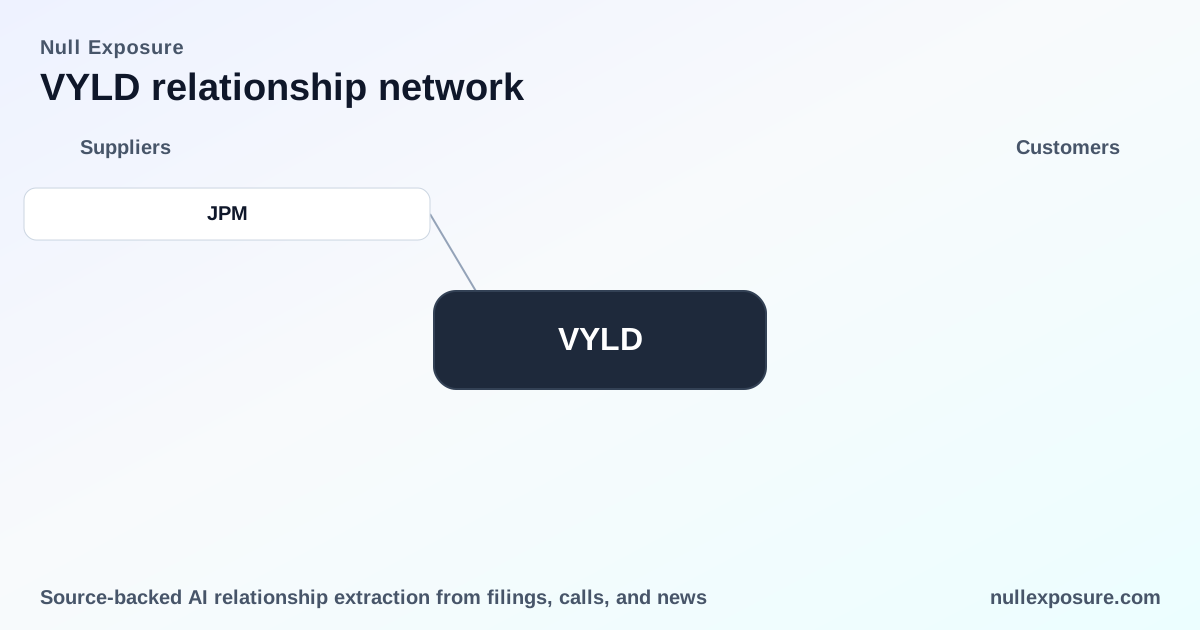
J.P. Morgan Chase Financial Co. — The Short‑Term Futures ETNs due March 22, 2045 (VYLD) were issued by J.P. Morgan Chase Financial Co. and priced on 19 March (reporting in March 2026). This identifies the sponsoring legal entity that carries issuance and credit exposure for the ETN. (Source: StructuredRetailProducts coverage reporting the issuance and pricing activity in March 2026 — https://www.structuredretailproducts.com/insights/80712/jp-morgan-revives-short-volatility-play-with-new-etn)
JPMorgan Chase & Co. — Market commentary and listing data reference JPMorgan Chase & Co. as the brand and parent under which VYLD is issued, confirming the broader firm resources and balance‑sheet backing that support issuance and funding. (Source: TradingView listing note and market summary, March 2026 — https://www.tradingview.com/symbols/BOATS-VYLD/analysis/)
What constraints and supplier signals reveal about operational posture
The observed constraint signals describe a company‑level operating model rather than a single partner relationship, and they carry direct implications for supplier risk and contract strategy:
- Short‑term contracting posture is dominant. Evidence emphasizes large volumes of securities sold under repurchase agreements and overnight/continuous repos as primary short‑term secured funding sources. For an ETN issuer that executes frequent futures rolls, this signals dependence on short‑dated funding liquidity and active repo counterparties to finance positions and manage collateral.
- Long‑term funding exists but plays a secondary role. The firm explicitly maintains long‑term funding as a stabilizer, which reduces refinancing risk but does not displace the operational centrality of short‑term repo markets.
- Critical materiality of funding suppliers. Funding and deposit channels are described as essential to the firm’s balance‑sheet funding, meaning supplier disruptions in repo markets or clearing could immediately affect the ETN’s ability to hedge and settle positions.
- Supplier relationships are service‑provider oriented. The firm classifies many third parties — exchanges, clearing houses, custodians and intermediaries — as service providers that are embedded in daily operations and thus sources of cyber and operational risk.
Collectively these signals imply high operational concentration around short‑dated funding and clearing suppliers, with elevated criticality and the need for mature, redundant contracts.
Explore supplier risk monitoring and relationship mapping at NullExposure.
Commercial and risk implications for investors and operators
Given the product structure and supplier signals, the actionable implications are clear:
- Funding concentration risk: Heavy reliance on overnight/30‑day repo lines increases vulnerability to dislocations in short‑term funding markets. Under stress, roll costs and financing spreads will expand and directly erode ETN returns.
- Counterparty and clearing risk: Clearing members, custodians, and authorised participants are operationally critical; the issuer’s ability to maintain hedges depends on these service providers functioning without interruption.
- Tracking and roll execution risk: Because the ETN tracks a rolling synthetic short, implementation costs and slippage from the roll strategy are value drivers that are opaque to end investors but material to issuer economics.
- Credit and reputational backing: The association with JPMorgan Chase & Co. provides deep balance‑sheet support and operational scale, which mitigates some counterparty concerns but does not eliminate market liquidity or short‑term funding vulnerabilities.
Practical due‑diligence checklist for supplier exposure
- Confirm the identity and credit standing of the legal issuer and the parent guarantor support.
- Map the short‑term funding counterparties (repo lines) and evaluate fallback arrangements for roll execution.
- Verify clearing members and custodians used for futures and collateral; assess concentration and haircut practices.
- Review fee schedule and historical roll costs to understand the drag on returns.
- Monitor authorized participant and market‑maker liquidity, especially in stressed volatility regimes.
Bottom line — what investors and operators should do next
VYLD is a short‑volatility engineered product whose economics depend as much on supplier plumbing and short‑term funding as on market direction. Investors should price in the issuer’s repo and clearing exposure when assessing performance scenarios; operators should ensure contractual redundancy and stress tested funding lines. For a deep operational read on these supplier relationships and a systematic way to monitor their exposure, start with supplier mapping and counterparty concentration analysis.
Visit NullExposure for supplier mapping and ongoing counterparty monitoring.
Contact your trading desk or relationship manager for specific documentation and a contractual review of clearing, custodian, and repo counterparties before taking material positions in VYLD.