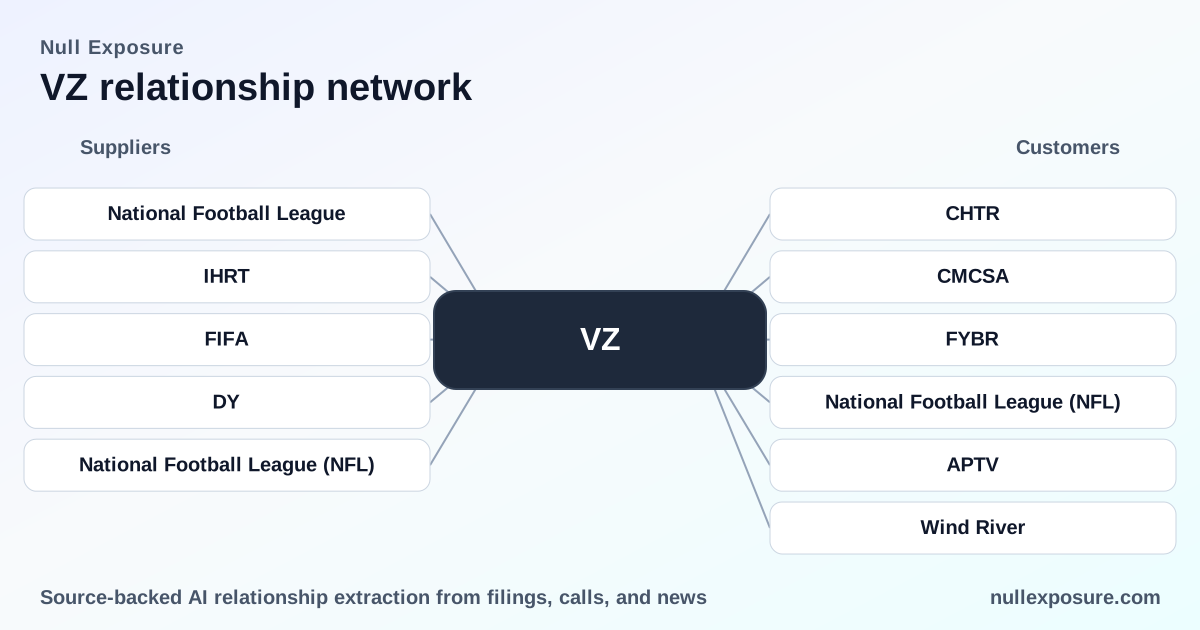
Verizon (VZ) as a Supplier Counterparty: Where cash, content and construction collide
Verizon monetizes a capital-intensive network and content strategy through consumer and enterprise subscriptions, advertising partnerships, and B2B services; it funds that model with steady cash flow, dividend policy and heavy, long-dated supplier commitments for network equipment, content rights and marketing. For investors evaluating Verizon as a buyer/partner, the key dynamic is predictable, large-scale spend on a small set of strategic suppliers and sponsorships — committed costs that shape near-term margins and partner negotiating leverage.
Explore vendor exposures and signals at https://nullexposure.com/.
Why supplier relationships matter for a telecom giant
Verizon is a cash-generative, dividend-paying telecom with FY revenue north of $138 billion and EBITDA around $50 billion, trading at a mid- to low-teens P/E and a dividend yield above 5%. That profitability rests on two supplier-driven pillars: capital expenditure and content/marketing spend. Large, multi-year contracts for network gear, software and content both constrain flexibility and create counterparty dependence; sponsorship and rights deals drive customer acquisition and brand reach but are obvious levers for cost reduction. Investors must treat Verizon’s supplier book as an operational lever with measurable impact on margins and free cash flow.
Partner map: sponsorships and vendors to watch
National Football League (NFL)
Verizon is reviewing its high-profile sponsorship arrangements with the NFL and is considering scaling back or exiting that partnership as part of cost-cutting. This is a material marketing lever given Verizon’s annual sponsorship expenditure. Source: Finviz reporting on Verizon sponsorship review (Mar 10, 2026).
iHeartRadio (IHRT)
Verizon’s marketing commitments include a sizeable agreement with iHeartRadio as part of a broader sponsorship portfolio that together exceeds $250 million annually; management is re-evaluating these commitments to reduce marketing spend. Source: Finviz coverage noting iHeartRadio among sponsorships under review (Mar 10, 2026).
FIFA
Global sports rights with FIFA are included in the package of content and sponsorship agreements Verizon spends on; these deals are part of the same sponsorship review and represent brand-and-audience reach that Verizon can scale back to lower costs. Source: Finviz article listing FIFA as a sponsored partner (Mar 10, 2026).
Dycom Industries, Inc. (DY)
Dycom lists Verizon among its major clients; following Verizon’s acquisition of Frontier, Dycom reported combined revenue contributions from Verizon that exceeded 10% of its own quarterly sales, underscoring a significant supplier-customer concentration at the subcontractor level. Source: Bitget reporting and an earnings call transcript for Dycom (Q4/FY2026, reported Mar 2026).
What the contract signals reveal about Verizon’s operating posture
Verizon’s public disclosures estimate $16.7 billion in unconditional purchase obligations for contracts longer than one year, covering content, network equipment, software and marketing services. Treat that figure as a company-level signal of long-term, high-dollar commitments rather than a list of vendor names. From that statement investors should conclude:
- Contracting posture: Verizon operates with long-term, capital-backed supplier commitments that limit short-term cost flexibility but secure supply and pricing for mission-critical network deployments.
- Spend concentration: Single large categories (network equipment, content, marketing) account for a disproportionate share of commitments; subcontractor concentration (for example, Dycom’s reliance on Verizon) creates asymmetries in bargaining power and revenue volatility for suppliers.
- Criticality: Many suppliers provide inputs essential to operations — equipment, software and content — so supplier disruptions would translate directly into service or margin impacts.
- Maturity and optionality: The size and multi-year nature of the commitments indicate a mature sourcing model; sponsorships remain more discretionary and therefore are the fastest lever for cost reduction, as management’s review confirms.
These are company-level constraints and signals; they contextualize the partner list above without single-vendor attribution unless the company explicitly names a counterparty.
What investors should watch and how to react
Verizon’s sponsorship review is a direct margin-management action: cutting or reshaping rights deals can free >$250 million in annual spend, improving near-term free cash flow with minimal immediate impact on network operations. Conversely, reducing sponsorships could erode brand momentum and customer acquisition at the margin — monitor customer growth metrics post-reduction.
Dycom’s commentary demonstrates supplier-level concentration risk: if a subcontractor loses Verizon as a large client, its revenue and execution capacity suffer. For Verizon, reliance on vendors that aggregate significant revenue exposure (construction, installation) creates counterparty risk that is operational rather than purely financial.
Key monitoring checklist:
- Quarterly updates on sponsorship decisions and quantification of expected savings.
- Capex guidance and disclosed multi-year equipment and software commitments by category.
- Supplier concentration disclosures and material customer acknowledgements from major contractors (e.g., Dycom).
- Customer net adds and churn trends following any large marketing or sponsorship resizing.
Consider short-duration event hedges around Verizon’s sponsor renegotiations and vendor-quarter releases; for long-term equity positions, the primary levers are improved free cash flow from reduced marketing and continued disciplined capex execution.
Explore deeper supplier signal intelligence at https://nullexposure.com/ for structured monitoring and alerts.
Bottom line: predictable buyer, actionable levers
Verizon operates with large, long-term supplier commitments that provide operational stability but reduce short-term flexibility, and it retains a discretionary sponsorship bucket that management is now using to manage costs. The sponsor review is a concrete near-term action that improves the company’s cash profile while supplier concentration — illustrated by Dycom’s dependency — remains a live operational risk to monitor. For business partners and investors, the practical takeaway is clear: sponsorships are the fastest cost lever; network and software commitments are the durable tail that shapes capital intensity and counterparty risk.
For an ongoing, investor-focused view of Verizon’s supplier relationships and alerts on material changes, visit https://nullexposure.com/.