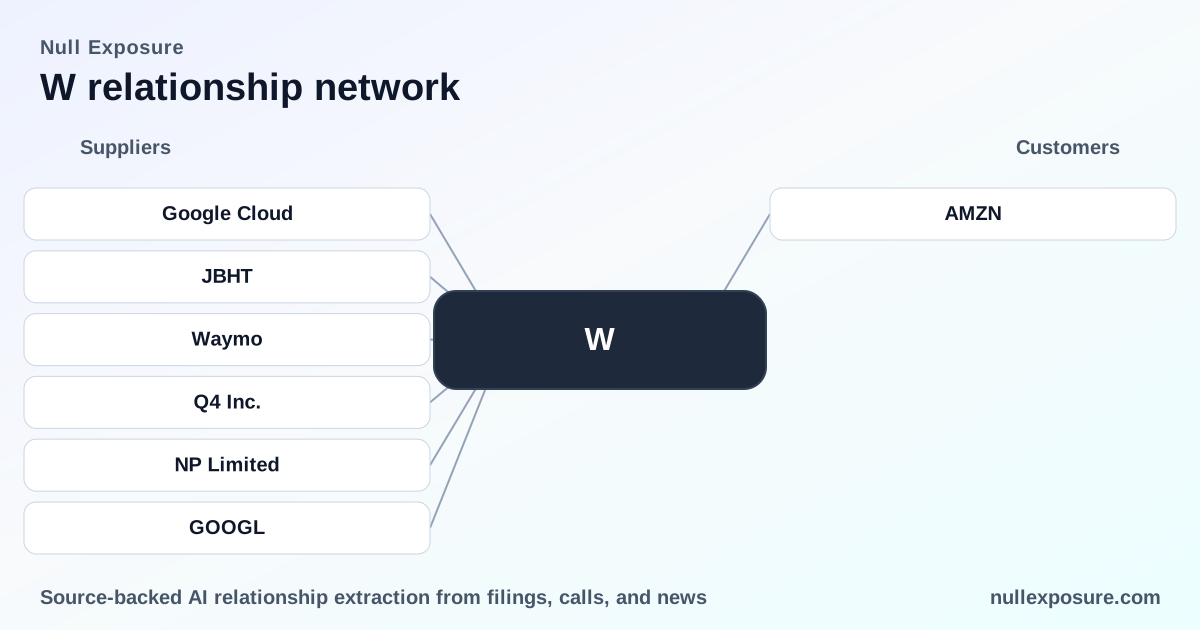
Wayfair’s supplier map: what investors need to know about W’s external relationships
Wayfair operates a high-volume e-commerce marketplace for home goods, monetizing primarily through retail margins on direct sales, marketplace commissions, advertising and logistics services as it routes product flows between over 20,000 suppliers and end customers. The company offsets thin unit economics with scale in merchandising, data-driven customer acquisition and strategic partnerships for infrastructure and distribution. For investors evaluating counterparty risk or supplier concentration, the runsheet below highlights the mix of fragmented merchant exposure, critical platform dependencies, and select strategic technology and logistics relationships that shape Wayfair’s operational leverage. Learn more at https://nullexposure.com/.
Why these supplier relationships matter for valuation and risk
Wayfair’s business model blends marketplace dynamics with direct fulfilment. That creates a hybrid contracting posture: tens of thousands of short-tail commercial relationships with small suppliers on one side and a small set of strategic, higher‑criticality service providers on the other. The most important implications for an investor are:
- Concentration risk is low at the merchant level but high at the infrastructure level. A single supplier rarely moves the business, but losing a critical cloud or logistics partner would have outsized operational impact.
- Counterparty profile is skewed toward small businesses, which reduces counterparty bargaining power but increases operational overhead and assortment variability.
- Contract maturity is mixed. Merchant relationships are largely transactional and active; capital and financing structures include long-dated instruments that lock in financing costs and covenants at the company level.
- Service providers add operational gating factors. Infrastructure and logistics partners are functionally critical and therefore increase platform fragility in concentrated areas like compute, fulfilment and emerging autonomous logistics.
Two immediate company-level signals from Wayfair’s public disclosures: the presence of long-term capital instruments (convertible senior notes identified in filings) and the explicit disclosure that it sources from many small, family-run suppliers, which collectively define its supplier operating risk. See company filings and investor communications below for source context. For more supplier-level insights and comparative vendor mapping, visit https://nullexposure.com/.
Relationship run‑sheet — what the data shows (each entry with source)
Below I cover every named relationship returned in the supplier-scope results. Each entry is a succinct, investor-focused summary with source context.
Google Cloud (Wayfair FY2024 10‑K)
Wayfair discloses it “solely rely[s] on Google Cloud to facilitate certain aspects of our business,” indicating a single-provider dependency for core cloud infrastructure as of FY2024. This is documented in Wayfair’s FY2024 Form 10‑K where cloud reliance is explicitly called out.
Google (industry commentary, 2026)
A January 2026 industry commentary noted Wayfair’s partnership with Google to co-develop a Universal Commerce Protocol, signaling strategic collaboration on commerce infrastructure and AI capabilities that could shift Wayfair’s tech stack and product discovery economics. (Sahm Capital commentary, January 2026)
J.B. Hunt (TruckingInfo, 2022)
A 2022 TruckingInfo report described J.B. Hunt’s involvement in an autonomous trucking pilot that included delivering goods to Wayfair, pointing to experiments to optimize last-mile and long-haul freight costs via carrier partnerships. (TruckingInfo, 2022)
J.B. Hunt Transport Services (TechXplore, 2022)
TechXplore coverage of the same 2022 pilot mentioned J.B. Hunt Transport Services by name as a counterparty in the Waymo/J.B. Hunt autonomous initiative, reaffirming the carrier-level operational testing tied to Wayfair shipments. (TechXplore, 2022)
Waymo (TechXplore, 2022)
TechXplore reported that Waymo’s self‑driving truck operations were contracted to deliver goods for Wayfair on certain corridors, demonstrating Wayfair’s participation in early autonomous freight pilots intended to lower transportation unit costs. (TechXplore, 2022)
Waymo (TruckingInfo, 2022)
TruckingInfo likewise reported on Waymo’s role in delivering goods for Wayfair as part of J.B. Hunt’s autonomous trucking collaboration, documenting multiple industry reports corroborating the same pilot. (TruckingInfo, 2022)
Q4 Inc. (Wayfair investor releases, 2024–2025)
Several Wayfair investor press releases across FY2024 and FY2025 show “Powered By Q4 Inc.” on their investor site, indicating that Q4 Inc. provides IR website and disclosure publishing services to Wayfair. Examples include Wayfair’s Q3 2024 release and multiple 2025 investor communications. (Wayfair investor relations releases, 2024–2025)
Q4 Inc. (Wayfair proposed offering press release, 2025)
Wayfair’s 2025 press release announcing a proposed offering of senior secured notes similarly carries Q4 Inc. attribution, reinforcing that Q4 Inc. is the vendor for Wayfair’s investor communications and web publishing across multiple disclosure events. (Wayfair investor relations, 2025)
Q4 Inc. (Q1 and Q2 2025 releases)
Wayfair’s Q1 and Q2 2025 earnings and corporate communications again reference Q4 Inc. as the platform powering its investor web pages, providing repeated public evidence of the vendor relationship across quarterly filings and news. (Wayfair investor releases, 2025)
NP Limited (HFBusiness, 2025)
A hospitality/retail trade article covering a Columbus, Ohio retail development quoted NP Limited’s managing director welcoming Wayfair to the Polaris project, indicating Wayfair has engaged NP Limited in brick‑and‑mortar smaller-format store development in at least one regional pilot. (HFBusiness report, 2025)
What these relationships imply about Wayfair’s operating profile
- Contracting posture: large number of short transactional supplier agreements coexisting with a handful of strategic long-term service contracts (e.g., cloud provider and investor-relations platform). Company-level evidence includes a long-term convertible note filing and the FY2024 10‑K cloud disclosure.
- Concentration: low at merchant level, high at service-provider level — particularly Google Cloud for infrastructure and discrete logistics partners for freight initiatives.
- Criticality: cloud and logistics relationships are operationally critical; vendor outages or contractual shifts here would cause outsized disruption.
- Maturity: supplier base is mature in breadth but immature in standardization — a heavy proportion of small, family-run suppliers increases variability and operational complexity.
Key takeaways and investor actions
- Primary risk to monitor: cloud dependence and logistics execution. Google Cloud is a single critical provider cited in the FY2024 10‑K; any change here affects platform uptime, search and AI capabilities, and costs.
- Supplier diversification cushions merchant-level shocks, but not service outages. The long tail of small suppliers limits single-supplier exposure but raises fulfilment complexity.
- Operational innovation underway in freight and store formats. Pilots with Waymo/J.B. Hunt and the Polaris smaller-format store indicate an emphasis on cost reduction and omnichannel experiments.
For a deeper vendor‑level risk brief and to map this profile against peers, visit https://nullexposure.com/ and request a supplier risk snapshot. If you’re building a thesis on logistics arbitrage or AI-driven merchandising at Wayfair, these supplier vectors frame where operational upside and downside are concentrated — explore more at https://nullexposure.com/ to convert this supplier intelligence into investment signals.