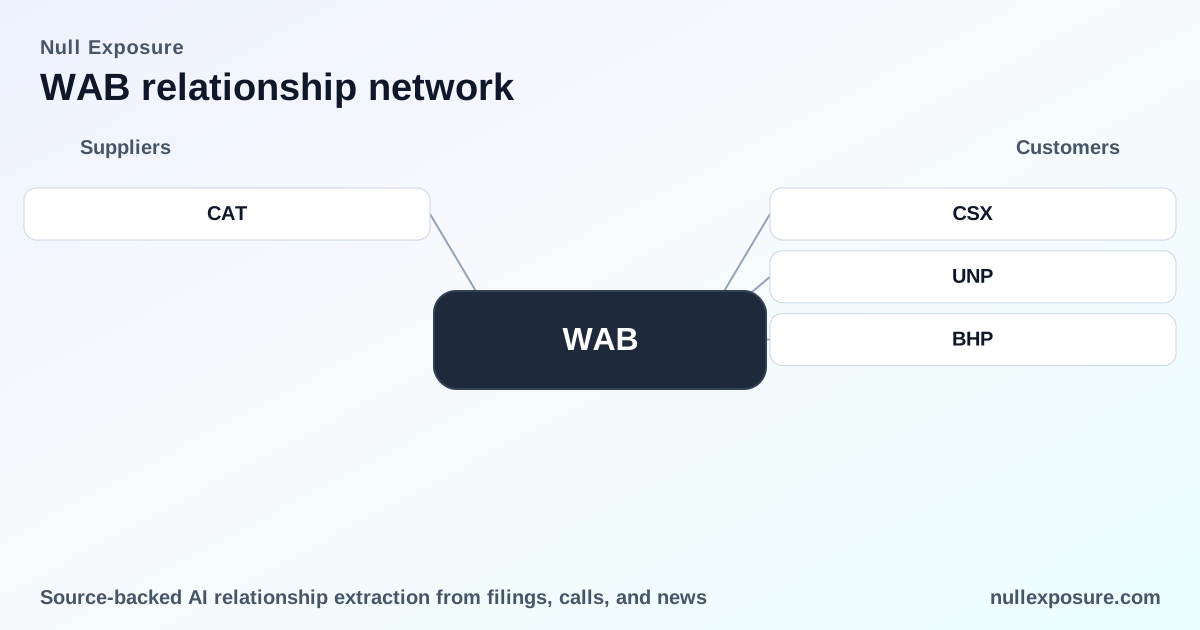
Wabtec (WAB): supplier posture, the Progress Rail settlement, and what buyers and investors should price in
Wabtec Corporation (WAB) sells locomotives, freight and transit equipment, aftermarket parts, and maintenance services; the company monetizes through a mix of new-equipment sales, recurring aftermarket revenue, and service contracts that drive higher margins over time. At a $40.9 billion market capitalization with $11.17 billion in trailing revenue and a 15% operating margin, Wabtec is a large industrial supplier and manufacturer whose commercial outcomes are driven as much by supply-chain dynamics and working-capital programs as by locomotive orders. For investors evaluating supplier relationships, the twin realities are straightforward: Wabtec is both a significant buyer of raw materials and a critical manufacturer/supplier to the rail industry, and its capital structure and supplier programs materially affect cash conversion and counterparty exposure.
Learn more about supplier exposure and counterparty risk at https://nullexposure.com/.
Why the supplier view matters for Wabtec investors
Wabtec’s business model is integrated across manufacturing and services, so supplier dynamics translate directly into margin and delivery risk. Two company-level signals define that posture: Wabtec sources core inputs with predominantly short-term pricing arrangements, and it operates a material supply-chain financing program that has accelerated vendor receipts of over $300 million in accounts payable. The combination creates a working-capital lever that improves reported liquidity while tying Wabtec to the health and payment terms of its vendor ecosystem.
- Short-term contracting posture: Wabtec purchases energy, steel, aluminum, copper, rubber and chemicals from outside suppliers under largely short-term arrangements and negotiates payables between net-45 and net-180 terms—this structure increases exposure to raw-material price swings but preserves procurement flexibility.
- Material supply-chain financing: Vendors accelerated receipt of payment totaling $311 million of Wabtec accounts payable as of December 31, 2024 (and $305 million as of December 31, 2023), signaling a mature vendor-financing program that shifts working-capital timing without changing payable classification on the balance sheet.
- Global sourcing and manufacturing role: Wabtec conducts business with suppliers across international markets and both buys and manufactures components, which centralizes operational risk but also enables scale in aftermarket and OEM product lines.
These are company-level operating characteristics, not claims about a particular supplier, and they shape how investors should value Wabtec’s margin stability and counterparty exposures. If you want a concise counterparty map for portfolio analysis, see https://nullexposure.com/ for research tools.
The relationships recorded in the public record: Progress Rail (twice)
Below are the supplier/relationship items surfaced in the available results. Each entry is presented with a plain-English summary and a short source reference.
-
Wabtec and Progress Rail reached a settlement that ends their legal dispute, closing out the ongoing litigation between the two locomotive suppliers. According to a Simply Wall St news article dated March 10, 2026, the agreement resolves the contested matter and removes the legal overhang. (Simply Wall St, March 10, 2026 — https://simplywall.st/stocks/us/capital-goods/nyse-wab/westinghouse-air-brake-technologies/news/wabtec-settlement-with-progress-rail-clears-path-for-rail-gr/amp)
-
A second news entry records the same settlement between Wabtec and Progress Rail, reiterating that the dispute has been closed and confirming the public reporting of the resolution. The additional report mirrors the March 10, 2026 coverage and is published by Simply Wall St. (Simply Wall St, March 10, 2026 — https://simplywall.st/stocks/us/capital-goods/nyse-wab/westinghouse-air-brake-technologies/news/wabtec-settlement-with-progress-rail-clears-path-for-rail-gr)
Key takeaway: the public record documents a single substantive relationship event—Wabtec’s settlement with Progress Rail—which removes litigation risk between two major locomotive suppliers and clears the way for normalized commercial interactions.
What the Progress Rail settlement means for procurement and market dynamics
The settlement closes an active litigation vector that had the potential to disrupt procurement or aftermarket competition between locomotive suppliers. Removing that legal overhang has three practical consequences for Wabtec stakeholders:
- It restores commercial clarity between two OEMs in a capital-intensive market, reducing the probability of contract interference or procurement delays tied to litigation.
- It simplifies legal expense forecasting and risk-adjusted cash flows tied to that dispute, which supports earnings quality in the near term.
- It normalizes competitive dynamics in locomotive supply chains, which is relevant to aftermarket parts pricing and long-term service revenue—a material part of Wabtec’s margin profile.
These effects are direct and observable in public reporting; the Simply Wall St coverage on March 10, 2026 documents the closing of the dispute and the practical end of that overhang.
Operational constraints that investors must price in
Beyond the Progress Rail relationship, company filings and disclosures provide operational constraints that shape supplier risk and valuation:
- Contract duration: Wabtec’s procurement is oriented toward short-term raw-material pricing rather than long-term hedges, increasing sensitivity to commodity cycles and inflationary episodes.
- Payment-terms variability: Payables range from net-45 to net-180 days, which creates variability in cash conversion and exposes the company to vendor credit dynamics when payables extend.
- Material spend concentration: The supply-chain financing program accelerated vendor receipts for hundreds of millions in payables ($311M at year-end 2024), which is evidence of both sizable payables and sophisticated supplier financing mechanics; this program reduces near-term cash outflow while transferring credit exposure to financing institutions.
- Global supplier footprint: Wabtec’s international supplier network introduces geopolitical and logistics complexity that can affect lead times and cost volatility.
These constraints are company-level signals derived from Wabtec’s disclosures and should be integrated into any supplier-counterparty risk model an investor or operator constructs.
If you are modeling counterparty risk across suppliers or benchmarking supply-chain exposure, start here: https://nullexposure.com/.
Bottom line — how to act on the supplier view
For investors and operators, the settlement with Progress Rail removes a specific litigation risk and simplifies the commercial landscape. The larger, persistent drivers of Wabtec’s supplier and margin profile are short-term raw-material contracting, a global supplier base, and a material supply-chain financing program that affects working capital and vendor credit dynamics. Price Wabtec’s shares with those levers in mind: legal overhangs can be one-off catalysts, but procurement posture and payables financing are structural and recur across cycles.
Actionable steps:
- Reconcile your cash-conversion model with the documented supply-chain financing balances ($311M in accelerated payables at 2024 year-end).
- Stress-test margins against commodity shocks given the short-term purchasing posture.
- Monitor other OEM/legal developments that could influence aftermarket pricing now that the Progress Rail dispute is closed.
For more detailed cross-supplier exposure analysis and to evaluate counterparty concentration in a portfolio context, visit https://nullexposure.com/.