Washington Federal (WAFD): Supplier Relationships that Shape Operational Risk and Opportunity
Washington Federal, Inc. is a regional banking holding company that monetizes through traditional banking channels — originating and holding or selling loans, taking deposits, earning net interest margin, and collecting fee income from commercial and consumer services. WAFD’s profitability is driven by interest spread and fee generation from its retail and small-business franchises, while capital and liquidity management rely on both deposit franchises and wholesale funding. For an investor assessing counterparty and supplier exposure, the bank’s vendor choices and funding relationships are material to operational resilience and funding cost dynamics.
Explore our broader supplier-risk coverage at https://nullexposure.com/ to compare vendor concentration across regional banks.
How WAFD uses suppliers to run the bank
Washington Federal outsources specific processing and payments functions and relies on wholesale funding sources to supplement deposits. That operating posture reduces in-house complexity but elevates vendor dependency and the need for careful contracting and business continuity clauses. WAFD’s financial profile — a market capitalization near $2.37 billion, price-to-book under 1.0, and a mid-single-digit dividend yield — makes it particularly sensitive to service interruptions that could affect deposit flows or loan origination churn.
One-line takeaways up front
- Payments capability: WAFD has contracted modern payment tech to improve small-business deposit and payment flows.
- Funding counterparties: The bank uses the Federal Home Loan Bank system for sizeable wholesale borrowings, which underpins liquidity strategy.
- Supplier dependence: Company disclosures flag reliance on third-party service providers for critical functions.
Find comparative supplier intelligence and action items at https://nullexposure.com/.
Fiserv — payments platform for small-business customers
WAFD selected CashFlow CentralSM from Fiserv to streamline payment and receivables workflows for its small-business banking customers, a move that integrates a third-party payments engine into the bank’s small-business product suite. According to an industry news release on March 10, 2026, this contract positions WAFD to offer streamlined payments and cash-flow tools that are typically a differentiator in the SMB channel. (FFNews, March 10, 2026)
Implication: outsourcing payments to a large vendor accelerates product rollout and reduces build cost, but places payments availability, data integration, and fee negotiation squarely into vendor management oversight.
Federal Home Loan Bank — wholesale funding counterparty
Washington Federal reported $1.72 billion of borrowings from the Federal Home Loan Bank as of December 31, 2021, a stable figure from the prior quarter that illustrates use of FHLB advances as a consistent component of WAFD’s liquidity mix. This detail was disclosed in the company’s quarterly release carried by FinancialContent in January 2022. (Business Wire / FinancialContent, Jan 13, 2022)
Implication: dependence on FHLB advances is a normal and scalable source of liquidity for regional banks, but it is a funding concentration to monitor during dislocated markets and regulatory stress tests.
What the relationships collectively tell investors
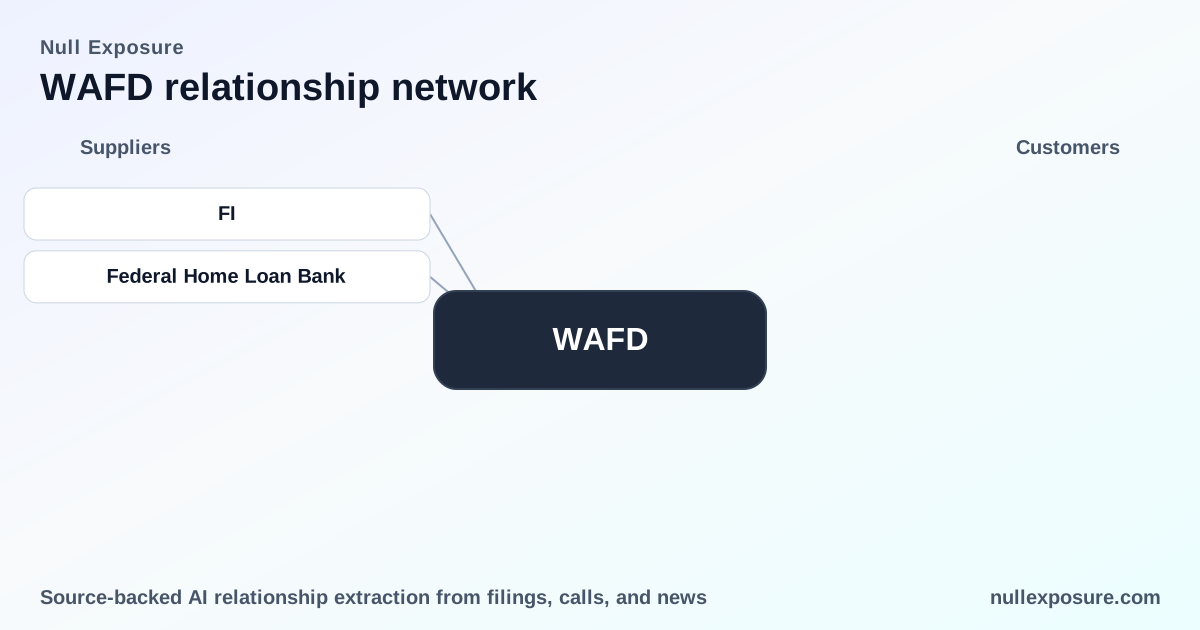
WAFD’s supplier map contains two clear functional axes: technology and payments (handled via vendor partnerships) and liquidity and funding (handled through established financial counterparties). The combination reflects a pragmatic operating model: outsource specialized tech to lower-cost providers while anchoring liquidity with long-standing wholesale channels.
- Contracting posture: WAFD contracts out for non-core functions (payments, processing), consistent with a strategy to prioritize capital and management bandwidth on lending and deposit growth.
- Concentration profile: While the current disclosures list a small number of named relationships, the bank’s own risk disclosures highlight dependence on third-party providers for critical services — a signal that concentration and single-vendor failure need monitoring.
- Criticality: Payments platforms and wholesale funding are operationally critical; failures in either area would materially affect customer experience or liquidity.
- Maturity: The relationships cited are standard for regional banks — established vendors and FHLB advances indicate mature sourcing rather than ad hoc, novel counterparties.
These operational characteristics should be considered alongside financial metrics: WAFD’s forward P/E (~13.6), price-to-book (~0.86), and modest dividend profile point to a bank priced for steady performance where vendor execution is a differentiator.
Risk and governance checklist for investors
- Ensure vendor contracts include strong SLAs, data protection, and termination rights.
- Track vendor concentration metrics and migration plans in investor materials.
- Monitor FHLB advances as a share of total funding and stress-test liquidity under deposit runoff scenarios.
Boldly: vendor failures or funding squeezes are not theoretical for a regional bank; they are real operational and solvency levers that investors should quantify in downside scenarios.
Constraints and company-level signals
WAFD’s disclosures explicitly identify dependence on third-party service providers for necessary or critical services, which is a company-level signal of outsourcing dependency. That disclosure indicates a contracting posture oriented toward external providers for operational capabilities, and it implies investor attention to vendor resilience, contract terms, and business-continuity plans. The relationship-role constraint has a high-confidence annotation in the public record, reinforcing that third-party service reliance is an acknowledged and material part of the business model.
Bottom line and recommended investor actions
Washington Federal leverages vendor partnerships to modernize customer-facing payments while relying on conventional wholesale counterparties for liquidity. For investors, the critical evaluation points are vendor execution, contract protections, and funding concentration — each able to swing short-term earnings and medium-term valuation.
- Review WAFD’s next proxy and 10-K for updated vendor disclosure and SLAs.
- Benchmark WAFD’s vendor concentration against peers using our supplier-risk tools at https://nullexposure.com/.
- Track quarterly FHLB advance levels as an early indicator of funding stress or strategic shifts.
For a deeper comparative vendor-risk analysis across regional banks and direct access to model-ready supplier intelligence, visit https://nullexposure.com/.
Sources cited in the article:
- FFNews report: "WaFd Bank to streamline payments for small businesses with CashFlow Central from Fiserv," March 10, 2026.
- Washington Federal quarterly earnings release as carried by Business Wire / FinancialContent, January 13, 2022 (notes FHLB borrowings as of December 31, 2021).
Key takeaway: WAFD runs a low-cost operating model by outsourcing specialized functions and leaning on traditional wholesale funding; that structure improves capital allocation but elevates vendor and funding-concentration risk that investors must monitor closely.