Washington Trust Bancorp (WASH) — supplier relationships that shape liquidity and operations
Washington Trust Bancorp is a regional bank holding company that earns through net interest margin, fee income from wealth management and services, and recurring customer deposits, while supplementing balance-sheet flexibility with wholesale funding. The firm monetizes its branch and advisory footprint and augments fee revenue through acquisitions and integrations of advisory teams. For investors, the critical lens is supplier and counterparty exposure: funding sources that underpin liquidity, vendors that deliver customer-facing technology, and inbound acquisitions that expand fee-bearing assets. Learn more or track supplier intelligence at https://nullexposure.com/.
Why supplier relationships matter for a regional bank
Washington Trust’s operating model mixes traditional banking economics with modern vendor dependency. Long-term occupancy commitments and growing outsourced services reshape fixed and variable cost structures, while the bank’s membership with the Federal Home Loan Bank provides a direct liquidity lever. Contract posture is a hybrid: significant long-term lease obligations coexist with expanding subscription-based vendor services, creating a mix of predictable fixed costs and rolling operating expenses. The firm treats third-party vendors as core service providers and has a formal lifecycle for vendor risk — onboarding, renewal and risk-based reassessments — which indicates a maturing third-party risk program.
- Concentration and criticality: Wholesale funding relationships and a small set of technology vendors are points of concentration that directly affect liquidity and customer experience.
- Maturity: The bank evidences a controlled approach to vendor governance with periodic security assessments and contract renewals.
- Contracting posture: A blend of long-dated leases (weighted average remaining lease term ~12.6 years) and subscription services where expenses scale with service volume.
Counterparties that visibly influence WASH performance
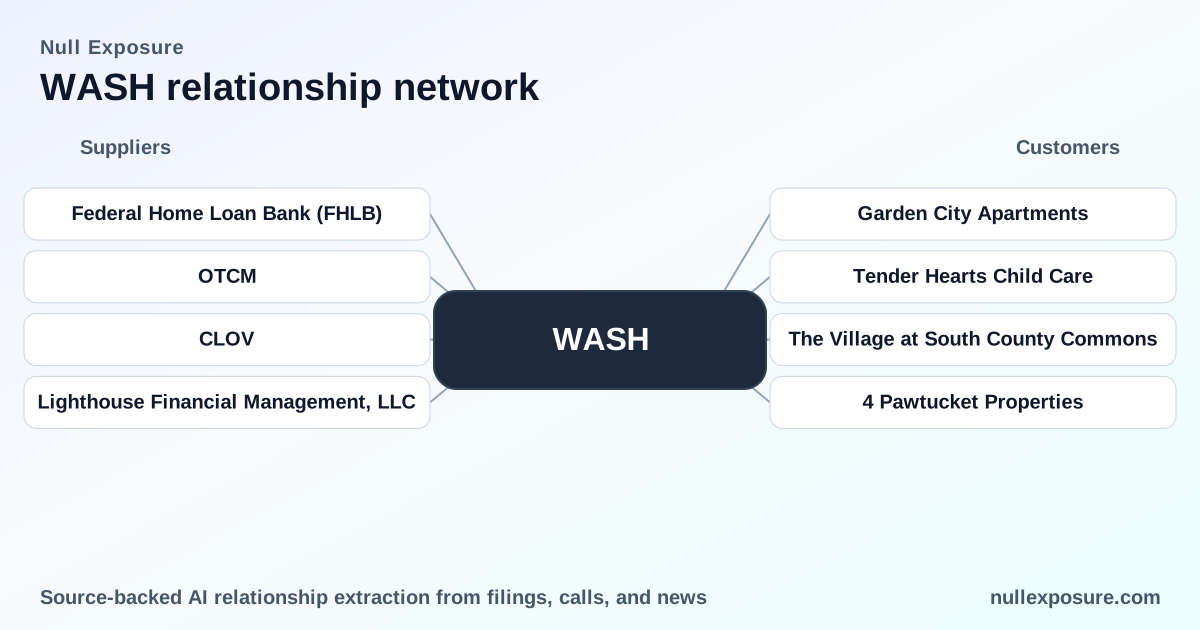
Federal Home Loan Bank (FHLB)
Washington Trust relies on advances from the Federal Home Loan Bank to meet short-term liquidity needs and to finance loan growth and securities portfolio additions, making FHLB funding a core funding relationship for the bank. According to a trading report referencing the company’s FY2026 10-K disclosures, FHLB reliance is material to liquidity strategy and exposes the bank to counterparty performance risk in stress scenarios (reported March 2026).
OTC Markets Group
Daily share pricing and certain market-data distribution for Washington Trust are made available through the OTC Markets platform, which affects public visibility and trading accessibility for certain market participants. A Spokane Journal report referencing FY2022 noted that daily stock prices are listed via the OTC Markets Group platform (article published/first seen March 2026).
Clover (business management technology)
Washington Trust has announced use of Clover’s business management technology for aspects of its operations and merchant-facing services, representing a vendor relationship that embeds third-party software into customer and branch workflows. MarketScreener reported Washington Trust’s use of Clover technology in connection with its November earnings-related communications (reported FY2026) and earlier references (FY2025) to such vendor use.
Lighthouse Financial Management, LLC
Washington Trust completed a strategic acquisition in which the Lighthouse Financial advisory team and approximately $190 million in assets under management joined Washington Trust Wealth Management, representing an inorganic expansion of fee-bearing assets and advisory scale. The transaction and team integration were announced via PR Newswire in FY2025.
What the constraints tell investors about business model risk and resiliency
Washington Trust’s public disclosures and reporting signal a specific supplier posture:
- Long-term lease commitments are a company-level signal: the bank carries non-cancelable operating leases with a weighted average remaining term of roughly 12.6 years, translating to persistent occupancy cost and limited near-term flexibility on facility footprint.
- Subscription and outsourced services are rising components of noninterest expense, indicating the bank increasingly uses vendor-provided software and managed services instead of capital purchases; this converts some capital intensity into recurring operating expense and concentrates operational dependency on software providers.
- Service provider reliance is explicit: outsourced services are listed among principal noninterest expenses, so third-party vendors materially affect operating leverage and customer-facing functionality.
- Vendor lifecycle maturity is visible: the bank conducts security risk assessments at onboarding and renewal and applies a risk-based approach to reassessment, reflecting a structured third-party risk management program.
- Buyer role with the FHLB is specific to that relationship: the bank uses FHLB advances as an active funding source, which makes the FHLB both a provider of liquidity and a counterparty concentration to monitor.
Investment implications — practical signals to watch
Washington Trust’s supplier and counterparty profile creates both upside and risks for investors. Key takeaways:
- Liquidity dependency: Monitor the level and tenor of FHLB advances reported in quarterly filings and regulatory disclosures; increases signal reliance on wholesale funding while reductions reflect deposit growth or alternative funding.
- Vendor concentration: Track material vendor agreements (for example, Clover) and outsourced spending trends in noninterest expense to assess operational leverage and potential single-vendor outages.
- Earnings and fee growth via acquisitions: Integration of Lighthouse’s $190 million AUM is an earnings-accretive path to fee income; assess retention of acquired advisors and client assets in subsequent quarters.
- Fixed cost rigidity: Long lease terms elevate baseline occupancy costs; in a revenue downturn fixed costs amplify margin pressure.
- Third-party risk controls: The bank’s structured security assessments at onboarding and renewal are positive governance signals; investors should review disclosure of vendor incidents or material service disruptions.
For decision-ready intelligence on counterparties and vendor risk, visit https://nullexposure.com/ to see supplier profiles and relationship timelines.
Action checklist for investors and operators
- Review quarterly management commentary for changes in FHLB advance balances and tenor.
- Watch noninterest expense trends tied to outsourced services and subscription costs to model forward operating leverage.
- Follow post-acquisition retention metrics and fee revenue contributions from Lighthouse integration.
- Evaluate disclosures around vendor incidents, contract renewals, and lease commitments in the 10-Q/10-K cadence.
- Confirm the scope and frequency of third-party security reassessments during earnings calls or risk disclosures.
Washington Trust’s model combines steady regional banking economics with growing reliance on third-party technology and strategic advisory acquisitions; that mix is favorable for scalable fee growth but requires active monitoring of funding counterparties and vendor concentration. For ongoing supplier monitoring and model inputs, start tracking Washington Trust supplier relationships at https://nullexposure.com/.