Energous (WATT): supplier relationships that define a nascent wireless-power platform
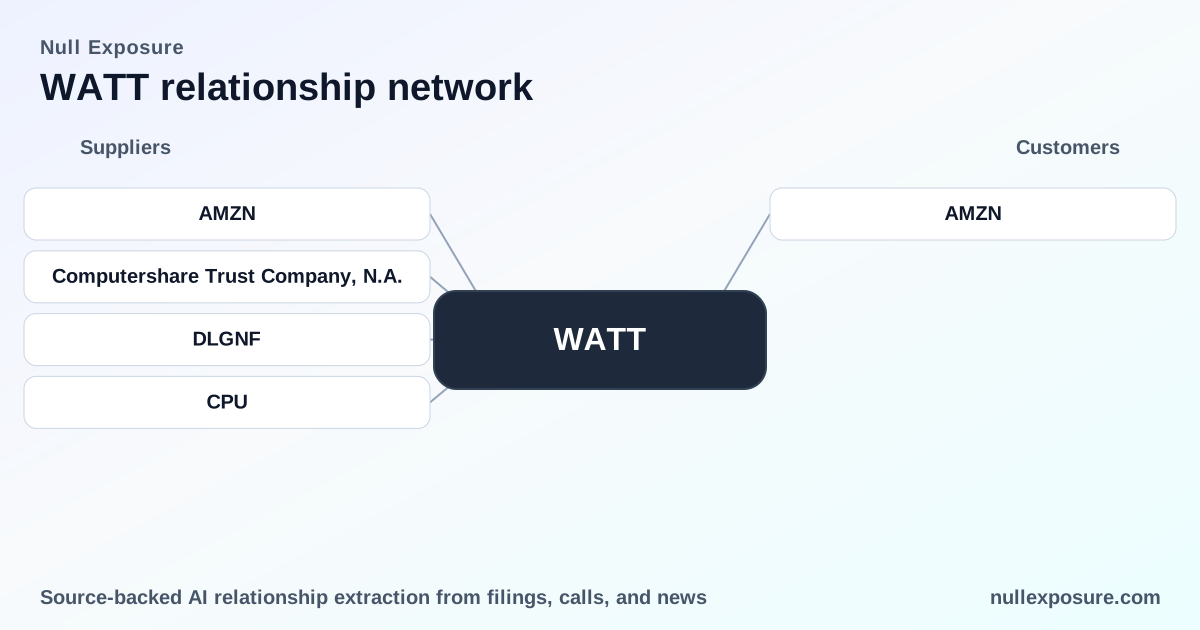
Energous develops and sells wireless charging hardware and supporting software—commercializing its WattUp radio-frequency charging and sensing technology through a mix of silicon/firmware partners, marketplace distribution, and cloud integrations. The company monetizes by selling hardware modules and platform software, licensing its technology to chip partners, and enabling enterprise deployments through cloud and marketplace channels. For investors evaluating supplier risk and go‑to‑market durability, the most material signals are manufacturing posture, channel partnerships with Amazon/AWS, and the legacy strategic alliance with Dialog Semiconductor. Learn more at https://nullexposure.com/.
How Energous makes money and where growth comes from
Energous positions itself as a fabless developer of wireless power systems: the company designs transmitters, receivers and firmware, then outsources production and partners for silicon and cloud integration. Revenue sources are direct hardware sales, software/platform services for enterprise customers, and licensing relationships that supply chipsets to OEMs. Public filings show a small market capitalization and profitable growth claims in recent press; revenue and profitability remain nascent at scale. According to company fundamentals, trailing twelve‑month revenue is $1.976 million with negative operating margins and an EBITDA loss, while a 2025 press release cited a record $5.6 million in revenue for FY2025 and rapid year‑over‑year growth (QuiverQuant, 2026). These figures underline a transition from R&D into early commercial traction.
Explore supplier diligence frameworks at https://nullexposure.com/ to map counterparty concentration and contracting posture.
The partner map — who Energous works with (and why it matters)
Amazon Web Services (AWS)
Energous joined the AWS Partner Network and has integrated parts of its platform with AWS cloud services to support enterprise deployments, including solutions built on AWS IoT Core for environmental sensing and compliance. According to a company update and third‑party coverage in early 2026, AWS integrations are positioned to enable scalable, data‑driven operations for Energous customers (Sahm Capital, March 2026; Yahoo Finance, 2025). This is a distribution and systems‑integration relationship that increases the company’s addressable enterprise market and evidences SaaS‑style stickiness around telemetry and device management.
Amazon Marketplace
Energous’ hardware and software offerings are qualified and available through the Amazon Marketplace, simplifying procurement for enterprise and channel buyers and shortening sales cycles. QuiverQuant reported that Energous products became available on Amazon’s marketplace as part of commercial expansion in FY2026 (QuiverQuant, 2026). This channel presence reduces friction for downstream customers while exposing Energous to pricing transparency and marketplace competition dynamics.
Computershare Trust Company, N.A.
Computershare acted as the exchange agent and transfer agent for Energous’ 1‑for‑30 reverse stock split announced in August 2025, a corporate action executed to reconstitute the company’s public float and compliance profile (GlobeNewswire, Aug 6, 2025; Yahoo Finance, 2025). This is a typical transfer‑agent relationship tied to corporate governance and shareholder services rather than product supply; it is material for capital structure and investor relations rather than operations.
Dialog Semiconductor (now part of Renesas/related channels)
Dialog has served as a strategic alliance partner and exclusive supplier for Licensed Products incorporating WattUp technology, providing chip supply and commercial support to early adopters. Historical coverage notes Dialog as Energous’ strategic manufacturing and silicon partner under an Alliance Agreement first disclosed in 2016 (ElectronicDesign, FY2018). That relationship historically mitigates early supply risk by ensuring chip availability for licensed products, but also concentrates manufacturing dependency on a named supplier.
Constraints that shape the operating model and risk profile
- Fabless, outsourced manufacturing posture. Energous states that it is a fabless company and engages contract manufacturing partners in the United States and internationally; this is a deliberate contracting posture that reduces capital intensity but increases supplier management risk and quality control demands (company filings/excerpts). Treat this as a company‑level signal: product supply is dependent on third‑party contract manufacturers rather than in‑house fabs.
- Named manufacturing concentration with Dialog. The Alliance Agreement with Dialog explicitly designated Dialog as an exclusive supplier for certain licensed products, creating historical concentration in chip supply and commercialization support for WattUp devices (Alliance Agreement excerpt). This is a relationship‑specific constraint that raises supplier concentration risk for product lines tied to that arrangement.
- Global footprint but early maturity. Evidence supports a global manufacturing outlook and international partner engagement, yet the firm remains in early commercial stages with limited trailing revenues and negative profitability metrics; commercial relationships with cloud and marketplace providers are strategically important to scale distribution quickly.
Key operational implications: outsourced manufacturing improves capital efficiency but increases exposure to contract manufacturer timelines, quality, and geopolitical disruptions; the Dialog alliance reduces early supply uncertainty but centralizes supplier concentration for chipset-dependent products.
Investment implications — risk and reward synthesis
Energous trades as a small‑cap, early‑commercial technology company with high upside tied to enterprise adoption and continued execution on cloud and marketplace channels, but it retains clear operational risks: low absolute revenue base, negative profitability, and supplier concentration for critical silicon. Partnerships with AWS and Amazon Marketplace materially improve go‑to‑market reach and enterprise credibility, while Computershare’s role on corporate actions signals standard public‑company governance infrastructure. Investors should prioritize diligence on contract manufacturer capacity, the current status of Dialog/partner chip supplies, and verifiable recurring revenue from cloud integrations.
If you are mapping supplier concentration or building a vendor risk scorecard, see practical tools and supplier datasets at https://nullexposure.com/.
Final read: what to watch next
Monitor three levers that determine outcomes: (1) sustained revenue growth from enterprise AWS deployments and marketplace sales, (2) supply continuity from contract manufacturers and any transition away from Dialog exclusivity, and (3) margin expansion as hardware volumes scale and software/analytics attach rates grow. For investors and operators, the balance between rapid commercial uptake and supplier concentration will define whether Energous evolves into a durable platform or remains a technology with brittle supply lines.
Dig deeper into supplier analysis frameworks and scenario planning at https://nullexposure.com/.