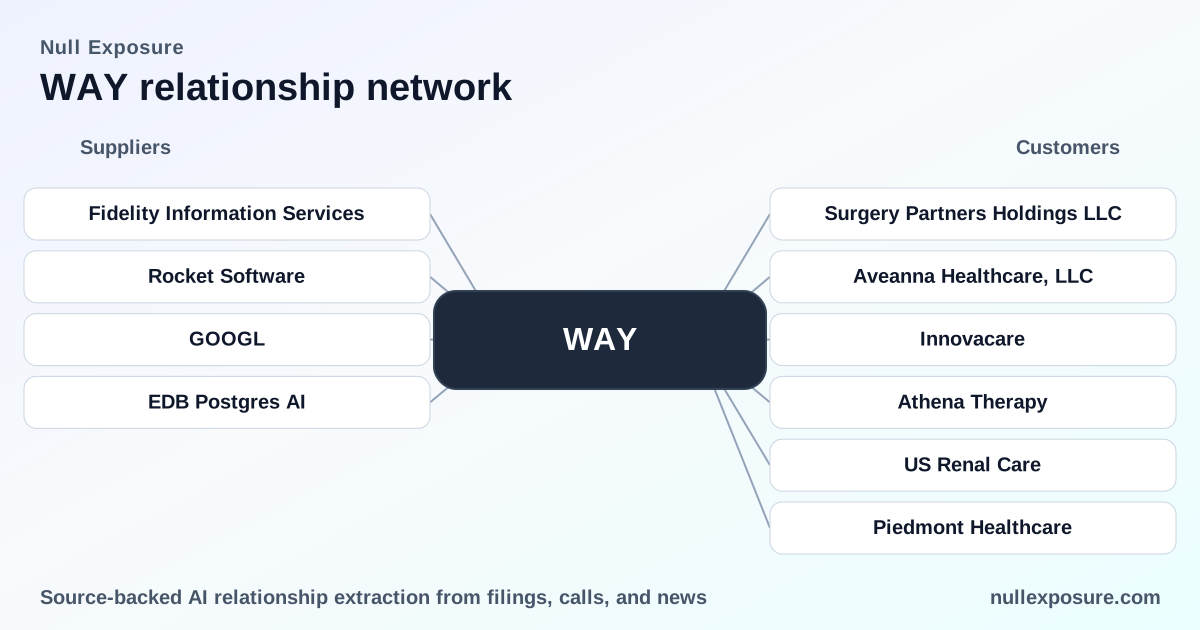
Waystar (WAY) — supplier map, constraints, and what investors should price in
Waystar runs a healthcare revenue-cycle platform that sells cloud-delivered software and services to hospitals, health systems and payers; it monetizes through recurring subscription and licensing fees plus transaction and service revenues tied to claims processing and payment workflows. The company leverages third‑party infrastructure and specialized vendors for components of its stack, and recent moves into large‑language model integrations and database consolidation are central to its growth narrative and operational risk profile. For a concise view of supplier exposure and how it affects valuation and operational resilience, visit https://nullexposure.com/.
Executive takeaway: platform-critical suppliers, modest spend, elevated strategic leverage
Waystar relies on a mix of traditional software vendors and hyperscale cloud and AI partners. Supplier spend is small relative to revenue (sub‑$2m per vendor in disclosed cases) but the functional criticality is high: cloud hosting and data infrastructure underpin the entire revenue‑cycle product, while new AI partnerships are becoming distribution and differentiation channels. Investors should treat Waystar’s supplier set as low-cost but high‑strategic‑impact — a pattern that supports margin expansion but introduces concentration and contractual renewal risk.
Visit https://nullexposure.com/ for supplier intelligence tailored to investor due diligence.
Supplier relationships: concise line‑by‑line summaries
Below are the relationships disclosed in public filings and press coverage, each followed by the source.
Fidelity Information Services
Waystar purchases software solutions from Fidelity Information Services and paid approximately $1.6 million to the vendor in FY2024, indicating a material but relatively modest annual spend. According to Waystar’s FY2024 10‑K, Fidelity is a vendor providing software solutions (FY2024 10‑K).
Rocket Software
Rocket Software is a vendor that provides Waystar with software solutions, and Waystar paid roughly $0.4 million per year to Rocket for 2022–2024, showing a low absolute spend but an ongoing operational relationship. This supplier relationship is disclosed in the FY2024 10‑K (FY2024 10‑K).
Google (Gemini LLM integration)
Waystar has announced integration with Google’s Gemini large‑language model to accelerate AI features while retaining control over client data and outcomes, positioning Google’s LLM as an innovation engine for Waystar’s product roadmap. This integration was discussed on Waystar’s Q4 2025 earnings call and reported by The Globe and Mail in March 2026 (Q4 2025 earnings call transcript, The Globe and Mail, March 2026).
Google Cloud
Waystar expanded its collaboration with Google Cloud to accelerate agentic AI capabilities and pursue an “autonomous revenue cycle,” making Google Cloud a strategic cloud and AI partner for product development and deployment. The expansion was announced in a PR Newswire release and covered widely in March 2026 (PR Newswire, March 2026; broader March 2026 press coverage).
EDB Postgres AI
Waystar adopted EDB Postgres AI to consolidate and scale its data infrastructure for healthcare payments, signaling a move to standardize and modernize the data layer that underpins revenue‑cycle operations. Media coverage in January 2026 reported the EDB Postgres AI adoption as a strategic infrastructure choice (SahmCapital, January 29–31, 2026).
What the disclosed constraints say about Waystar’s operating model
Public excerpts and vendor disclosures produce a coherent picture of Waystar’s contracting posture and platform dependence:
- Contracting posture — licensing focus. Waystar relies on third‑party software licenses that renew only by mutual consent and include standard cure/termination provisions; this creates negotiation points at renewal that can influence roadmap and cost structure (company 10‑K language on licensing).
- Materiality and criticality. Management states that withdrawal or restriction of data providers would have a material adverse impact on the business, which flags high operational criticality even when direct spend is limited. This is a company‑level signal about service dependence and switching risk.
- Buyer role and vendor payments. Waystar acts as a buyer of specialized software — disclosed payments include ~$1.6m to Fidelity (2024) and ~$0.4m per year to Rocket (2022–24) — placing these vendors in a supplier rather than platform partner position from a cash outflow perspective, but not removing their operational significance.
- Cloud and service provider reliance. Waystar operates inside co‑located data centers and hyperscaler environments (Microsoft Azure, AWS, Google Cloud Platform), making cloud providers both infrastructure partners and strategic enablers of AI capabilities; this elevates concentration risk around hyperscalers.
- Relationship maturity and stage. Disclosures describe these relationships as active and integrated into proprietary products, indicating established, productionized dependencies rather than exploratory pilots.
- Spend profile versus importance. The disclosed spend bands (mostly in the $100k–$1m range, with at least one vendor in the $1m–$10m band) indicate that cost exposure is small but the operational leverage is large — a classic software‑platform tradeoff.
Investment implications: upside, risks, and monitoring priorities
- Upside: The Google Cloud + Gemini integration and EDB Postgres AI consolidation accelerate product differentiation and scalability. These moves support Waystar’s forward P/E (forward PE ~15.4) and analyst optimism (consensus target mid‑$30s) by improving gross margin and feature velocity if executed cleanly.
- Key risks: Vendor concentration on hyperscalers and a small set of infrastructure suppliers creates outsized operational risk relative to spend; licensing renewal clauses and the materiality of data providers introduce potential service interruption or cost pressure events that would reverberate through margins and customer churn.
- What to watch next: contract renewal disclosures, service‑level incidents involving cloud partners, and any material changes in vendor spend or dependency. Also monitor how revenue attribution shifts as AI features drive new transaction or subscription lines.
Explore supplier risk and concentration across peers and suppliers at https://nullexposure.com/ to quantify these dynamics for portfolio decisions.
Bottom line
Waystar’s supplier footprint is characterized by low direct spend but high strategic impact: cloud and AI partnerships are core to growth, while traditional software vendors and data providers remain critical to operations. Investors should value Waystar’s modernization steps while factoring in contractual renewal and hyperscaler concentration risks when assessing upside versus operational exposure.
For deeper supplier intelligence and tailored exposure reports, visit https://nullexposure.com/.