WaterBridge Infrastructure (WBI): Supplier Relationships and Strategic Implications
WaterBridge Infrastructure operates and monetizes an asset-light to asset-moderate water midstream model: the company builds and acquires water handling networks and pipeline access, then sells recurring fee-based water management and disposal services to upstream operators and land managers. Revenue derives from transport and handling contracts, asset acquisitions that create control over pore-space and produced-water flows, and scale-driven margin expansion in core basins. For deeper supplier mapping and exposure analysis, visit https://nullexposure.com/.
How WaterBridge makes money and why supplier relationships matter
WaterBridge’s economics are driven by contracted access to pore space and contiguous acreage, plus the ability to convert acquired infrastructure into stable fee income. The company reports healthy underlying cash generation—TTM Revenue of $525.6M and Adjusted EBITDA of $233.6M—while operating margins are positive even as GAAP EPS remains negative. That split highlights a business that is capital-intensive but capable of converting scale into midstream profits.
Key commercial characteristics investors and operators should track:
- Contracting posture: WaterBridge secures long-term commercial rights (pore space and handling agreements) that convert operational control into predictable revenue streams.
- Concentration and criticality: Access to contiguous acreage and pore space is a critical input for produced-water economics; a handful of land and asset relationships can materially affect throughput.
- Maturity and growth mode: Growth mixes organic buildouts with targeted acquisitions of water assets sold by upstream companies, producing rapid basin consolidation effects.
For an executive-level supplier map and to monitor counterparties, see https://nullexposure.com/ — useful for sourcing diligence on counterparties and historic asset transactions.
The partner roster you need to know
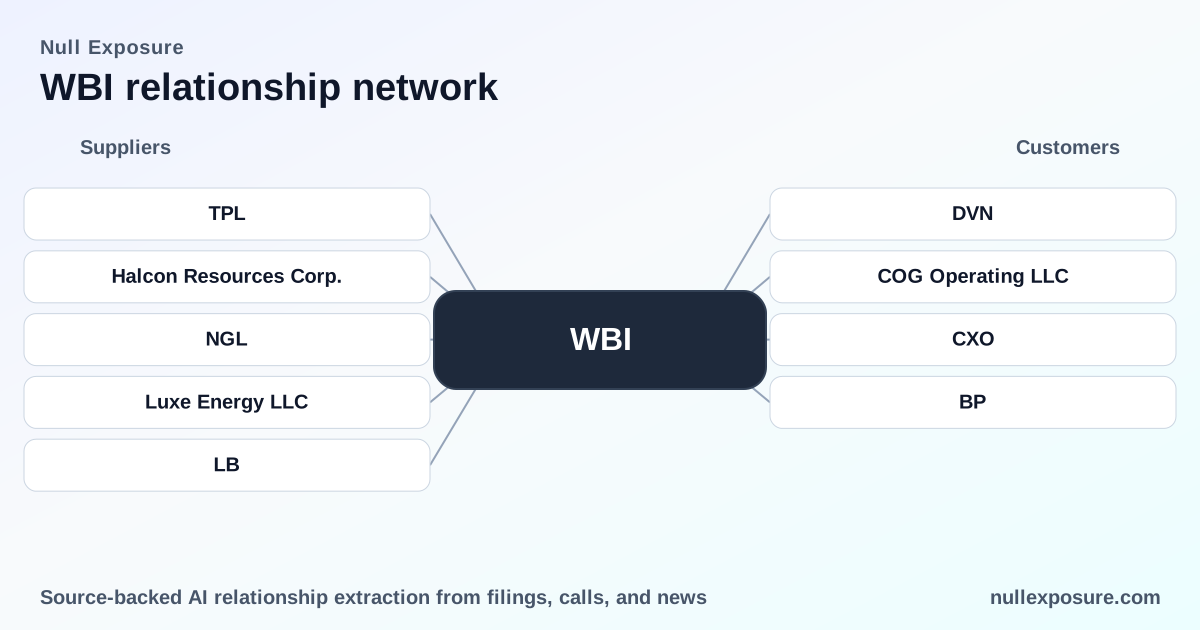
Below are every supplier/partner relationship surfaced in our source set, presented with plain-English summaries and source citations.
- Texas Pacific Land (TPL) — WaterBridge stated that its relationships with Texas Pacific Land provide contractually agreed access to economically managed pore space, an input that underpins produced-water disposal economics and midstream routing. According to WBI’s 2025 Q3 earnings call, this access is a material operational lever for the company.
- LandBridge (LB) — WaterBridge disclosed significant access to pore space through LandBridge, which controls more than 300,000 mostly contiguous acres in the Stateline region of the Northern Delaware Basin, giving WaterBridge scale and routing optionality in a high-activity basin (WBI 2025 Q3 earnings call).
- Halcon Resources Corp. — A market report covering WaterBridge's history of asset purchases notes that WaterBridge completed an acquisition of assets from Halcon Resources in transactions tied back to FY2019, reflecting the company’s strategy of buying producing-water or handling assets from upstream sellers (energy-oil-gas.com, March 2026).
- NGL Energy Partners LP (NGL) — The same report identifies NGL Energy Partners as a prior seller of assets to WaterBridge, demonstrating that WaterBridge sources growth through selective purchase of third-party water infrastructure (energy-oil-gas.com, March 2026).
- Luxe Energy LLC — Energy-Oil-Gas also records that WaterBridge acquired assets from Luxe Energy LLC as part of a cluster of FY2019 transactions, reinforcing a pattern of inorganic basin consolidation (energy-oil-gas.com, March 2026).
Each relationship above delivers either long-term operational rights (pore space, acreage access) or represents a past acquisition channel through which WaterBridge expanded network scale — both critical to throughput and fee revenue.
Operational constraints and company-level signals investors should internalize
Although no formal constraint list was supplied in the materials reviewed, the relationship evidence and public metrics imply several company-level signals that affect supplier diligence and counterparty risk management:
- Contract-anchored access. WBI’s public statements emphasize contractual access to pore space; this is a durable commercial asset that converts physical geography into recurring economics. Treat pore-space contracts as strategic collateral when assessing counterparty dependence.
- Counterparty diversity via acquisition. Historical purchases from multiple sellers (Halcon, NGL, Luxe) indicate a playbook that reduces single-seller concentration risk by sourcing assets across multiple upstream counterparties.
- Basin concentration risk. Scale benefits come from contiguous acreage and basin density; concentration in the Delaware Basin is a commercial advantage but creates localized operational exposure to basin-level production cycles and regulation.
- Maturity vs. integration risk. The company’s mixed model—organic build plus acquisitions—accelerates growth but requires disciplined integration to preserve margins and contractual protections.
These signals are company-level characteristics for any supplier or investor evaluating exposure to WaterBridge; they do not attribute specific constraints to individual counterparties beyond what WBI itself disclosed.
Numbers that drive valuation and due diligence
For quantitative context: Market cap ~$1.04B, Revenue TTM $525.6M, Adj. EBITDA $233.6M, EV/Revenue ~3.2, EV/EBITDA ~35.8. Price-to-sales sits near 1.97 and price-to-book at 1.70, while the company reports a negative GAAP EPS (-$0.66 TTM) despite positive operating margin (9.21%). Analysts’ consensus target sits at $28.56 with a range of Buy-to-Hold opinions.
These metrics underscore a midstream-like valuation premised on growth and contract durability rather than current GAAP profitability. Investors should weigh premium multiple compression risk against the stability of contracted pore-space access and realized throughput growth.
Risk and upside: what operators and investors should prioritize
- Upside: Scale and contiguous acreage access translate into network effects—higher throughput improves per-unit margins and raises barriers for new entrants. Strategic acquisitions from upstream sellers accelerate this pathway.
- Risk: Basin concentration, regulatory changes to wastewater handling, integration execution on acquired assets, and the valuation multiple relative to current EBITDA are the primary risk vectors.
Practical takeaways and next steps
- Validate contractual terms for pore-space access and disposal fees when conducting partner-level diligence; these are revenue anchors.
- Assess basin balance: contiguous acreage and Stateline/Delaware exposure produce asymmetric returns—favorable in growth cycles, concentrated in downturns.
- Monitor acquisition cadence and integration outcomes; past purchases from Halcon, NGL, and Luxe establish a repeatable growth channel that can be either value-accretive or capital-consuming depending on execution.
For ongoing monitoring and supplier intelligence on WBI and its counterparties, explore https://nullexposure.com/ for detailed mapping and alerts.
Concluding, WaterBridge’s supplier relationships combine contractual operational levers (pore space) and a proven acquisition path to scale. For investors and operators, the central question is whether growth and contract durability justify the current valuation multiple; focused diligence on the relationships and contracts outlined above answers that question materially. Visit https://nullexposure.com/ for deeper counterparty analysis and tailored exposure reports.