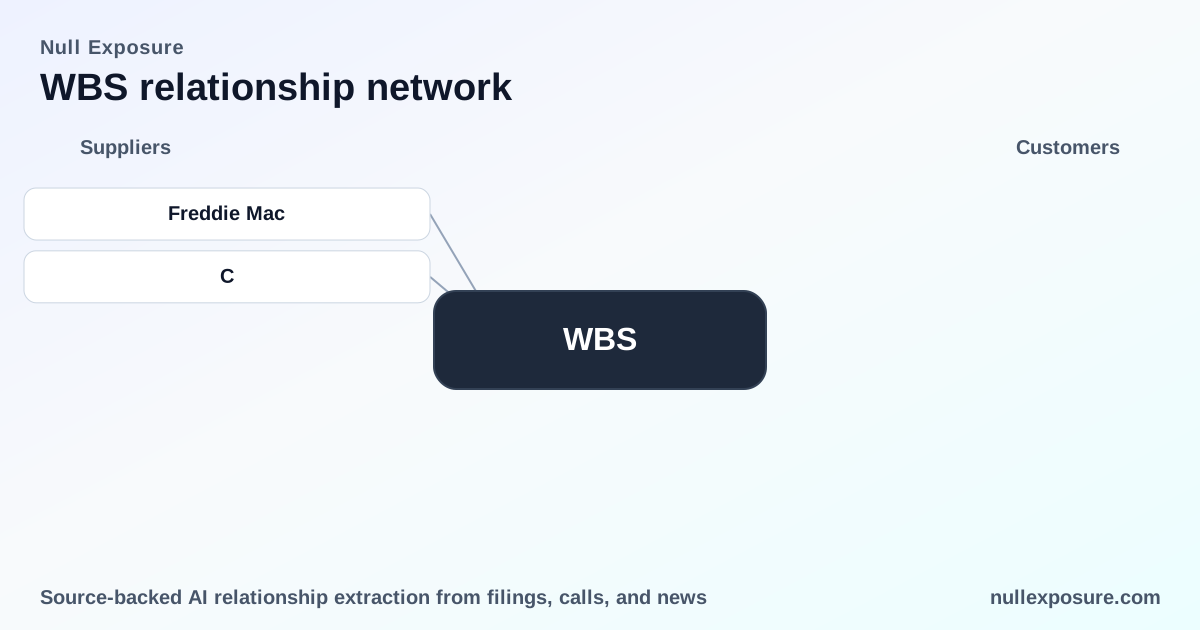
Webster Financial (WBS) — supplier relationships and operational read-throughs
Webster Financial Corporation operates as the banking holding company for Webster Bank, monetizing through net interest margin on loan portfolios, fee income from deposit and treasury services, and capital markets activity such as loan sales and securitizations. The business combines steady commercial lending and mortgage origination with periodic balance-sheet management via debt issuance and short-term funding, producing $2.68 billion in revenue and a healthy operating margin in the most recent trailing twelve months. Investors should evaluate supplier and counterparty links as extensions of that capital-management program—particularly relationships tied to securitization and branch / lease acquisitions—and judge how they affect liquidity, interest-rate sensitivity, and geographic concentration. For a deeper supplier-risk read, visit https://nullexposure.com/.
Executive snapshot: what matters for operators and allocators
Webster is a regional bank with national capital-market plumbing: its core earnings derive from lending in the Northeast while funding and risk distribution rely on both long-term debt instruments and short-term repurchase agreements. Key balance-sheet signals for procurement and operations teams are contract tenor (long-term notes vs. repos), counterparty credit standing, and the domestic focus of activity. The company’s market capitalization (~$10.96B) and return-on-equity (roughly 10.8% reported) reflect a bank that is profitable and institutionally owned (over 93% institutional holders), which shapes its contracting posture and counterparty expectations.
- Contracts and funding mix matter: long-dated notes bring structural stability; repos provide tactical liquidity.
- Geography concentrates operational risk domestically, with limited foreign financial relationships.
Learn how that profile changes your supplier oversight at https://nullexposure.com/.
The explicit supplier relationships in public filings and reporting
Below are every relationship surfaced in the available results, presented plainly with source context.
-
Webster’s multi-family loan pass-through certificates were issued and guaranteed by Freddie Mac through a two-step securitization process, indicating use of government-sponsored enterprise securitization mechanics to distribute multi-family mortgage credit risk and access capital markets. This is documented in Webster’s FY2024 Form 10‑K.
Source: Webster Financial Corporation FY2024 Form 10‑K filing (discussion of multi-family loans and pass-through certificates). -
In a transaction reported in December 2015, Webster acquired most of Citigroup’s branch leases and reopened the locations under the Webster brand, a move that expanded branch footprint and took on Citi lease obligations as part of an inorganic growth push. This was covered by the Boston Globe in December 2015.
Source: Boston Globe business report, December 11, 2015 (coverage of Webster taking over Citi branches).
What those relationships mean in practice
These two relationships intersect different parts of Webster’s operating model:
-
Freddie Mac engagement ties directly to Webster’s mortgage packaging and capital markets strategy. When Webster securitizes multi-family loans with Freddie Mac guarantees, it reduces on‑balance-sheet credit concentration, frees funding capacity, and transfers credit risk to the guarantee structure—improving liquidity and supporting loan origination scale without a proportional increase in long-term funding needs. This is an essential lever for a regional bank that competes in commercial real estate lending.
-
The Citi branch lease takeover demonstrates Webster’s readiness to execute opportunistic, asset-light expansion through lease assumption and rebranding rather than greenfield branch builds. That approach accelerates deposit growth but imports lease and operational integration risk—useful context for contract managers negotiating facility services, IT migration, and vendor continuity during rollouts.
Company-level constraints that shape supplier relationships
The public constraint signals describe Webster’s contracting posture and operational boundaries (these are company-level signals; they are not assigned to specific counterparties unless explicitly named):
-
Contracting maturity mix — long-term and short-term: Webster discloses senior, subordinated, and junior subordinated notes maturing in 2029–2033, which indicates a material allocation to long-dated liabilities and a preference for multi-year funding to match asset duration. Separately, securities sold under agreements to repurchase are used as short-term funding tools—a tactical liquidity lever that increases sensitivity to short-term market funding conditions. Evidence for both long-term notes and repo use is reported in regulatory filings and the company’s financial notes.
-
Geographic concentration — North America focus: Webster states it conducts very few transactions with foreign financial institutions or foreign persons and maintains Bank Secrecy Act / USA PATRIOT Act compliance programs geared toward domestic activity. This reinforces a domestic counterparty universe and reduces cross‑border operational complexity, but also concentrates exposure to U.S. regional economic cycles.
These constraints imply a mixed maturity funding strategy (structural long-term debt plus tactical short-term repos), domestic counterparty concentration, and an operational stance that values predictable regulatory compliance over international expansion.
Risk and opportunity map for investors and operators
- Funding flexibility is a strength: long-term notes reduce refinancing risk on a portion of liabilities, while repos provide tactical liquidity for market windows or stress events.
- Counterparty risk is concentrated domestically: counterparties and suppliers are primarily U.S.-based, simplifying legal and compliance oversight but increasing correlation with U.S. macro and real-estate cycles.
- Operational integration risk exists when acquiring leases or branch footprints: the Citi lease takeover is a precedent for assuming legacy vendor agreements, facility contracts, and local employee arrangements—areas for close supplier diligence.
Practical next steps for buyers, vendors, and allocators
- For procurement: prioritize counterparty credit and contract-tenor clauses—ensure vendor contracts align with Webster’s long-term debt profile and repo-driven liquidity cycles.
- For operations: map lease and branch transition playbooks to the Citi takeover precedent; insist on continuity clauses for core services and migration timelines.
- For investors: monitor securitization flow volumes and Freddie Mac activity as a leading indicator of loan origination appetite and capital relief.
Explore supplier-level intelligence and comparative supplier profiles at https://nullexposure.com/.
Bottom line and recommended actions
Webster’s supplier footprint reflects a dual funding strategy and a domestic operational posture: securitization relationships like Freddie Mac support credit distribution and liquidity, while past lease acquisitions from Citi illustrate a pragmatic approach to scaling retail presence through assumed contracts. For investors and operators, the appropriate focus is on contract tenor alignment, domestic counterparty concentration, and integration risk when acquiring third-party obligations.
If you manage supplier risk or evaluate bank counterparties, take action now: review Webster’s recent 10‑K sections on securitization and funding, and reassess vendor contract tenors against the company’s long-term note schedule. For tailored supplier intelligence and ongoing monitoring, visit https://nullexposure.com/ for service details and comparative supplier analytics.