WBS-P-G: Preferred stock under an acquisition spotlight
Webster Financial’s preferred issuance WBS-P-G delivers fixed-income exposure anchored to a bank holding company that generates revenue through net interest income, fee businesses and wealth management services; the security’s yield profile is fundamentally a play on Webster’s capital structure and balance-sheet resilience. Webster is currently the subject of a strategic sale process, and the actions of financial and legal advisors are the immediate drivers of outcomes that will determine treatment of preferred holders and the timing of any capital-structure changes. For a fast read on counterparties and what they imply for investors, visit https://nullexposure.com/.
What happened, in plain investor terms
Banco Santander announced a transaction to acquire Webster Financial, initiating a finite corporate process where bankers and counsel set valuation and transaction mechanics. That process places WBS-P-G squarely in the crosshairs of deal negotiations: preferred holders will be evaluated against the buyer’s capital plan and the deal’s definitive documentation. For income-focused investors, the central question is how the acquisition instruments handle existing preferreds—redemption, exchange, or continuation under new ownership.
Who’s advising Webster — and why it matters
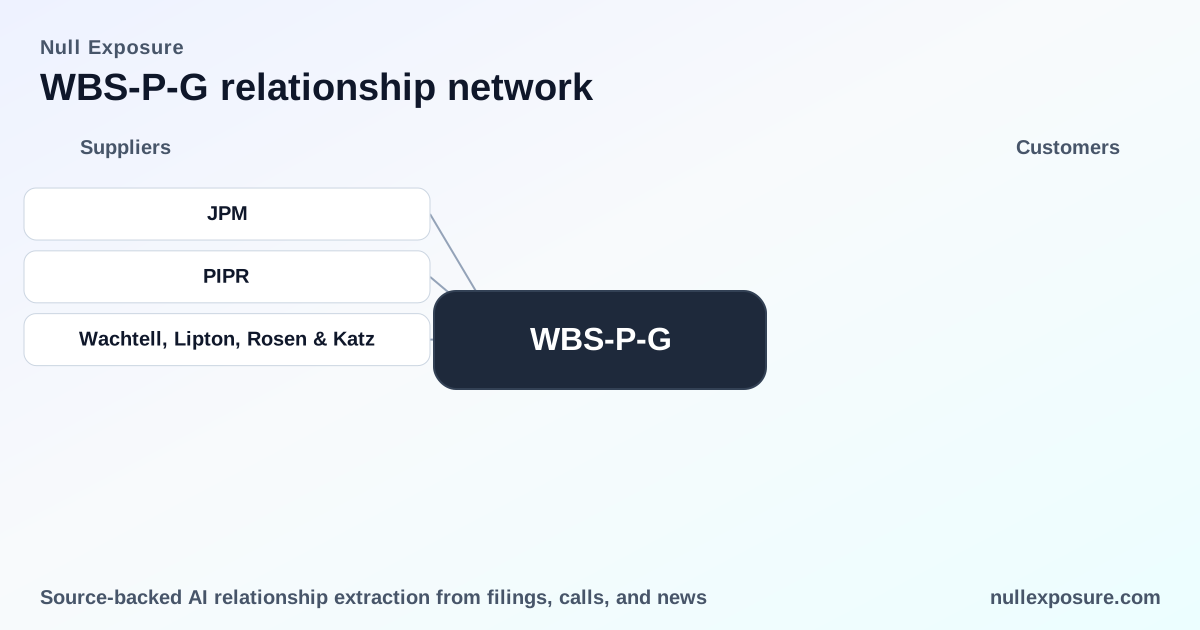
- J.P. Morgan Securities LLC: J.P. Morgan is serving as lead financial advisor and rendered a fairness opinion to Webster in the sale to Banco Santander, a role that concentrates valuation and negotiation authority with a top-tier investment bank in FY2026. According to a CityBiz report (March 10, 2026), J.P. Morgan led the advisory effort and provided a fairness opinion for Webster.
- Piper Sandler & Co.: Piper Sandler also served as a financial advisor to Webster during the transaction, providing complementary advisory capacity in the sale process in FY2026. A CityBiz article (March 10, 2026) notes Piper Sandler’s advisory role on the deal.
- Wachtell, Lipton, Rosen & Katz: Wachtell Lipton is serving as legal advisor to Webster for the transaction, delivering high-stakes corporate and M&A counsel in FY2026. The CityBiz write-up (March 10, 2026) identifies Wachtell Lipton as Webster’s legal counsel on the acquisition.
Each of these relationships is documented in reporting on the Banco Santander–Webster transaction and collectively forms the negotiation nucleus that will determine preferred-security outcomes.
How these counterparties shape the likely path for WBS-P-G
The combination of a global investment bank lead, a specialist regional advisor, and elite M&A counsel is a classic configuration for time-sensitive, value-maximizing transactions. That configuration signals a structured, high-governance sale process designed to crystallize value quickly and to minimize arbitrage around capital instruments. Practically, investors should expect:
- Transaction documents and the buyer’s capital model to define redemption/exchange mechanics for WBS-P-G.
- A fairness opinion and dual advisory coverage to compress negotiation windows and reduce the probability of protracted pricing uncertainty.
- Legal counsel with deep takeover experience to ensure regulatory and shareholder approvals proceed on standard M&A timetables.
For immediate monitoring, prioritize deal filings and the buyer’s public statements for explicit language on preferred-stock treatment. If you are tracking this security, register alerts and review proxy and merger agreements as they are filed.
Visit https://nullexposure.com/ for structured monitoring and alerting on supplier and advisor relationships that affect capital instruments.
Company-level signals about operating model and maturity
With no explicit constraints listed in the record, the advisory mix and public transaction coverage function as company-level signals:
- Contracting posture — Strategic and transactional: Webster is operating in a sell-side posture with formal financial and legal retention, indicating a negotiated, contracted sale rather than an opportunistic market exit.
- Concentration — Focused advisory set: A limited set of high-quality advisors suggests concentrated counterparty exposure in the sale process rather than a diffuse network of firms.
- Criticality — High short-term dependence on advisors: Advisors are critical to deal closure; their inputs (valuation, fairness, legal structuring) will directly determine preferred-holder outcomes.
- Maturity — Sophisticated governance and process: The use of top-tier advisory firms signals a mature governance posture and a process structured to withstand regulatory and shareholder scrutiny.
These signals are company-level and describe the operating environment for WBS-P-G holders without attributing constraints to individual advisors.
Key risks and what investors should watch
- Deal documentation controls outcome: The merger agreement and any supplemental terms will explicitly state whether WBS-P-G is redeemed, converted, or assumed; investors will receive definitive answers only at filing.
- Regulatory timing and approvals: Banking-sector transactions of this scale involve regulator scrutiny; any required capital fixes could affect the buyer’s willingness to assume preferred liabilities.
- Integration and re-rating risk: Post-close capital and strategic integration choices by the acquirer can alter the credit profile of instruments historically issued by Webster, with knock-on effects for yield and market pricing.
- Information asymmetry during process: Until definitive filings are published, advisors’ public roles are the primary signals available; active monitoring of SEC filings and proxy materials is essential.
Practical next steps for investors
- Read the merger agreement and proxy materials as soon as they are filed; those documents contain the operative language for preferred treatment.
- Monitor investor relations releases and regulatory filings from both Webster and the buyer for capital-plan details.
- Consider scenarios—redemption at par, exchange into buyer securities, or continuation under new ownership—and stress-test portfolio impact under each.
For tailored tracking and a curated timeline of advisor disclosures, see https://nullexposure.com/.
Bottom line: a transition that demands active monitoring
WBS-P-G is not a static income play while Webster sits in a sale process; the lead advisors and counsel are actively shaping the transaction mechanics that will govern preferred-holder outcomes. Investors should treat this as a binary process window—actionable clarity will come through deal filings and buyer statements—and manage positions accordingly until definitive language is public. For ongoing updates, advisory mappings, and timeline alerts, visit https://nullexposure.com/ and subscribe to deal monitoring.