WCT (Wellchange Holdings) — supplier relationships, capital posture, and what investors should know
Wellchange Holdings Company Limited (ticker: WCT) runs a technology-enabled health and wellness business that monetizes through product and services revenue plus strategic channel partnerships and periodic equity raises. The company reports modest revenue (USD 2.45M TTM) with positive gross profit but negative operating metrics and cash-generation indicators, which positions it as a small-cap, high-control issuer that finances growth primarily through equity. For investors and operator-partners evaluating WCT as a supplier or counterparty, the commercial signal is clear: active capital markets behavior, concentrated insider control, and constrained profitability drive counterparty risk and potential dilution outcomes. Learn more at https://nullexposure.com/.
One-line investment thesis: small revenues, growth dependency on equity
Wellchange is a NASDAQ-listed application software/health-wellness operator that sells technology-driven wellness products and services and supplements cashflow with capital raises; revenue growth is present but profitability is negative, so equity financing and placement agents are a material part of the operating model. According to company filings (latest quarter 2025-03-31), trailing revenue is USD 2.45M and gross profit USD 1.68M, while diluted EPS is negative USD 3.68.
What happened in FY2025: a $4 million private placement and the placement agent
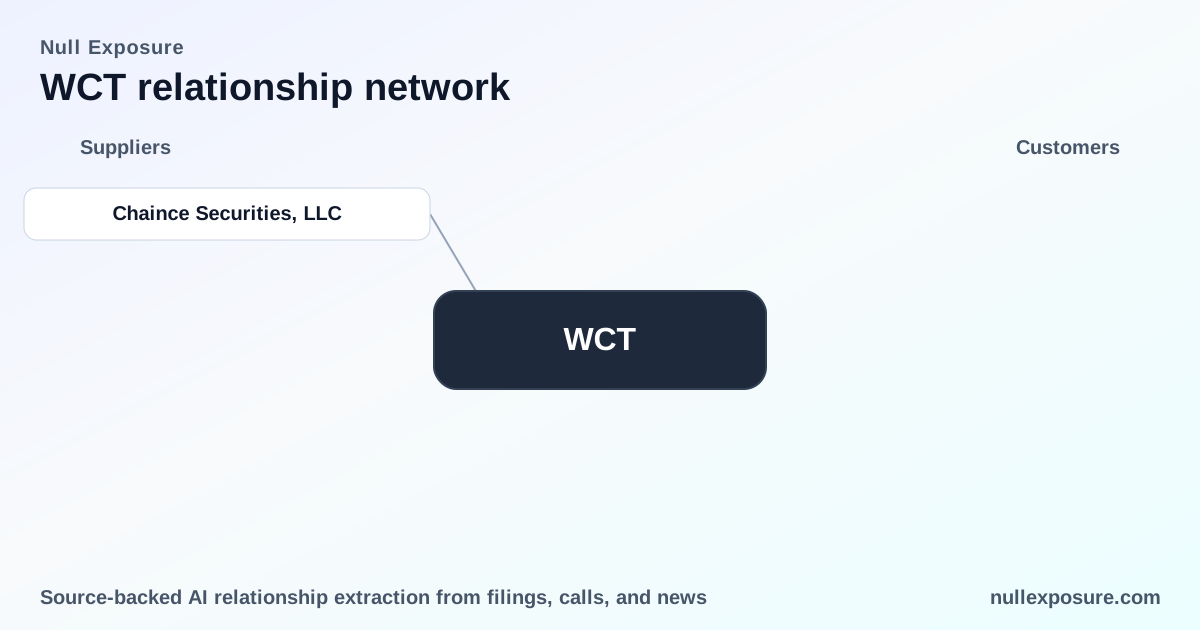
A Quiver Quant News item reported on March 10, 2026 that Chaince Securities, LLC acted as the sole placement agent for a $4 million private placement of Class A ordinary shares for Wellchange in FY2025, highlighting an explicit reliance on contracted placement services to raise capital. The news post confirms Chaince’s role as sole placement agent in the transaction (Quiver Quant News, March 10, 2026).
Every supplier / placement relationship found in public records
- Chaince Securities, LLC — Chaince served as the sole placement agent in a FY2025 private placement that raised approximately USD 4.0 million in Class A ordinary shares; this is the identifiable capital-market supplier relationship on record for WCT. A Quiver Quant News post dated March 10, 2026 reported the transaction and Chaince’s agent role.
No other supplier or placement relationships are present in the supplied results for WCT; the Chaince item is the sole recorded external capital-market counterparty in the dataset.
How the relationships shape WCT’s operating model and supplier posture
With the Chaince placement agent engagement as the visible external relationship, investors should interpret several company-level signals:
- Contracting posture: the company actively uses placement agents to access equity capital instead of relying on debt or operating cashflow; that pattern signals a transactional, raise-as-needed contracting stance rather than long-term capital partnerships.
- Concentration and control: insiders hold about 70.8% of shares, while institutions own roughly 0.19%, indicating high insider concentration and limited institutional liquidity in the float (shares float ~991,830). That ownership profile concentrates decision-making and increases the likelihood that future raises will be negotiated on insider timelines.
- Criticality of capital markets: negative profitability (EPS -3.68; EBITDA negative) combined with modest cash-generating revenue (USD 2.45M TTM) makes external capital critical to maintain operations and execute growth initiatives.
- Maturity and scale: market capitalization (~USD 11.04M) and small absolute revenue indicate an early-stage or small-scale commercial footprint; operational maturity is limited and sensitive to financing cycles.
These are company-level characteristics drawn from the public financials and the single observed placement-agent engagement; they should guide supplier-contract terms and credit-limit settings.
What the metrics imply for counterparties and operators
Operators evaluating WCT as a supplier or buyer of services should treat the company as a high-counterparty-risk, high-dilution client. Key considerations:
- Payment and credit terms: prioritize shorter payment windows and stronger security (escrows, advance deposits, or milestone billing) because the company relies on equity raises to manage liquidity.
- Contract language: include protective covenants that trigger remedy or renegotiation if WCT undertakes dilutive financings or materially alters ownership structure.
- Commercial upside vs. concentration risk: revenue growth (quarterly revenue growth YOY ~12.9%) indicates commercial traction, so there is upside if the company stabilizes cash generation; however, dilution and insider control are countervailing risks that suppliers must price into contracts.
For capital allocators and market counterparties, the presence of a recent $4M placement handled by an external agent is a signal that management is willing to use equity markets to fund operations, which affects valuation sensitivity and liquidity expectations.
Read more operational intelligence and supplier-risk frameworks at https://nullexposure.com/.
Practical takeaways for investors and operator-partners
- Capital-dependency is explicit. The FY2025 private placement organized through Chaince demonstrates that external equity raises are an operational lever for WCT.
- Ownership concentration is a governance risk. High insider ownership reduces free float and increases the potential for non-market-driven decisions.
- Commercial traction exists but financials are weak. Positive gross profit and modest revenue growth coexist with negative margins and negative EBITDA, so upside depends on execution and continued financing.
Actionable next steps:
- If you are a supplier, tighten payment terms and secure milestone-based contracts until WCT establishes consistent operating cashflow.
- If you are an investor, monitor future placement activity and insider selling as leading indicators of dilution and sentiment.
- If you need deeper counterparty intelligence, visit https://nullexposure.com/ for extended supplier dossiers and update alerts.
Closing view
Wellchange is a classic small-cap, capital-dependent operator: the chain of controls (70.8% insiders), limited institutional ownership, negative profitability, and the FY2025 equity placement organized by Chaince Securities together define a risk profile where capital markets activity is as important as operational metrics. For suppliers and investors, the priority is to structure relationships and positions to protect against dilution and liquidity stress while staying positioned to capture upside if execution improves. For a full supplier-risk playbook and ongoing monitoring of WCT, go to https://nullexposure.com/.