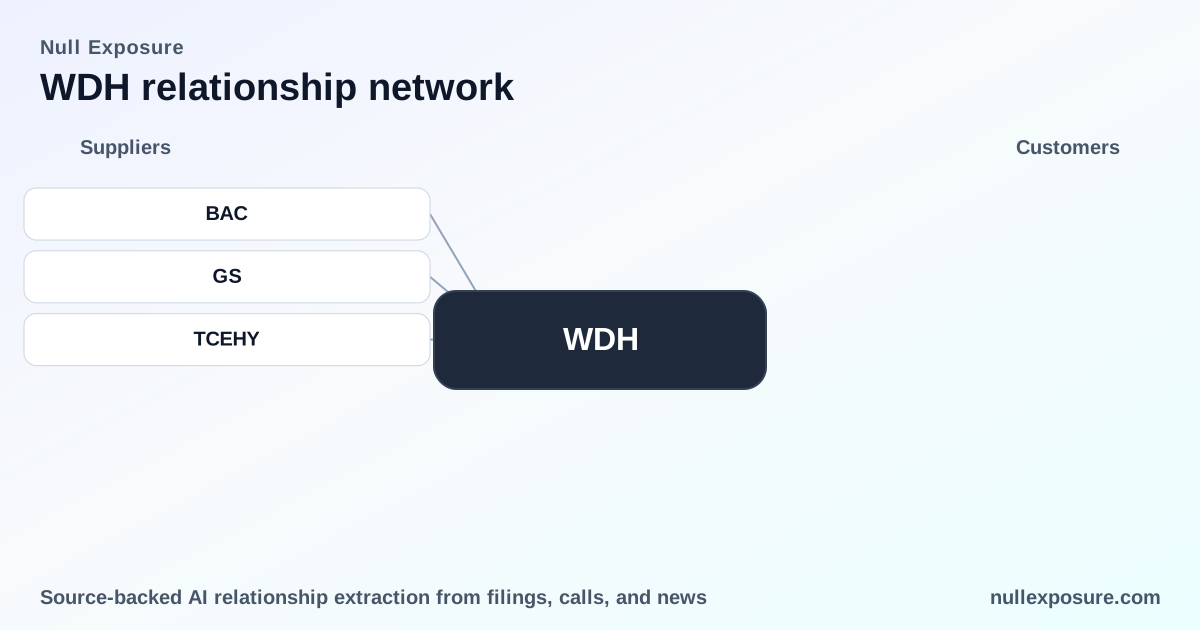
Waterdrop Inc (WDH) — supplier relationship profile and investor implications
Waterdrop operates an online insurance-brokerage platform in China that connects users to insurance products underwritten by third‑party insurers and monetizes through premiums-related fees, commissions and platform services. The company reports scale — roughly $3.25 billion revenue TTM with a ~15.6% profit margin — which supports a supplier posture that mixes strategic distribution partners and one‑off transactional vendors. For investors and operators evaluating Waterdrop as a supplier or customer, the critical axes are distribution concentration, capital-market readiness, and partner criticality to user acquisition. Learn more on the firm and related supplier signals at https://nullexposure.com/.
How Waterdrop’s commercial engine functions and what that means for suppliers
Waterdrop is a platform intermediary in the insurance value chain: it brings customer flows and digital distribution to underwriters and takes commissions or fees on placement and value‑added services. The company’s financials show substantial gross profit ($1.66B) and positive operating margins, which indicate the business generates cash from its brokerage and product distribution model rather than being a pure-growth subsidy.
From a supplier-management perspective this operating model implies:
- Contracting posture is likely commercial and performance‑driven — suppliers that enable distribution, payments, or regulatory compliance will be evaluated on cost per acquisition and uptime rather than long, bespoke engineering engagements.
- Concentration risk clusters around distribution partners because user acquisition is the marginal driver of revenue; losing a distribution channel would have outsized top‑line impact.
- Maturity is mix of startup agility and institutional governance — Waterdrop’s engagement with global financial advisers at IPO indicates corporate readiness to work with large, regulated counterparties.
If you want a deeper look at Waterdrop supplier exposures and relationship signals, start here: https://nullexposure.com/.
Strategic supplier relationships disclosed in public coverage
Bank of America — capital markets adviser for IPO
Waterdrop engaged Bank of America as one of the banks hired to manage its U.S. IPO process, signaling that the company sought major global investment‑bank distribution and underwriting expertise during its public listing phase. This was reported in fintech.global’s coverage of Waterdrop’s IPO planning in 2021. (Fintech.global, Feb 19, 2021)
Takeaway: Engagement with a global bank for listing work demonstrates corporate governance and investor‑market access but does not indicate an ongoing vendor dependency beyond the transaction.
Goldman Sachs — co-adviser on the float
Waterdrop also retained Goldman Sachs for the same IPO engagement, reinforcing the firm’s decision to use top‑tier capital markets advisers to manage regulatory, syndication, and investor outreach work around the float. The fintech.global article noted both banks were hired in connection with IPO preparations. (Fintech.global, Feb 19, 2021)
Takeaway: Dual engagements with leading banks suggest a well‑executed capital markets strategy and increase institutional confidence; for supplier managers this points to episodic, transaction‑level supplier relationships rather than recurring operational dependence.
Tencent — strategic investor and distribution channel via WeChat
Tencent is a returning strategic investor in Waterdrop and is explicitly used for distribution: WeChat functionality (QR codes and integrations) has been a primary user acquisition channel, and Tencent participated in a $230M funding round that underscored a formal commercial tie between the platforms. TechCrunch covered the fundraising and distribution linkage in August 2020. (TechCrunch, Aug 20, 2020)
Takeaway: Tencent is a high‑criticality supplier/partner because WeChat directly powers user acquisition and transaction flows; this is a structural channel dependency rather than a one‑time transaction.
Constraints and company‑level operating signals
The supplier feed returned no explicit constraint excerpts for Waterdrop in the current supplier report. As a company‑level signal set, buyers and investors should treat the following operating attributes as material:
- Contracting posture — transactional with strategic anchors. The business uses short‑term commercial contracts for many suppliers but maintains strategic, high‑impact partnerships (Tencent) for distribution.
- Concentration — distribution concentrated. Public coverage highlights Tencent/WeChat as a primary acquisition engine; concentration around a single major gateway increases supply‑side vulnerability.
- Criticality — distribution partners are critical, capital‑markets advisers are episodic. Investment banks supported IPO readiness but do not represent recurring operational dependencies; the distribution partner does.
- Maturity — corporate governance and capital access are advanced. Ties to top global banks and sizeable public revenues and profits indicate an ability to manage institutional suppliers and compliance regimes.
Investment considerations and operational risk checklist
Waterdrop’s public metrics (market cap ~$638M, P/E ~8.65, EV/Revenue ~0.91, healthy margins) show a profitable, cash‑generating platform with modest valuation multiples relative to growth. For investors and supplier managers, prioritize these risks and opportunities:
- Distribution concentration risk (high). Tencent/WeChat is a clear single point of failure for user acquisition; a disruption would pressure new business and CAC economics.
- Regulatory and sovereign risk (elevated). Operating in China’s insurance and fintech space exposes commercial partners to policy changes that affect product availability and gross margins.
- Vendor categorization. Treat capital‑markets advisers as transactional vendors and Tencent as a strategic supplier with SLAs, revenue‑share clarity and exit contingencies.
- Commercial leverage. Waterdrop’s gross profit and operating margin imply a capacity to invest in supplier diversification or to secure favorable commercial terms without sacrificing growth.
Key considerations at a glance:
- Revenue TTM: $3.25B; profit margin ~15.6%.
- Distribution reliance: Tencent/WeChat is a priority supplier for customer flow.
- Capital markets: Bank of America and Goldman Sachs were engaged for the IPO process.
If your team evaluates supplier risk or partnership strategy, review Waterdrop’s partner exposure in more detail at https://nullexposure.com/.
Bottom line and recommended next steps
Waterdrop is a commercially mature Chinese insurtech platform that monetizes through brokerage and distribution economics, backed by profitable operations and strategic distribution ties. For supplier risk management and investment decisions, treat Tencent as a strategic dependency to be monitored and stress‑tested, while viewing investment banks as episodic capital‑markets suppliers. Operational teams should model scenarios for a sudden change in WeChat integration terms and pursue diversification where commercially feasible.
For a consolidated view of supplier relationships and tailored scrutiny for your portfolio or procurement team, revisit the full profile at https://nullexposure.com/ and consider commissioning a targeted partner exposure review.