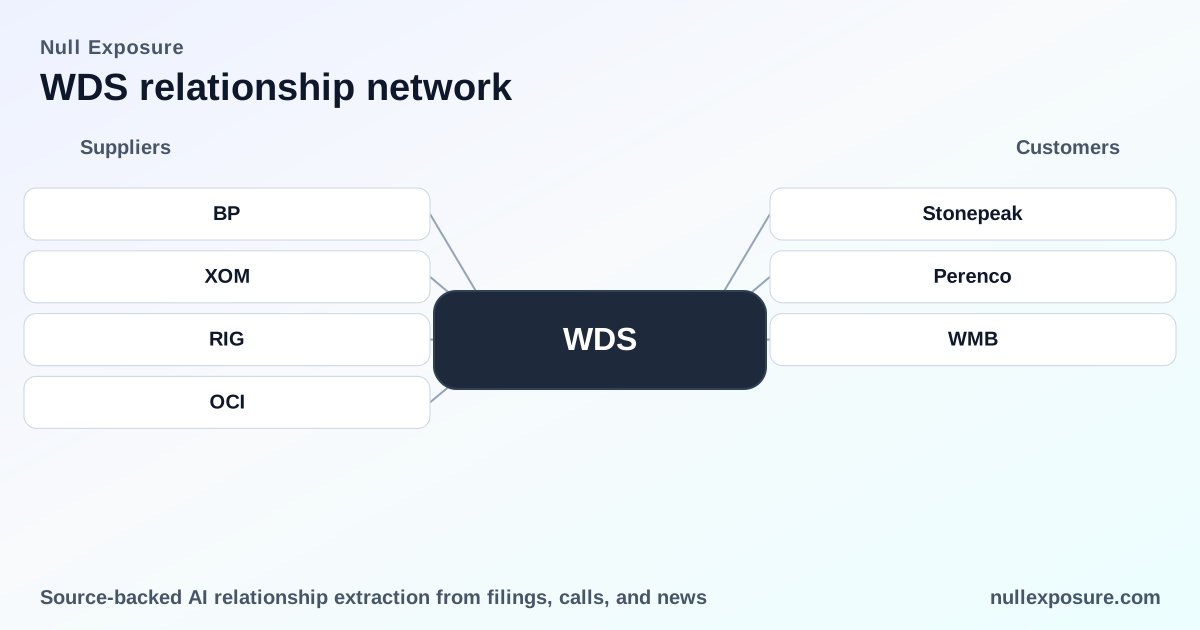
Woodside Energy Group (WDS): Supplier relationships that shape project delivery and decarbonization optionality
Woodside is a global hydrocarbon producer that monetizes through upstream exploration, project development, and the marketing of oil, gas and lower‑carbon products; revenue derives from physical commodity sales and long‑dated project contracts tied to major export hubs. With roughly $42.2 billion market capitalization and trailing revenue around $13.0 billion, Woodside finances large, capital‑intensive developments by locking in long‑term supplies, contractor handovers and strategic partnerships that push risk off the balance sheet and into the supply chain. For investors evaluating supplier exposure, the current relationships signal a mix of long‑term offtake stability, turnkey project execution and strategic decarbonization partnerships.
Explore supplier relationships and counterparty risk at https://nullexposure.com/ for deeper portraits of counterparties and contract terms.
Why these supplier links matter for returns and execution
Woodside’s supplier footprint is not a scattering of spot vendors — it is a structured set of commercial and operational commitments that determine project timelines, cash flows and transition optionality. Long‑dated gas offtake, construction handovers and reliance on specialist drilling and logistics partners each change where execution risk sits and how predictable future cash flows will be. Key operating model signals for investors:
- Contracting posture: Woodside secures multi‑year supply and offtake arrangements to underpin project economics and fuel export hubs, reducing merchant exposure for material volumes.
- Concentration and criticality: The company uses a small number of strategic partners for core functions — feed gas, drilling and EPC handover — which concentrates counterparty risk but simplifies governance and schedule alignment.
- Maturity and timing: Several supplier commitments are tied to discrete milestones between 2026 and 2029, creating identifiable catalyst dates for project de‑risking and potential forward cash flow recognition.
- Outsourced execution: Project handovers to engineering and construction firms and the use of third‑party drilling contractors reduce Woodside’s capital intensity and operational staffing burden during ramp phases.
For a consolidated view of counterparties and their commercial roles, visit https://nullexposure.com/.
Supplier map: BP, ExxonMobil, Transocean and OCI — what each relationship means
BP — Woodside has a long‑term gas supply agreement with BP to provide up to 640 billion cubic feet of natural gas to the project starting in 2029, providing secured feedstock volumes for export and domestic processing. This offtake commitment anchors a material portion of project gas and supports forecastable mid‑cycle cash flows (Woodside 2025 Q4 earnings call, disclosed March 2026).
ExxonMobil — Woodside is coordinating with ExxonMobil on lower‑carbon ammonia production enabled by carbon‑abated hydrogen and ExxonMobil’s CCS facility expected to be operational; production of lower‑carbon ammonia is targeted for the second half of 2026, linking Woodside’s project economics to third‑party CCS execution and hydrogen supply (Woodside 2025 Q4 earnings call, March 2026).
Transocean — Drilling for the Trion campaign will be executed by Transocean’s Deepwater Thalassa, with support from supply vessels and regional logistics operating from Tamaulipas ports, demonstrating reliance on a large third‑party drilling contractor and regional maritime logistics for offshore execution (Euro‑Petrole news report, March 2026).
OCI — Woodside expects full handover of the project by OCI in the first half of 2026, indicating a near‑term engineering, procurement and construction transition that shifts operational responsibility from the contractor to Woodside for the next phase of commissioning and production (Woodside 2025 Q4 earnings call, March 2026).
What these relationships imply for investors — tactical takeaways
- Offtake de‑risking through BP strengthens revenue visibility for later‑stage projects by locking in gas volumes starting 2029; that contracted supply reduces merchant exposure on a material tranche of feed gas.
- ExxonMobil partnership elevates Woodside’s lower‑carbon optionality, but execution is now linked to the timeliness and performance of third‑party CCS and hydrogen systems — the lower‑carbon product line’s timeline becomes a function of partner delivery.
- Reliance on Transocean and regional logistics underscores execution dependency on specialist offshore contractors; any downtime, fleet availability constraints or local port disruptions can materially affect drilling schedules.
- OCI handover in H1 2026 is a discrete operational catalyst; successful transfer reduces construction risk but increases near‑term operational and commissioning responsibilities for Woodside.
Key risk: concentrated reliance on a handful of strategic suppliers increases counterparty concentration risk even as it centralizes accountability and schedule coordination.
Risks that flow from supplier structure
Woodside’s supplier relationships trade direct operating control for contractual certainty. This structure reduces capital and operational burden but increases exposure to third‑party delivery timing and contractor performance. Specific investor‑relevant risks:
- Schedule slippage at partners (drilling, CCS, EPC handover) directly delays revenue recognition and can compress margins through contract remedies or cost overruns.
- Counterparty default or force majeure events on a long‑dated supply agreement would immediately affect feedstock availability for export projects.
- Geopolitical and regional logistics disruptions in operating jurisdictions (for example, Gulf of Mexico ports supporting drilling and supplies) create localized operational risk that propagates to global revenue streams.
Monitor the announced milestone dates — OCI handover H1 2026, ExxonMobil‑enabled ammonia H2 2026 and BP feed gas starting 2029 — as these are the principal near‑term de‑risking checkpoints for project economics.
For counterparty breakdowns, exposure scoring and supplier contract timelines, consult comprehensive supplier profiles at https://nullexposure.com/.
Bottom line — what investors should watch next
Woodside is structuring its capital projects around a small set of deep, strategic supplier relationships that convert project execution risk into contractual counterparties. The balance between offtake certainty (BP), decarbonization leverage (ExxonMobil), drilling execution (Transocean) and EPC handover (OCI) frames the company’s near‑term catalysts and medium‑term cash flow profile. Investors should track partner milestone delivery and counterparty performance against the 2026–2029 timeline as the central determinant of whether those contractual relationships become value multipliers or points of concentrated risk.
For detailed term sheets, counterparty histories and event‑driven monitoring, visit https://nullexposure.com/ for supplier‑level intelligence and ongoing updates.