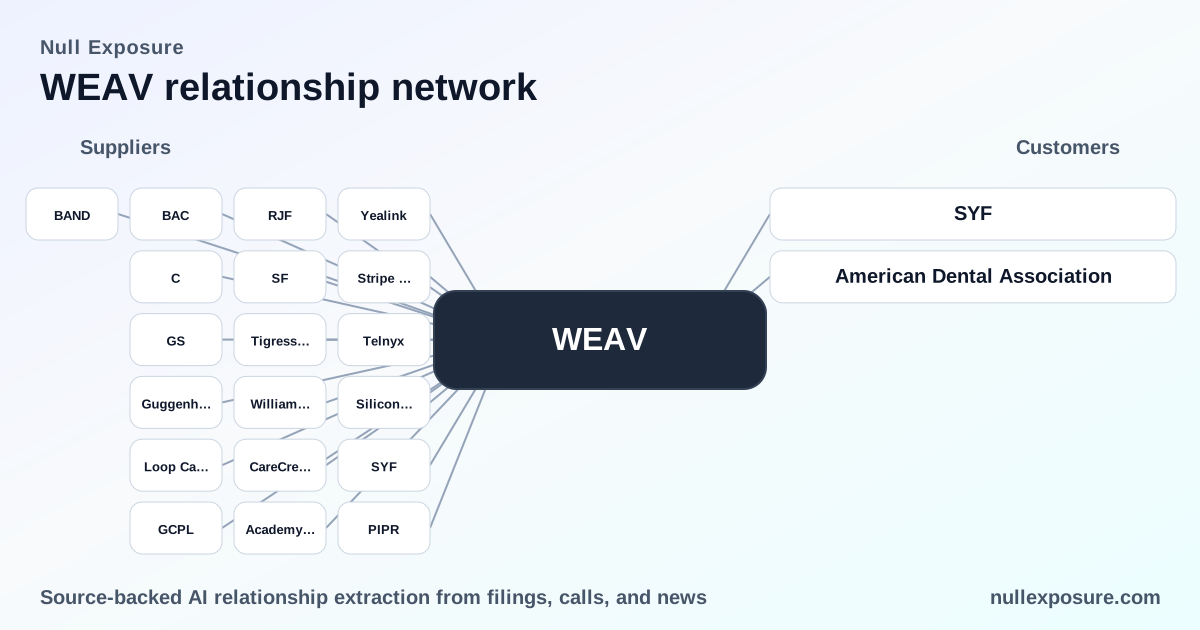
Weave Communications: Supplier relationships that shape platform economics and operational risk
Weave is a vertically integrated customer-communication platform that sells SaaS subscriptions to healthcare and service businesses and captures additional revenue through payments, hardware, and financing integrations. The company monetizes via recurring software fees, hardware sales (phones and POS devices), transaction fees from Weave Payments, and referral or integration economics with patient-financing partners. Operational scalability therefore depends on a small set of critical third parties that provide cloud hosting, payment rails, messaging and hardware. For investors, the supplier map is a direct input into revenue durability and margin sensitivity. Learn more about supplier concentration and risk tools at https://nullexposure.com/.
How to read Weave’s supplier posture: concentration, criticality and contracting
Weave’s operating model mixes subscription SaaS economics with embedded payments and hardware distribution, producing a hybrid contracting posture. Several features matter for underwriting:
- Concentration: Weave outsources a substantial share of infrastructure and payments to a handful of providers, which concentrates single-point failure risk and bargaining leverage. According to the company’s FY2024 10‑K, Weave “outsources a substantial majority of our cloud infrastructure to GCP,” and the firm “currently rely[s] primarily on Stripe to enable our Weave Payments solution.”
- Criticality: Suppliers providing cloud compute, payment processing, messaging and phones are functionally critical — outages or pricing shifts translate directly into service interruptions or margin pressure.
- Contracting posture and covenants: Financial relationships include secured lending with covenants; Weave’s loan and security agreement with Silicon Valley Bank (SVB) imposes restrictive operating and financial covenants that constrain strategic flexibility, per the FY2024 10‑K.
- Maturity and market signals: Partnerships with established banks and underwriters for the IPO, and integrations with mainstream payment and financing providers, indicate standard institutional relationships that lower counterparty execution risk versus early-stage vendors.
These company-level signals frame supplier risk without attributing every constraint to a single counterparty; where the filings name a partner directly (GCP, Stripe) those are noted above as explicit dependencies.
If you want a consolidated view of supplier exposure and covenant risk for your model, explore our resources at https://nullexposure.com/.
The supplier and partner map — relationship-by-relationship review
Below are every named relationship in Weave’s open-source records, summarized in plain English with source context.
Yealink
Weave relies on Yealink as a single-source supplier for desk phones and point‑of‑sale terminals that run on the platform, making Yealink a direct hardware dependency for customer install base functionality. This is documented in Weave’s FY2024 Form 10‑K.
Stripe Inc.
Stripe is the primary payments processor and point‑of‑sale device provider that enables Weave Payments; the company identifies Stripe as the core payment technology partner in its FY2024 10‑K. This partnership is central to payments revenue and transaction processing.
Telnyx
Telnyx supplies part of the SMS/messaging infrastructure that powers Weave’s text‑message features; Telnyx is named alongside Bandwidth in the FY2024 10‑K as a messaging provider that enables two‑way customer communications.
Bandwidth
Bandwidth is a co‑provider of text‑messaging services for Weave’s platform, cited in the FY2024 10‑K; messaging functionality is therefore split across multiple vendors to balance redundancy and cost.
Silicon Valley Bank (SVB)
Weave’s loan and security agreement with SVB contains restrictive covenants that impose operating and financial limits on the company, potentially constraining capital deployment and strategic flexibility, per the FY2024 10‑K.
GCP (Google Cloud Platform)
Weave “substantially rely[s] upon GCP to operate our platform” — GCP hosts the software and data processing backbone, making cloud availability and pricing a direct input to uptime and cost of goods sold, as stated in the FY2024 10‑K.
Synchrony (CareCredit)
Weave announced a strategic partnership with Synchrony to integrate CareCredit patient financing into the Weave platform, positioning CareCredit as a financing option embedded at point of care; news reports and company statements in early‑2026 cover this arrangement (news coverage, March 2026).
CareCredit
CareCredit — Synchrony’s patient‑financing product — is being integrated into Weave’s product set to provide consumer financing for healthcare customers, a partnership highlighted in Weave’s Q4‑2025 earnings commentary and March 2026 press reporting.
Investment banks and IPO co‑managers (Piper Sandler; Raymond James; Stifel; William Blair; Guggenheim Securities; Academy Securities; Loop Capital Markets; Tigress Financial Partners)
These firms acted as co‑managers or book‑running managers on Weave’s 2021 IPO, establishing the company’s public capital markets relationships and distribution history; this syndicate is listed in contemporaneous IPO coverage from November 2021.
Lead book‑running managers (Goldman Sachs & Co. LLC; BofA Securities; Citigroup)
Goldman Sachs, BofA Securities and Citigroup served as lead book‑running managers for Weave’s IPO, indicating institutional underwriting support at the time of the public offering (IPO coverage, FY2021).
Mid‑report assessment: what this supplier map means for investors
Two structural facts drive the investment case and downside:
- Operational exposure is concentrated and easily measurable. GCP and Stripe provide core infrastructure and transaction rails; any material service degradation or price reset at either vendor would compress margins and interrupt revenue capture, as confirmed in Weave’s FY2024 10‑K.
- Financial constraints are present. The secured loan with SVB imposes covenants that limit optionality; covenant enforcement or refinancing risk would be a meaningful capital‑structure event.
Key takeaway: Weave’s platform economics are strengthened by integrated payments and financing offerings, but those same integrations create vendor concentration risk that directly maps to revenue continuity and gross margin.
If you need a deeper counterparty exposure report for portfolio stress tests, see how we aggregate contract and covenant signals at https://nullexposure.com/.
Investment implications and headline risks
- Revenue durability depends on execution across software, hardware sales and payments processing; hardware single‑sourcing (Yealink) and cloud outsourcing (GCP) create identifiable single points of failure.
- Payments and financing partners (Stripe, Synchrony/CareCredit) are revenue multipliers but also represent operational counterparty risk if pricing, contract terms, or routing change.
- Loan covenants with SVB impose financial constraints that could limit strategic M&A or investment in product if liquidity conditions tighten.
For investors and operators evaluating supplier relationships, the decision framework is simple: quantify the probability and impact of an interruption for each critical partner, and stress test margins under alternative pricing or covenant outcomes.
Final recommendation
For active investors, maintain exposure to Weave only with a clear plan for vendor disruption scenarios and covenant stress. For strategic operators, prioritize contractual redundancy for messaging and payments and negotiate stronger SLA and migration rights with GCP and Stripe.
Explore supplier‑risk tools and covenant monitoring that align with this analysis at https://nullexposure.com/.