WEC Energy Group: supplier posture, market dependencies, and what investors should track
WEC Energy Group operates as a vertically integrated regulated utility, delivering electricity and natural gas to roughly 4.4 million customers across four states. The company monetizes through rate-regulated returns on invested utility assets, retail commodity sales, and a mix of bilateral power purchase agreements and market purchases that balance supply and demand for its generation fleet. For investors and operators assessing supplier relationships, the key dynamic is a deliberate mix of long-term contracting to stabilize cost and reliability combined with meaningful spot-market exposure through regional markets like MISO.
Explore more supplier intelligence at https://nullexposure.com/.
How WEC structures procurement and what that implies for counterparties
WEC’s procurement posture is contract-first but flexible: its filings and disclosures document extensive long-term arrangements to secure coal, pipeline capacity, storage and PPAs, yet the company routinely supplements that base with spot purchases when market conditions or operational needs require. This hybrid model preserves regulatory stability and creditable cost-recovery through long-term commitments, while using spot markets to optimize dispatch and manage short-term imbalances.
- Long-term contracts dominate: Multiple excerpts from WEC’s regulatory disclosures describe coal purchases, pipeline capacity and storage arrangements under long-term contracts—this is the centered strategy for price stability and regulatory defensibility.
- Spot and short-term liquidity are material: WEC uses spot natural gas markets and the MISO energy market for incremental supply; filings quantify this activity as a material component of total supply.
- Geographic and fuel diversification: Coal sourcing spans Wyoming and Pennsylvania and natural gas access is backed by interstate pipeline capacity and storage services, which reduces single-source concentration risk.
- Procurement scale is large: Constraint signals indicate spend in a band above $100 million, with an excerpt that lists “Total $9,574.0” in procurement context—highlighting that supplier contracts are economically meaningful to counterparties.
These characteristics make WEC an attractive, stable customer for large infrastructure and commodity suppliers while requiring counterparties to meet regulatory and reliability expectations.
Counterparty rundown: the relationships that matter (complete)
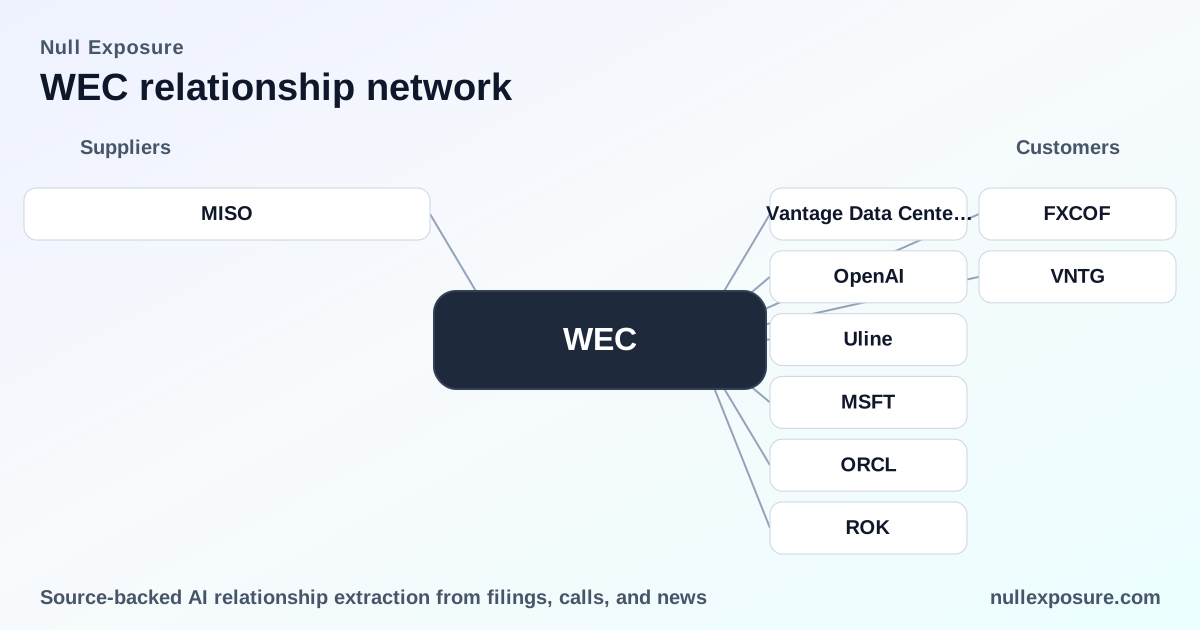
MISO — WEC is an active participant in the Midcontinent Independent System Operator regional market and supplements internally generated supply with market purchases in MISO; company disclosures flag that 31.0% of incremental supply was sourced from power purchase contracts and MISO market purchases in FY2026. According to a TradingView summary of WEC’s FY2026 disclosures, WEC, WPS, and UMERC are non‑transmission owning members and customers of MISO, which positions the regional market as a primary operational counterparty for short-term energy and imbalance settlement. (Source: TradingView summarizing WEC’s FY2026 SEC filing — 2026-03-10.)
What the constraints tell investors about WEC’s operating model
WEC’s supply relationships are defined by several structural constraints that translate directly into business-model behaviors:
- Contracting posture (mature, long-term anchored): Repeated excerpts show WEC relies on long-term coal contracts, pipeline capacity agreements and long-term PPAs (including the Point Beach PPA). That contracting profile supports stable cost recovery under regulated rates and reduces commodity cost volatility for rate cases.
- Operational flexibility through spot markets: The company explicitly purchases natural gas on the spot market and uses MISO energy market purchases to fill gaps, so market exposure is a controlled part of the procurement mix rather than a full replacement for contracts.
- Service-provider criticality: WEC uses specialized service providers for storage and transmission services—constraints name Bluewater as a natural gas storage provider and reference ATC as the transmission coordinator expected to support service to WE, WPS and UMERC—both relationships are operationally important for fuel availability and market access.
- Scale and concentration signal: A spend-band flag above $100m indicates procurement is large enough that supplier creditworthiness, performance, and contract terms materially affect WEC’s cost profile.
- Regulatory and system interdependence: Because WEC is a non-transmission-owning member of regional structures and relies on interstate pipelines and storage, counterparties and market operators play a direct role in system reliability and the company’s risk management.
These constraints show a utility that balances regulatory stability (long-term contracts, asset-backed returns) with necessary exposure to wholesale markets to optimize day‑to‑day operations.
Explore supplier risk dashboards and counterparty scoring at https://nullexposure.com/.
Operational and investor implications — what to watch next
WEC’s supplier architecture creates a clear set of monitoring priorities for investors and counterparties:
- Contract expirations and renewal terms: Track rolling expirations of long-term PPAs, coal contracts and storage agreements; renewal pricing and counterparty credit will drive future supply costs.
- Mix of long-term vs. spot procurement: A rising share of spot purchases increases earnings sensitivity to market volatility; a reversion to long-term contracting reduces price risk but can lock in higher fixed costs.
- Regional market exposure via MISO: Because MISO supplies a meaningful portion of incremental needs, transmission constraints, market price spikes, and capacity allocations in MISO directly affect margins and reliability.
- Storage and pipeline entitlements: Terms and availability of Bluewater storage capacity and interstate pipeline firm capacity are operationally critical, particularly during winter or periods of tight natural gas supply.
- Procurement scale and supplier credit: Given the large spend profile, counterparties should be evaluated for financial strength and delivery performance; conversely, suppliers should monitor WEC’s regulatory trajectory and allowed returns.
Bold takeaway: WEC’s procurement framework reduces single-vendor risk through diversification but concentrates systemic exposure in regional market functioning (MISO) and in infrastructure providers such as storage and pipeline operators.
Risk checklist for investors and counterparties
- Confirm PPA and coal contract maturity schedule and any take-or-pay obligations.
- Monitor MISO price and capacity trends and any shifts in WEC’s market purchase share.
- Review storage and pipeline service agreements for firm capacity coverage and force majeure language.
- Evaluate supplier credit exposure given the large procurement spend band.
Conclusion and next steps
WEC manages procurement with a conservative core of long-term agreements supported by active use of market purchases in MISO; that structure gives the company regulatory defensibility and operational flexibility. Investors should focus on contract roll-off dates, the evolving long-term/spot mix, and the health of regional market and infrastructure providers that underpin WEC’s supply chain.
For further supplier-focused intelligence and tailored counterparty analysis, visit https://nullexposure.com/ — our platform aggregates relationship signals and contract posture to help investors and operators quantify counterparty risk.
Explore WEC supplier insights and start a deeper supplier review at https://nullexposure.com/.