Wen Acquisition Corp (WENN): Sponsor-driven SPAC economics and counterparties that matter
Wen Acquisition Corp is a special purpose acquisition company that monetizes by selling public units and using the resulting trust capital and sponsor equity to complete a business combination; value is realized when a target is acquired and public-market investors reprice the combined entity. Wen currently shows no operating revenue or profit metrics and carries the profile of a transaction vehicle whose investment thesis is execution of a qualifying merger rather than organic cash flow generation. For more supplier and counterparty intelligence, see https://nullexposure.com/.
How this SPAC actually operates in plain terms
Wen raises capital through a public offering of units (shares plus warrants) and holds that capital in trust until it identifies and completes a business combination. The company’s team of executives and investment professionals sources targets, negotiates terms, and relies on a small set of external service providers—underwriters, exchanges and legal/financial advisors—to convert a private target into a listed public company. The entity’s economics are driven by sponsor promote, potential post-merger equity upside, and any advisory or deal fees tied to closing a transaction. At present Wen reports zero revenue, zero EBITDA and standard SPAC balance-sheet characteristics where the primary asset is IPO proceeds awaiting deployment.
For further detail and supplier analytics, visit https://nullexposure.com/.
What the public record lists as supplier relationships
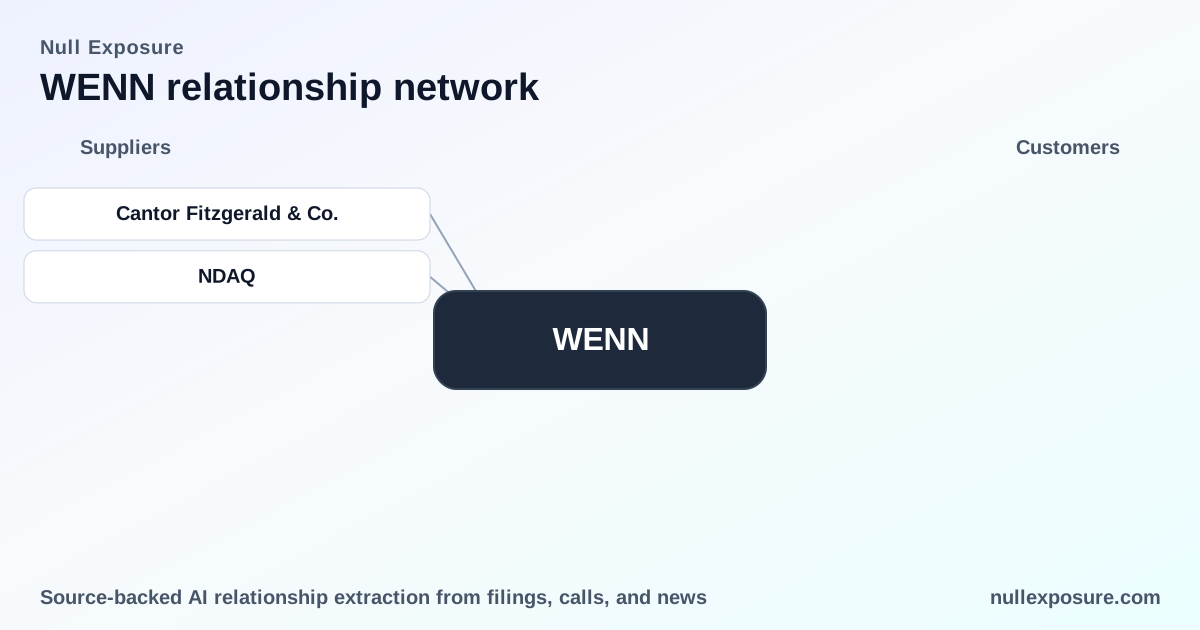
The supplier-scope results for WENN identify two public counterparties tied to its offering and listing process. Each relationship is operationally straightforward and tied to the SPAC lifecycle—underwriting and exchange listing.
Cantor Fitzgerald & Co.
Cantor Fitzgerald is disclosed as the sole book-running manager for Wen’s offering, indicating Cantor handled syndication and primary distribution for the unit sale. According to a press release reported by Yahoo Finance on March 10, 2026, Cantor Fitzgerald & Co. acted as sole book-running manager for the offering and therefore held primary placement responsibility for the IPO units.
The Nasdaq Global Stock Market LLC
The Nasdaq Global Stock Market is the intended trading venue for Wen’s securities; the company’s units will split and the Class A shares and warrants are expected to trade on Nasdaq under WENN and WENNW once separation occurs. The Nasdaq listing expectation is included in the same Yahoo Finance announcement published March 10, 2026.
Operating-model signals and constraint analysis
The supplier-scope data contains no explicit contractual constraints or vendor-specific limits. That absence itself is an informative company-level signal: no supplier-side restrictions were disclosed through the supplier search for WENN.
From a business-model perspective, the following characteristics define the company’s supplier posture and risk profile:
- Contracting posture — Transactional and event-driven. SPACs contract primarily for short, high-intensity services (underwriting, escrow/trust arrangements, exchange listing and deal advisory); relationships intensify around the offering and the business combination period.
- Counterparty concentration — Narrow but critical. Execution depends on a handful of providers (lead underwriter, listing exchange, legal and accounting firms). Concentration elevates single-provider risk even though counterparties are standard market participants.
- Operational criticality — High for specific milestones. Underwriting execution and exchange listing are gating items; delays or failures in those services directly impede the SPAC’s ability to consummate a merger and realize sponsor economics.
- Maturity and time sensitivity — Finite lifecycle. SPACs operate under limited timelines to complete an acquisition or return capital; supplier relationships are therefore intensely time-boxed and focused on transaction completion rather than long-term service engagements.
These model characteristics imply that providers of distribution and listing services are not optional—they are core to the SPAC value chain. For continued intelligence on supplier exposures, go to https://nullexposure.com/.
Financial and risk implications for investors
Wen’s public profile shows a market capitalization figure (approximately $381.9 million) but no operating income, revenue, or earnings data; this is consistent with a pre-combination SPAC whose intrinsic value is primarily its trust proceeds and sponsor’s ability to identify and close a deal. Portfolio managers should treat WENN as a deal-execution instrument: upside is binary and highly correlated with the outcome and terms of the forthcoming business combination.
Key risk vectors:
- Deal execution risk. The company’s economic outcome is entirely dependent on sourcing, negotiating and closing a qualifying target within the SPAC timeline.
- Concentration risk in counterparties. With Cantor Fitzgerald named as sole book-running manager and Nasdaq as the listing venue, single-provider disruption or poor execution could delay or impair the IPO and subsequent merger process.
- Market repricing risk. Even with a completed combination, market reception of the target’s fundamentals will determine value—SPAC sponsors do not deliver operating revenues during the pre-combination window.
What investors and operators should do next
- Monitor filings and press releases around the business-combination timeline to assess counterparty continuity and any changes to underwriting or listing arrangements.
- Confirm trust account levels and redemption terms at the time of merger announcement; those mechanics materially affect post-combination capitalization.
- Track operational counterparties (lead underwriter, listing exchange) for signs of substitution or dispute that could impede closing.
For a deeper supplier-risk profile and ongoing monitoring of Wen’s counterparties, visit https://nullexposure.com/.
Bottom line
Wen Acquisition Corp is a classic SPAC construct: capital raised from public units, no current operating revenue, and value contingent on successful deal-making. The public record identifies Cantor Fitzgerald & Co. as the offering’s book-running manager and Nasdaq as the listing venue—both are functional, high-leverage counterparties for the transaction. Investors should evaluate WENN on execution metrics and counterparty stability rather than on operating financials. For continuous surveillance of supplier relationships and to integrate this data into diligence workflows, see https://nullexposure.com/.