Werner Enterprises (WERN): Supplier Relationships and Operational Signals for Investors
Werner Enterprises operates as a freight transportation and logistics provider that monetizes through asset-backed truckload services, third-party logistics, and financing arrangements with independent contractors. The company combines company-owned tractors with independent contractors and logistics services to generate revenue across North America, deriving non-trucking revenue from multiple operating units while retaining exposure to equipment procurement and capital markets activity. For investors, the forward-looking lens is: asset intensity and supplier exposure (engines, manufacturers, and capital markets partners) drive capital needs and operational continuity.
Explore more supplier intelligence at https://nullexposure.com/.
Quick company snapshot for decision-makers
Werner listed on NASDAQ (WERN) has trailing revenue of ~$2.97B (TTM) and EBITDA of $319m, with a market capitalization around $1.63B. Profitability is thin: TTM profit margin is negative at -0.48%, and operating margin is -1.28%, while EV/EBITDA is ~7.7, suggesting valuation already reflects operational pressure. The capital structure and liquidity profile are influenced by regular fleet refresh programs, equipment financing activity, and occasional equity actions. Werner’s business model mixes direct asset ownership with outsourced capacity, which creates a distinctive contracting posture that blends fixed-cost leverage with variable third-party supply.
What the supplier relationships reveal
Below are every supplier or partner mention surfaced in the reviewed coverage, with a concise plain-English summary and source reference.
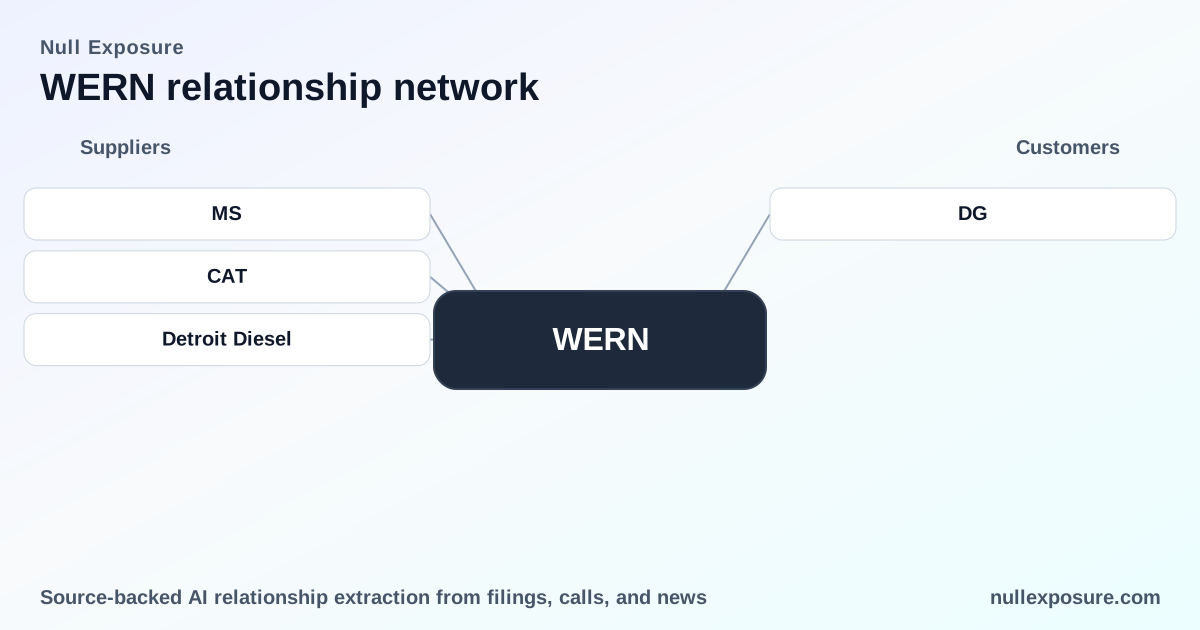
Morgan Stanley — equity underwriting role and option for additional shares
Werner’s founder trust granted Morgan Stanley a 30-day option to purchase up to 1.2 million additional shares as part of a proposed common-stock offering tied to corporate governance changes, indicating active capital-markets engagement and potential dilution risk for shareholders. According to TruckingInfo (article on the founder stepping down and proposed offering, March 2026), the underwriter relationship includes a standard over-allotment option: https://www.truckinginfo.com/news/werner-enterprises-founder-steps-down-common-stock-offering-proposed.
Takeaway: Equity underwriting relationships are active and can affect share float and capital availability.
Caterpillar — engine supplier referenced in vehicle deliveries
A company report cited delivery of approximately 325 new trucks with Caterpillar ACERT engines, signaling past procurement activity with Caterpillar for powertrain packages that support Werner’s fleet refresh cadence. This equipment detail was noted in TruckingInfo’s earnings coverage (article collected in FY2026) describing truck deliveries: https://www.truckinginfo.com/news/werner-reports-8th-quarter-of-higher-earnings.
Takeaway: OEM engine suppliers are operationally important to fleet reliability and replacement cycles.
Detroit Diesel — alternate engine supplier for fleet additions
The same earnings coverage documented plans to take delivery of about 200 new trucks equipped with Detroit Diesel EGR engines, highlighting a multi-sourced engine procurement strategy across Werner’s fleet renewal program. The TruckingInfo earnings article (referenced in FY2026) captures the planned mix of engine suppliers: https://www.truckinginfo.com/news/werner-reports-8th-quarter-of-higher-earnings.
Takeaway: Use of multiple engine suppliers mitigates single-vendor risk but requires supply-chain coordination and parts/maintenance planning.
Operational constraints and what they mean for partners and investors
Werner’s operating model shows several company-level signals that shape supplier and investor risk profiles:
- Counterparty mix includes individuals: Werner provides financing to some individuals who buy tractors and lease their services back, which increases exposure to owner-operator credit performance and creates receivables tied to personal borrowers rather than only corporations. This increases underwriting and servicing demands for the company’s financing arm.
- North American revenue concentration: Werner Logistics generates the majority of non-trucking revenues through three operating units and operates throughout North America, so macroeconomic shifts or regulatory changes in the region flow directly to top-line and capacity utilization.
- Service-provider posture: The TTS (truckload transportation services) segment employs both company-owned and independent contractor trucks, while the Logistics segment uses third-party capacity providers. That dual structure creates operational flexibility but also counterparty operational risk when third-party capacity tightens.
These constraints imply a hybrid contracting posture: fixed-cost exposure from owned assets, balanced by variable cost through contractors and third-party logistics. For investors, that structure translates to cyclically sensitive margins, procurement-driven capital needs, and a dependence on reliable OEM and financing partners.
(If you want the full supplier relationship context and monitoring tools, visit https://nullexposure.com/.)
Investment implications and risk checklist
- Capital intensity and procurement cadence: Regular truck deliveries and engine sourcing (Caterpillar, Detroit Diesel) drive capital spending and maintenance cost profiles; OEM relationships are operationally critical.
- Funding and dilution vectors: Equity underwriting and possible share over-allotments (Morgan Stanley) are active levers management can use to raise capital, impacting dilution and liquidity.
- Counterparty credit: Financing to individual owner-operators increases credit-risk monitoring needs and could amplify losses under adverse cycle dynamics.
- Geographic concentration: North America-focused operations concentrate macro and regulatory exposures, but also leverage a mature logistics market with scale advantages.
Key metrics to watch: EBITDA trajectory vs. capex for fleet replacement, receivables tied to owner-operators, cadence of equipment deliveries, OEM supply continuity, and capital markets activity (underwriting or debt issuance).
Final verdict: where value and risk sit
Werner is a capital-intensive transport operator with clear revenue scale and a mixed ownership/contractor operating model that reduces short-term labor cost rigidity but requires active supplier and capital management to sustain margins. Supplier relationships with engine OEMs and capital-market partners are not peripheral—they are core to operational continuity and financing flexibility. For investors evaluating exposure to Werner, the company’s OEM contracts, owner-operator financing program, and recent underwriting activity provide actionable signals about capital needs and operational resilience.
For deeper supplier monitoring and to track these partner dynamics in real time, see https://nullexposure.com/.
If you want a tailored briefing on how Werner’s supplier and capital relationships translate into downside scenarios or upside leverage, reach out via the homepage at https://nullexposure.com/ for customized research and alerts.