Western Midstream Partners (WES): Supplier Relationships and Strategic Implications for Investors
Western Midstream Partners operates and monetizes a portfolio of gathering, processing and transportation assets by combining fee-based service contracts with select commodity purchases and sales. The partnership generates cash through gathering and processing fees complemented by commodity margin when it purchases volumes at the wellhead, and supports distributions with steady EBITDA (USD 2.27B trailing) and a high cash return profile (dividend yield ~8.9%). For investors and operators assessing supplier and counterparty relationships, the mix of capital-market counterparties, pipeline tie‑ins, and legacy service arrangements defines both financing optionality and operational throughput risk. Learn more about how we map these relationships at https://nullexposure.com/.
How WES actually contracts and what that implies for counterparty risk
WES’s operating model blends contracted fee businesses with active commodity purchases. Company disclosures describe WES as a buyer of natural-gas volumes “at the wellhead or from a production facility, typically at an index price,” and as charging producers fees for downstream gathering and processing services. This is a company-level signal that informs several practical constraints:
- Contracting posture: WES operates as a counterparty purchaser in upstream markets, not just a toll‑operator — this creates direct exposure to producer credit performance and to indexed commodity price flows.
- Criticality: Pipeline tie‑ins and processing capacity are operationally critical; incremental throughput from a single pipeline can lift utilization and fee revenue materially.
- Concentration and maturity: The mix of short-to-medium-term wellhead purchases and longer-term service contracts creates a combined maturity profile that requires active capital markets access and periodic refinancing.
- Commercial leverage: Because purchases are often at index prices with fee recovery downstream, WES earns margin through scale and operational control of physical assets rather than pure commodity speculation.
These features explain why WES manages both bank syndicates and strategic pipeline partnerships as core supplier/counterparty relationships.
Capital markets counterparties: the March 2026 notes syndicate
WES used an established dealer syndicate to price a debt offering in March 2026; this group provides refinancing flexibility and distribution of underwriting risk.
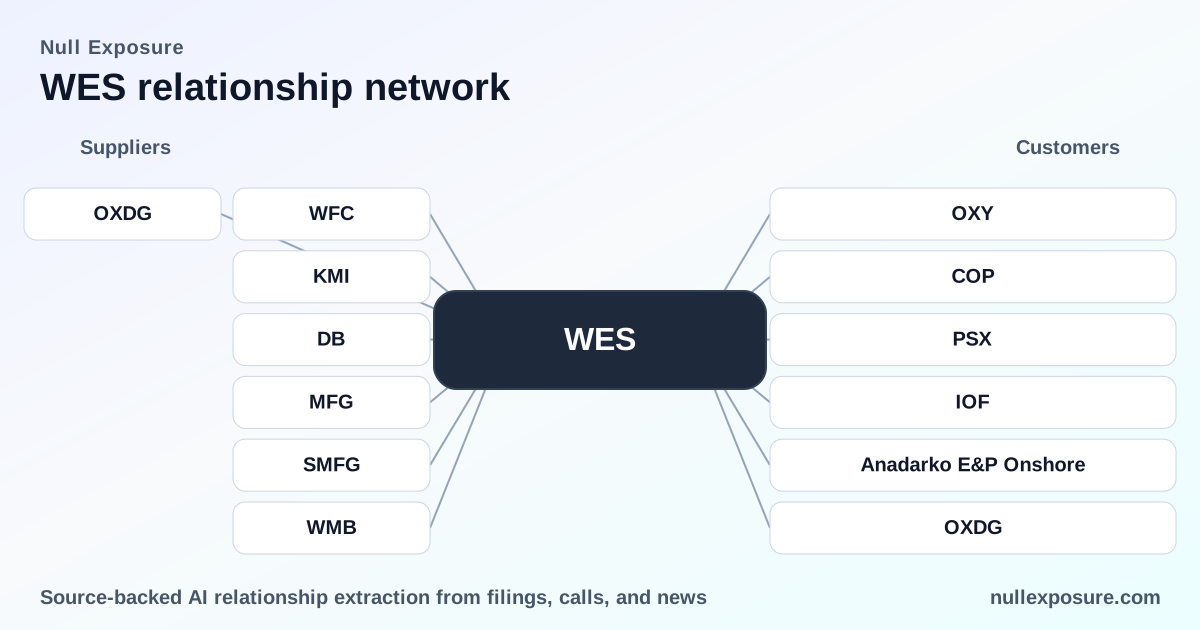
- Wells Fargo Securities, LLC: Acted as a joint book‑running manager on WES’s notes offering, providing distribution and underwriting services for the transaction. According to the March 10, 2026 PR Newswire release, Wells Fargo was listed among the joint book‑running managers for the offering.
- Deutsche Bank Securities Inc.: Named as a joint book‑running manager on the same notes offering, supporting WES’s access to institutional fixed‑income investors (PR Newswire, March 10, 2026).
- Mizuho Securities USA LLC: Participated as a joint book‑running manager for WES’s notes issuance, adding Asian and U.S. distribution channels to the syndicate (PR Newswire, March 10, 2026).
- SMBC Nikko Securities America, Inc.: Served as a joint book‑running manager on the transaction, broadening underwriting depth for the offering (PR Newswire, March 10, 2026).
Key takeaway: WES’s use of a multi‑bank syndicate demonstrates institutional access that mitigates near‑term refinancing risk and signals market confidence in its balance-sheet profile.
Operational counterparties and the throughput story
Pipeline and interconnect relationships drive volumetric growth and fee revenue; recent disclosures highlight tangible contributions to throughput.
- Kinder Morgan (KMI): WES disclosed the tie‑in of Kinder Morgan’s Altamont pipeline into WES’s Chipeta processing plant in early 2025, which drove increased natural gas throughput in the Uinta Basin (WES Q4 2025 earnings call). This is an operationally material interconnect that directly increases utilization and fee generation.
- Williams Companies (WMB): Management attributed part of the year‑over‑year growth to a full year’s contribution from the Williams Mountain West Pipeline expansion, indicating that Williams’s assets are a substantive source of incremental throughput for WES (WES Q4 2025 earnings call).
Key takeaway: Pipeline interconnects with major transport operators produce measurable volume gains; these relationships convert physical expansions into fee revenue and improved fixed‑charge coverage.
Legacy administrative services: Occidental relationship
WES’s historical service agreements illustrate an evolution from affiliate‑provided services to greater operational independence.
- Occidental: Western’s FY2024 Form 10‑K documents an amended and restated Services Agreement with Occidental under which WES reimbursed Occidental for administrative services performed on WES’s behalf through December 31, 2020, reflecting legacy shared‑services arrangements (WES FY2024 10‑K).
Key takeaway: Legacy arrangements with Occidental explain some historical cost and governance patterns but are recorded as past administrative reimbursement exposures rather than ongoing operational dependencies in the latest filings.
What investors should focus on now
WES’s supplier map reveals a hybrid profile: bank syndicates securing liquidity, pipeline partners securing volumes, and a buyer posture that creates direct commodity and counterparty exposure. From a risk/reward perspective:
- Financing resilience is strong — the March 2026 notes syndicate shows continued capital markets access via diversified underwriters (Wells Fargo, Deutsche Bank, Mizuho, SMBC Nikko).
- Operational upside is concrete — pipeline tie‑ins (Kinder Morgan, Williams) translated into identifiable throughput gains in recent quarters, supporting fee revenue.
- Commodity counterparty risk is non‑trivial — buying at index prices concentrates exposure to upstream producers’ credit and indexed price dynamics; underperformance from a handful of producers could compress realized margins. (This is a company‑level signal derived from WES’s description of its purchasing practices.)
For analysts and operators seeking granular counterparty intelligence, our platform maps these relationships alongside formal filings and transcripts. See detailed relationship mapping at https://nullexposure.com/ to inform underwriting and partner‑selection strategies.
Final assessment and next steps
Western Midstream’s commercial footprint balances stable fee cash flows and targeted commodity activity, supported by credible access to capital markets and strategic pipeline integrations. Investors should treat the company as a fee‑centered midstream operator with embedded buyer exposure that requires regular monitoring of producer counterparties and pipeline utilization metrics.
If you oversee counterparty risk or are evaluating supplier contracts, start with the public filings and event transcripts cited above—and continue your diligence using centralized relationship tracking at https://nullexposure.com/. For a tailored review of how these counterparties affect your exposure model, contact our team via the site.