Westrock Coffee Company (WEST): Supplier relationships that shape cost, capacity and capital
Westrock Coffee operates as a branded and contract beverage manufacturer that monetizes through three primary channels: finished-beverage and ingredient sales to consumer and foodservice customers, co-manufacturing and joint-venture beverage solutions (extracts/concentrates), and distributed logistics and warehousing for its supply chain partners. Revenue is driven by large-scale production capacity, ingredient sourcing, and strategic partnerships that convert green coffee and dairy inputs into finished and private-label products. Investors should evaluate supplier relationships for sourcing risk, contract tenor, and capital intensity because those factors directly affect margins and working capital.
Learn more about supplier transparency and relationship intelligence at https://nullexposure.com/.
Why supplier relationships matter for Westrock’s economics
Westrock reports $1.189 billion revenue (TTM) and operates with concentrated production assets and significant working capital programs. Green coffee is the company’s primary raw material and sourcing is global, so supplier agreements and financing programs determine input cost variability and the company’s effective cost of capital. The company also uses short-dated hedges and supplier financing to manage price and cashflow volatility, which feeds directly into gross margins and EBITDA conversion.
A quick navigational note: explore Westrock’s supplier footprint and risk signals at https://nullexposure.com/ for deeper supplier-level detail.
The counterparties you need to know (what each relationship does)
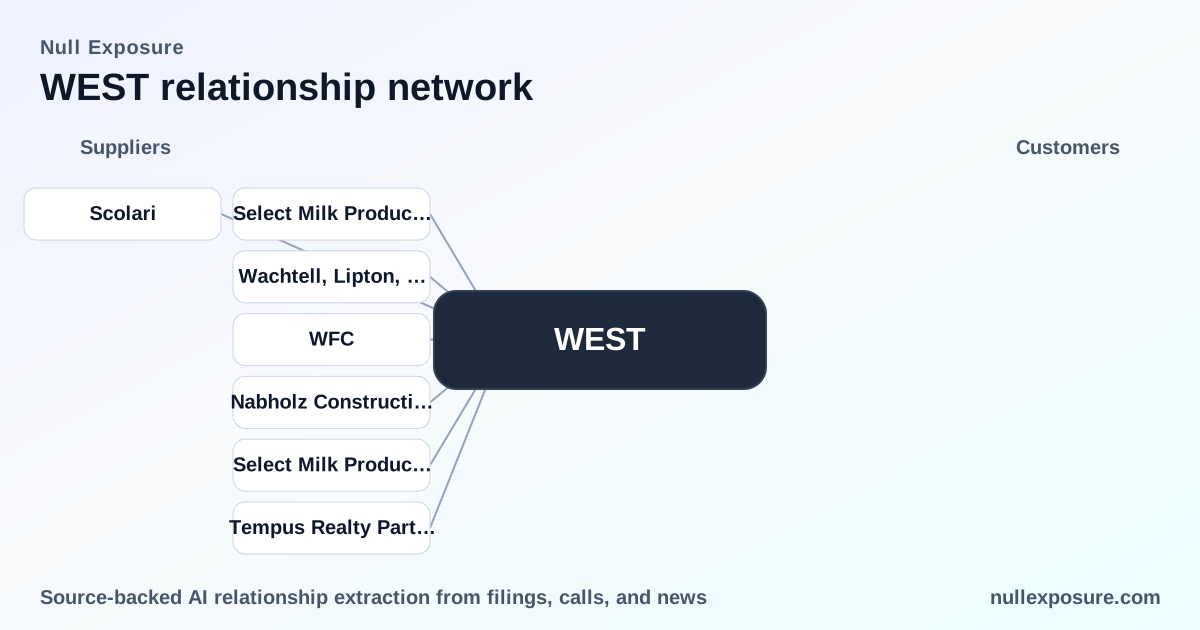
Select Milk Producers Inc. — joint-venture milk partnership (FY2024)
Westrock entered a joint venture with Select Milk Producers in which Westrock supplies coffee extracts and concentrates from its Conway facility while Select Milk provides milk from its Littlefield facility to produce ready-to-drink dairy-coffee beverages. This is a strategic co-manufacturing arrangement linking Westrock’s beverage extraction capability to a farmer-owned milk supply, lowering input friction for refrigerated beverage SKUs. (Reported in Arkansas Business and FoodEngineering, FY2024.)
Wachtell, Lipton, Rosen & Katz — legal counsel on corporate matters (FY2025)
Wachtell served as legal counsel to Westrock in connection with corporate disclosures and transaction work cited in the company’s third-quarter 2025 results release, indicating Westrock engaged top-tier corporate law resources for strategic or capital-structure work. (Reported on Comunicaffe, FY2025.)
Wells Fargo Securities — capital markets advisor (FY2025)
Wells Fargo Securities acted as Capital Markets Advisor to Westrock during its 2025 reporting cycle, signaling active capital-markets engagement and possible refinancings or capital-raising preparation. Access to large investment bank advisory is consistent with higher-complexity capital needs given Westrock’s investment in facilities and working capital programs. (Reported on Comunicaffe, FY2025.)
Nabholz Construction — construction partner for facility projects (FY2022)
Nabholz Construction participated in Westrock facility refurbishments and attended project groundbreakings, reflecting Westrock’s multi-year capital-expansion program to expand beverage production and distribution capacity. Contractor engagement with regional builders supports the company’s pace of fixed-capex deployment. (Reported on AR Money & Politics, FY2022.)
Tempus Realty Partners — development partner for distribution center (FY2023)
Westrock agreed to develop a $70 million, 530,000-square-foot distribution center in partnership with Tempus Realty Partners, underlining significant logistics capital commitments to scale national distribution and reduce unit logistics costs through owned/long-leased infrastructure. (Reported on TalkBusiness, FY2023.)
Scolari — equipment/supply partner for roasting and plant automation (FY2024)
Westrock’s Arkansas beverage factory includes automated Scolari roasters and large-capacity green coffee storage silos, indicating a relationship tied to production automation and throughput scaling. This relationship supports higher production cadence and lower per-unit roasting cost. (Reported on Daily Coffee News, FY2024.)
Operating-model constraints that drive supplier risk and opportunity
Westrock’s public disclosures and reporting surface several company-level operating constraints that contextualize supplier relationships:
- Contracting posture: short-term financing and hedges. Westrock uses short-dated supplier financing (payment programs with roughly 180-day repayment) and coffee futures hedges to manage input-price volatility; this creates predictable but time-bounded counterparty exposure. Evidence is disclosed in company filings describing supplier payment programs and three-to-twelve-month hedging activity.
- Geography: global sourcing. Westrock purchases raw materials—green coffee and tea—through importers/exporters from multiple countries, creating exposure to global supply chains and freight dynamics.
- Materiality: green coffee is critical. Green coffee is the primary raw material and exchange-traded commodity for Westrock; price moves and supply disruptions are therefore critical to gross margin variability.
- Relationship role: buyer with mature vendor programs. Westrock functions as the buyer in its supply chain and reports long-term, integrated vendor partnerships that include quality and transparency programs—indicative of a mature procurement discipline.
- Spend and working capital: meaningful program obligations. The company reported $78.8 million of obligations outstanding under its supplier financing Program as of December 31, 2024, placing program size in a $10m–$100m spend band and underscoring counterparty and liquidity management importance.
These constraints collectively mean investors should focus on supplier concentration, tenor of financing, and the durability of logistic/contract-manufacturing partnerships.
Discover how supplier intelligence alters valuation assumptions at https://nullexposure.com/.
Investment implications — what's priced in and what to watch
- Cost pass-through and margin sensitivity: Given global sourcing of green coffee and short-term hedging, Westrock’s gross margin will fluctuate with coffee markets and the company’s ability to pass costs to customers or lock-in input prices.
- Capital intensity and fixed-cost leverage: Partnerships with Tempus and Nabholz for large facilities, and equipment relationships like Scolari, indicate rising fixed costs that require volume growth to achieve margin expansion.
- Working capital and financing risk: A substantial supplier financing program (~$78.8m outstanding) reduces near-term cash outflows but concentrates counterparty and roll-risk into short-tenor programs; capital markets advisory relationships point to active management of that risk.
Conclusion and next steps for due diligence
Westrock’s supplier network is a blend of operational partners (milk co-ops, equipment suppliers, constructors), financial advisors, and capital-market counterparties that together determine the company’s cost structure and capital profile. For investors, the nexus of global coffee sourcing, short-term financing, and heavy capex in distribution is the primary driver of upside or downside.
For detailed supplier disclosure and risk scoring, visit NullExposure’s supplier intelligence hub at https://nullexposure.com/. To commission a tailored supplier exposure report for WEST, start here: https://nullexposure.com/.