WEX Inc.: Supplier relationships that shape a fintech payments infrastructure
WEX is a financial technology company that monetizes payment flows and embedded banking services across corporate fleet, mobility and healthcare verticals through a combination of transaction fees, card services and balance-sheet-enabled financing. The company operates by originating payment products through WEX Bank, partnering with payments processors and trustees, and selectively acquiring financial assets to accelerate deposits and fee income. Investors should view supplier and counterparty relationships as core operational levers that affect liquidity, product reach, and cost of capital. For more structured supplier intelligence on WEX and its counterparties, visit https://nullexposure.com/.
Why counterparties are central to WEX’s operating model
WEX is not a pure software vendor; it is a hybrid payments operator that combines platform economics with bank-like balance-sheet functions. That hybrid posture creates concentration and criticality risk that is different from a typical SaaS vendor: relationships that touch funding, custody or payment rails translate directly into liquidity and settlement outcomes rather than just uptime.
Two company-level signals from public disclosures help clarify WEX’s contracting posture:
- Long-term financing arrangements are part of the capital structure (evidence: references to an "Amended and Restated Credit Agreement"), indicating negotiated, covenanted relationships rather than spot-market reliance. This suggests a mature contracting posture for debt and liquidity providers.
- Service provider role is material: WEX Bank underpins a significant portion of Mobility and Corporate Payments operations, and WEX discloses fees paid to principal accounting and service providers. This is a company-level indicator that WEX depends on third-party operational and financial services to execute product delivery.
These characteristics make counterparties who provide funding, custody, and transaction routing more operationally critical than typical supplier contracts. Monitoring the stability and terms of those relationships is therefore essential for risk assessment.
Who WEX is working with (and what that means)
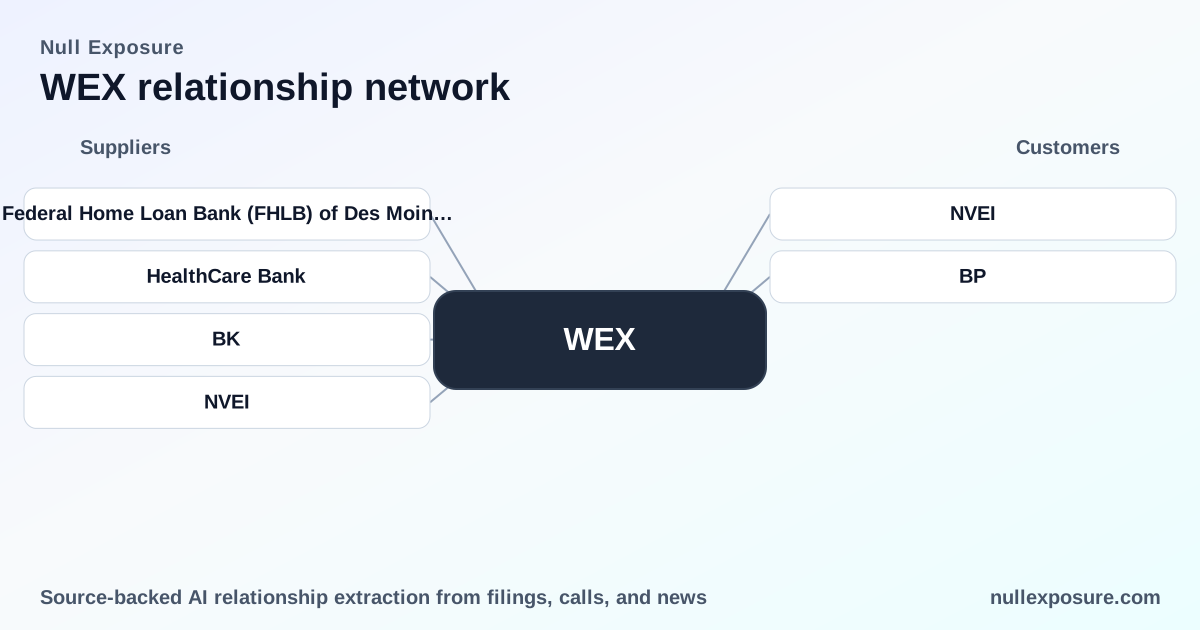
Below are the active supplier/counterparty relationships disclosed in recent public sources, each summarized in plain English with citation.
Federal Home Loan Bank of Des Moines — short-term funding partner
WEX Bank is a member of the Federal Home Loan Bank (FHLB) of Des Moines, which provides WEX Bank with short-term funding that is collateralized by investment securities. This membership directly supports WEX’s liquidity management and funding of payments activity. According to WEX’s 2025 Form 10‑K, the FHLB relationship is used to obtain collateralized short-term funding (WEX 10‑K, FY2025).
HealthCare Bank — HSA asset acquisition to grow deposit-like balances
WEX agreed to acquire health savings account (HSA) assets from HealthCare Bank for approximately $250 million, a transaction designed to better leverage WEX’s investment and funding position and to scale fee-bearing HSA balances. The transaction was reported by Mainebiz in March 2026 as a $250 million purchase to bolster the company’s HSA footprint (Mainebiz, March 2026).
The Bank of New York Mellon Trust Co. — trustee for note redemption activity
WEX announced redemption of outstanding senior secured notes and identified The Bank of New York Mellon Trust Co. as the trustee for those notes, signaling routine trustee engagement related to WEX’s debt capital management. The redemption and trustee role were reported alongside the HealthCare Bank transaction in the Mainebiz coverage (Mainebiz, March 2026).
Nuvei — virtual card partner for global travel merchants
WEX has entered a virtual card partnership with Nuvei to serve global travel merchants, extending WEX’s card issuance and merchant acceptance capabilities internationally through a payments processor partnership. This partnership was described in coverage by Sahm Capital, noting Nuvei’s role in WEX’s travel and virtual card initiatives (Sahm Capital, January 28, 2026).
What these relationships collectively imply about risk and strategy
Together, these counterparties reveal a deliberate strategy: augment balance-sheet liquidity, acquire fee-bearing financial assets, and outsourced payments-routing to expand distribution internationally. The FHLB membership and the HSA acquisition emphasize balance-sheet engineering to convert assets into lendable or usable collateral; the trustee and Nuvei relationships show reliance on specialty financial institutions and processors to enable product flows.
Key implications:
- Liquidity and funding are actively managed through secured facilities and asset purchases. That reduces short-term funding volatility but increases dependence on the terms of credit agreements and the availability of collateralized borrowing.
- Operational criticality of third parties is elevated. Trustees, custodians, and processors are not peripheral suppliers; disruptions or changes in these relationships would have immediate settlement and compliance effects.
- Geographic and product diversification is executed via partnerships and acquisitions. Virtual-card processing through Nuvei accelerates global merchant access without WEX owning full acquiring infrastructure.
(If you want a concise, sourced mapping of these supplier links against potential operational impacts, explore more at https://nullexposure.com/.)
How investors should monitor these relationships
To translate supplier intelligence into investment signals, focus on the contractual and financial dimensions:
- Track amendments to credit agreements and any covenant recasting; these documents indicate contractual seniority, collateral requirements, and liquidity buffers.
- Monitor acquisitions of bank or deposit-like assets (such as HSA portfolios) for deposit stability and yield characteristics, and for any changes in asset servicing arrangements.
- Confirm the operational scope of payments processors and trustees—changes in scope, pricing, or regulatory posture create near-term execution risk.
- Watch for concentration in counterparties; a small stable of funding or custody providers increases single-point-of-failure risk.
A pragmatic checklist for quarterly review:
- Credit agreement amendments or new facilities referenced in filings.
- Announced asset purchases and their funding sources.
- Changes in trustee, custodian, or processor contracts reported in press releases or 8‑K filings.
- Any regulatory or enforcement headlines involving counterparties.
Bottom line: supplier relationships are leverage points for WEX’s strategy
WEX’s supplier matrix shows a company that uses targeted partnerships and balance-sheet tools to scale payment products while outsourcing specialized functions. For investors, the critical questions are whether counterparties remain stable under stress, how long-term agreements protect liquidity, and whether acquired financial assets deliver the expected deposit and fee economics.
For a deeper dive into WEX’s counterparty network and supplier risk scoring, visit https://nullexposure.com/. For tailored supplier intelligence covering WEX and peer fintechs, start your research at https://nullexposure.com/ — the pages consolidate filings, news, and counterparty relationships in an investor-friendly view.
Final takeaway: WEX’s commercial logic is clear—marry platform economics with controlled balance-sheet exposure—but the company’s operational resilience depends on a small set of financially and operationally critical counterparties; active monitoring of those relationships should be a priority for investors.