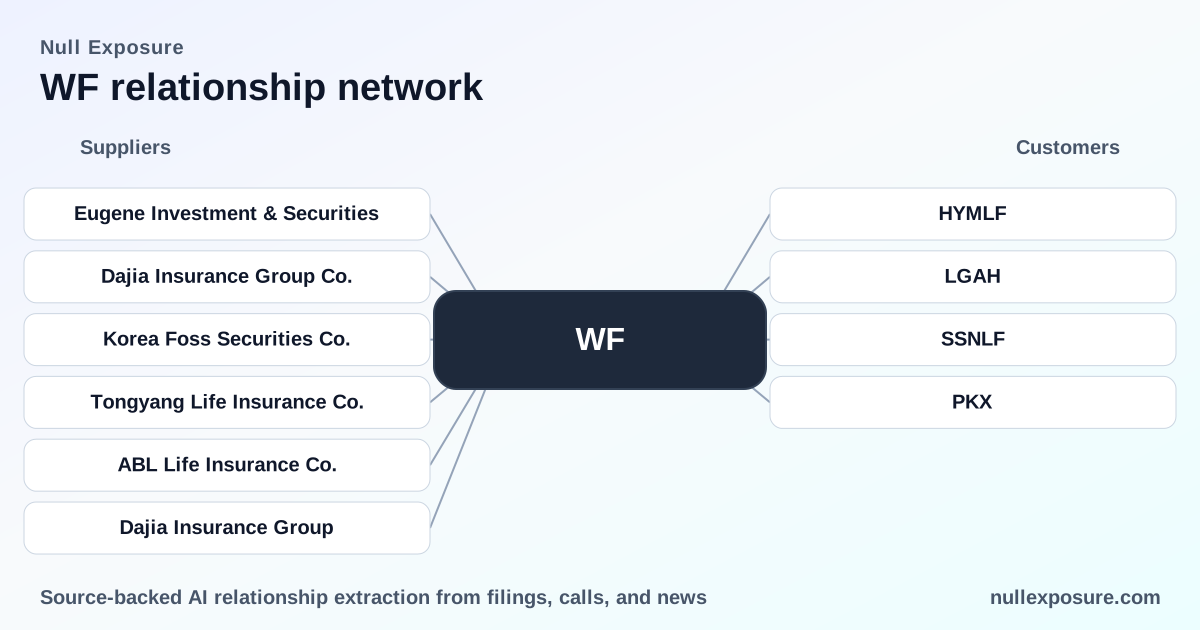
Woori Financial Group (WF): Supplier relationships that reshape the bank’s strategic footprint
Woori Financial Group is a Korea-headquartered commercial bank that monetizes through a combination of net interest income, fee and commission income, insurance premiums and investment income generated across retail, corporate and institutional channels. Management is actively reshaping the franchise through targeted acquisitions in insurance and brokerage and a board-authorized treasury share buyback executed via an external broker—actions that expand fee income, accelerate cross-sell opportunities and return capital to shareholders. For investors evaluating WF as a supplier partner or counterparty, these moves change counterparty concentration, contracting posture and operational criticality in measurable ways. Learn more on the Nullexposure homepage: https://nullexposure.com/
What these supplier signals mean for investors
Woori’s recent supplier and transaction activity reads like a strategic playbook: use third-party brokerages for capital actions, acquire insurance and securities companies to broaden product mix, and rebuild domestic brokerage capabilities. Collectively, these relationships reveal a company that is both buying scale and outsourcing execution for short-term capital moves.
- Contracting posture: Woori alternates between buyer and contracting client—appointing brokers for share buybacks while acquiring sellers in insurance and securities.
- Concentration and criticality: The appointments and acquisitions are concentrated around a handful of counterparties, which increases the operational importance of each relationship during execution and integration windows.
- Maturity and permanence: Brokerage engagements (e.g., buyback broker) are transactional and time-limited, while acquisitions represent longer-term, strategic supplier-to-subsidiary transitions.
No supplier constraints were returned in the records for the supplier scope; as a company-level signal, the absence of flagged contractual constraints means there are no recorded supplier-side covenants or restrictions surfaced in the search set, not that all contractual terms are unconstrained in reality.
At-a-glance: the counterparty list investors need to track
Below are the counterparties surfaced in public reporting and press coverage. Each relationship has an operational implication—some are temporary execution partners, others are full acquisitions that become integral to Woori’s product stack.
Eugene Investment & Securities
Woori’s board approved a KRW 200 billion trust to buy back treasury shares and appointed Eugene Investment & Securities as the executing brokerage for purchases scheduled between February 10 and June 10, 2026, indicating a short-term, high-importance transaction relationship for capital management. This was reported in a Globe and Mail press release covering Woori’s board action (Feb 2026). Source: Globe and Mail press release (Feb 2026).
Dajia Insurance Group Co.
Woori signed a deal to acquire two life insurers from China’s Dajia Insurance Group for KRW 1.55 trillion, signaling a strategic purchase of existing insurance franchises rather than greenfield expansion and a one-time counterparty role for Dajia as seller. KED Global covered the transaction and the total consideration in its reporting (Feb–Dec 2025). Source: KED Global (Feb and Dec 2025).
Korea Foss Securities Co.
Woori acquired Korea Foss Securities to re‑enter the domestic brokerage market, marking a deliberate rebuild of securities distribution capabilities a decade after exiting that market and converting a former market supplier into an owned channel. KED Global reported the acquisition and the strategic rationale (Feb 2026). Source: KED Global (Feb 2026).
Tongyang Life Insurance Co.
Acquired alongside ABL Life from Dajia, Tongyang Life adds insurance premium volume, distribution channels and longevity risk exposure to Woori’s consolidated balance sheet; the purchase price and transaction terms were disclosed in coverage of the deal. Source: KED Global (Feb 2025/2026), LifeInsuranceInternational (coverage).
ABL Life Insurance Co.
Also part of the KRW 1.55 trillion acquisition package, ABL Life complements Tongyang Life and increases Woori’s presence in life insurance—turning acquired insurers into strategic distribution assets for cross-selling banking products. Reporting on the deal is consistent across industry outlets (Dec 2025–Feb 2026). Source: KED Global (Dec 2025/Feb 2026), LifeInsuranceInternational (2024 coverage).
Why each relationship matters in practice
Woori’s appointment of Eugene for the share buyback is a time-bound, execution-critical supplier engagement: brokers determine pace and market impact of the buyback, which affects free float and EPS dynamics in the short term. The acquisitions from Dajia convert third-party suppliers into owned businesses, shifting Woori’s risk profile from counterparty exposure to consolidation and capital allocation risk. Re-acquiring a brokerage franchise through Korea Foss transitions Woori from client to operator in capital markets distribution—a structural change with implications for fee income and regulatory oversight.
If you track Woori’s supplier landscape professionally, these are the relationships to prioritize for diligence and ongoing monitoring: https://nullexposure.com/
What investors should watch next: integration and capital dynamics
The commercial logic is clear—acquire distribution and product capability, then capture higher-margin fee income and cross-sell. Execution risk and regulatory approvals are now the dominant near-term factors.
Key monitoring items:
- Capital adequacy and provisioning after the KRW 1.55 trillion acquisition; this affects dividend policy and solvency metrics.
- Integration milestones for Tongyang and ABL Life, including retention of agency forces and migration of IT/policy administration.
- Brokerage performance after bringing Korea Foss into the fold—does securities distribution lift non‑interest income as projected?
- Buyback execution pace and market impact as reported by broker filings and trading notices; the broker-appointed trust with Eugene will determine share supply dynamics through mid-2026.
A practical investor playbook: prioritize regulatory filings, quarter-over-quarter insurance premium and fee-income trends, and official progress reports on integration.
Middle-stage diligence and monitoring are where supplier intelligence adds disproportionate value—review the transaction disclosures and boards’ minutes for cadence on these items. For deeper supplier intelligence and continuous monitoring, visit https://nullexposure.com/
How to use this supplier view in valuation and operational risk
Translate the supplier moves into your models conservatively:
- Reallocate expected revenue mix toward insurance premiums and fees over a reasonable integration horizon.
- Model one-off acquisition costs and potential capital injections against improved return-on-equity scenarios.
- Stress-test scenarios where buyback execution is slower or more front-loaded, which changes share count dynamics and short-term EPS.
Operationally, treat acquired entities as newly critical internal suppliers whose processes, systems and people must be audited to manage counterparty operational risk.
Bottom line: strategic expansion with execution and capital tradeoffs
Woori Financial Group is executing a clear strategy to convert external supplier relationships into owned capabilities while continuing to use specialist brokers for capital actions. That dual approach lifts medium-term upside in fee income and cross-sell potential, but escalates integration and capital-management risk in the near term. Investors and counterparties should track regulatory filings, integration milestones, and buyback execution reports closely.
To stay informed on supplier-level developments and transactional coverage for WF and comparable issuers, visit the Nullexposure home page: https://nullexposure.com/