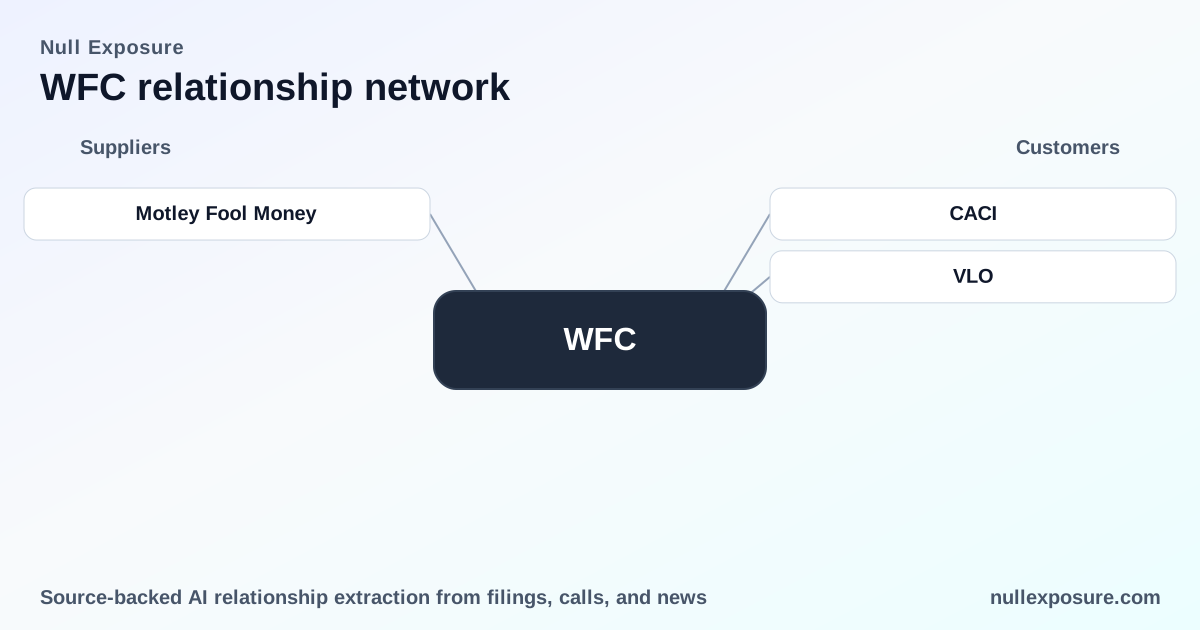
Wells Fargo & Company (WFC): Supplier relationships, marketing partnerships, and what investors should watch
Wells Fargo is a diversified U.S. bank that generates revenue through net interest income, fees from retail and commercial banking, wealth management, and mortgage lending; it monetizes customer deposits and lending spreads while leveraging scale in transaction services and advisory fees. Supplier relationships for a bank of this scale typically split between mission‑critical third‑party services (cloud, payments, custody) and discretionary partners (advertising, marketing, content providers) — understanding which category a supplier sits in is essential for assessing operational and reputational exposure.
Explore how supplier intelligence informs risk and strategy at the company level: https://nullexposure.com/
What the recorded supplier relationship tells investors about WFC's marketing posture
Wells Fargo’s single cited supplier relationship in the reviewed set is a marketing and advertising link to a financial media brand. That positions the bank as actively allocating marketing dollars into investor- and retail-facing channels, reinforcing brand and product distribution rather than outsourcing core banking functionality.
- According to a March 2026 news item referenced in The Globe and Mail, Wells Fargo is an advertising partner of Motley Fool Money, indicating paid placement or sponsorship arrangements with the financial media program. (March 2026 coverage citing Motley Fool Money)
This is a low‑touch, high‑visibility relationship: advertising partners elevate customer acquisition and perception but are not operationally critical to deposit or lending functions.
All relationships from the reviewed results
Wells Fargo — advertising partner with Motley Fool Money. The bank pays for advertising or sponsorship with a nationally recognized financial media brand, which supports retail investor reach and brand positioning. This relationship was documented in March 2026 media coverage. (The Globe and Mail / Motley Fool Money, FY2026)
Operating model and supplier constraints — company-level signals investors should register
The dataset of supplier relationships returned no explicit constraints for WFC, which itself is an informative signal. From a company-level lens:
- Contracting posture: Wells Fargo operates with centralized vendor management and regulated third‑party oversight, reflecting institutional contracting practices for a major bank. Supplier agreements for non-core services such as advertising are typically negotiated on campaign or annual terms, while core infrastructure contracts follow formal procurement governance.
- Concentration: As a diversified bank with substantial internal capabilities, supplier concentration risk for high-volume banking operations is generally low, while concentration can be higher in niche technology or custodial relationships. Advertising partnerships are inherently low concentration and easy to substitute.
- Criticality: Advertising and media sponsorships are non-critical to daily banking operations but are important for customer acquisition, retention, and brand equity. Criticality should therefore be weighted by function — operational risk versus reputational/marketing impact.
- Maturity: Supplier relationships for marketing are often short‑to‑medium term and campaign driven; overall vendor management across Wells Fargo is mature and institutionalized given regulatory scrutiny and historical remediation efforts.
Because no constraints are listed in the supplier set, these traits are presented as company-level signals rather than relationship-specific constraints.
Risk and opportunity implications for investors and operators
For investors evaluating supplier exposure, the Motley Fool Money partnership implies marketing emphasis, not operational dependency.
- Opportunity: Paid relationships with well-known financial media amplify product offerings (adoption of digital banking features, wealth services) and can accelerate retail deposit flows and cross-sell metrics if messaging is effective. Given Wells Fargo’s scale — market capitalization north of $237 billion and revenue around $80 billion annually — marketing channels can move the needle on growth at the margin.
- Risk: The primary risks are reputational (association with media controversies) and spend efficiency (return on advertising investment). Advertising partners do not introduce material operational risk unless the partnership becomes a vector for misinformation or regulatory scrutiny of marketing claims.
- Regulatory context: As a large U.S. bank with high regulatory visibility, Wells Fargo’s vendor management and marketing claims will be subject to compliance review; investors should prioritize transparency around third‑party marketing controls.
Stay current on how supplier intelligence maps to financial exposure and compliance controls: https://nullexposure.com/
Practical monitoring checklist for investors and procurement teams
To convert this relationship-level information into actionable monitoring, focus on a few high‑signal items:
- Track disclosures in proxy statements and the Form 10‑K/10‑Q for vendor concentration, marketing spend, and third‑party risk management.
- Monitor media mentions and sentiment for advertising partners to flag reputational spillovers.
- Review procurement and compliance statements for evidence of centralized oversight, SLAs, and indemnities covering marketing partners.
- Watch quarterly metrics that link to marketing effectiveness (deposit flows, retail account openings, digital engagement) to evaluate ROI on advertising spend.
Key takeaway: marketing partnerships are a visibility lever rather than a brittle operational dependency for Wells Fargo; investors should treat such supplier links as reputational and commercial signals instead of systemically critical exposures.
Final read and action points
Wells Fargo’s documented supplier relationship in this review is targeted advertising with Motley Fool Money — a strategic, low‑criticality channel for retail investor outreach. There are no supplier constraints reported in the provided relationship set, and company‑level signals point to centralized vendor governance, low supplier concentration for non-core services, and mature procurement practices.
If you want continuous supplier intelligence and to align supplier signals with investment decisions, start here: https://nullexposure.com/
Concluding recommendation: monitor changes in marketing partners, disclosures in SEC filings, and any vendor‑related regulatory commentary as early‑warning indicators, while prioritizing analysis of core third‑party rails (technology, payments, custody) separately for operational risk assessment.