Wells Fargo (WFC-P-A) — supplier footprint and what it means for preferred-stock investors
WFC-P-A represents preferred equity issued by Wells Fargo & Company, a diversified U.S. financial services firm that generates cash flow through retail and commercial banking, payments processing, lending, wealth management, and fee income; preferred holders benefit from fixed-dividend claims senior to common equity but subordinated to debt. This supplier review isolates the external technology and payments relationships that underpin Wells Fargo’s product delivery and operational continuity, and it evaluates how those relationships translate into operational concentration, vendor criticality, and counterparty risk for capital allocators.
Explore more supplier and counterparty intelligence on the NullExposure homepage: https://nullexposure.com/
Quick read: what the supplier map looks like
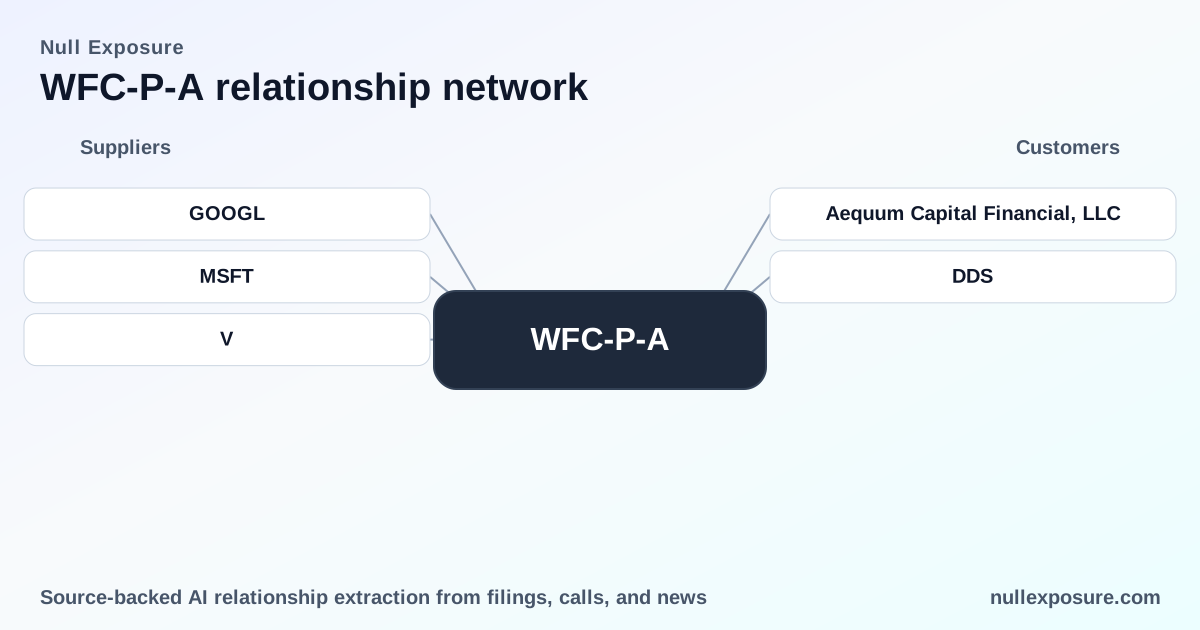
Wells Fargo operates a multicloud digital infrastructure and relies on major payments rails for its card-based products. The supplier set highlighted in public coverage is concentrated among three global platform providers — Google Cloud, Microsoft Azure, and Visa — each delivering a different but essential function: infrastructure, platform services, and payments network access. The relationships are public-facing and visible through product announcements and media reporting, which is useful for assessing third-party dependency and continuity planning.
Supplier relationships that matter to investors
Google Cloud
Wells Fargo uses Google Cloud as part of a multicloud strategy to host digital infrastructure and services, contributing to the bank’s modernization of customer-facing and back-office systems. According to a PYMNTS article covering product and infrastructure changes in September 2021, Wells Fargo included Google Cloud among its chosen cloud providers as part of a multicloud approach (https://www.pymnts.com/credit-cards/2021/new-wells-fargo-reflect-credit-card-rewards-on-time-payments/).
Microsoft Azure
Wells Fargo’s infrastructure strategy also includes Microsoft Azure as a principal cloud provider, enabling compute, storage, and platform services across its digital channels. A PYMNTS report from September 2021 described Wells Fargo’s multicloud method that explicitly uses Microsoft Azure alongside Google Cloud to support the bank’s digital transformation (https://www.pymnts.com/credit-cards/2021/new-wells-fargo-reflect-credit-card-rewards-on-time-payments/).
Visa
Wells Fargo issues cards that are accepted on the Visa network, giving the bank and its cardholders access to Visa’s global acceptance and processing capabilities. The same PYMNTS article noted that the featured cards are “accepted anywhere Visa Credit is accepted,” signaling standard reliance on Visa’s payments rail for card distribution and merchant acceptance (https://www.pymnts.com/credit-cards/2021/new-wells-fargo-reflect-credit-card-rewards-on-time-payments/).
What these supplier links imply for investment risk and opportunity
These three supplier relationships reveal a clear operational posture:
- Contracting posture: Public disclosures show Wells Fargo is procuring services from leading hyperscalers and payments networks, indicating enterprise-level vendor contracting with suppliers that offer high SLAs and broad geographic coverage. That contracting posture typically reduces single-vendor lock-in risk but raises negotiation complexity and vendor-management overhead.
- Concentration: The bank’s visible reliance on major hyperscalers and Visa implies concentration at the platform level — dependence on a few global providers for critical infrastructure and payments rails. Concentration is manageable from a redundancy perspective when multicloud is implemented correctly, but it increases systemic exposure if multiple providers face correlated outages or regulatory constraints.
- Criticality: Cloud providers and card networks are mission-critical for retail banking operations and card acceptance; interruptions translate directly into deposit-account access, payments flow, and fee revenue impacts. For preferred-stock investors, criticality maps to short-term operational risk that can affect near-term cash flow distributions if outages or regulatory actions disrupt revenue-producing activities.
- Maturity: A multicloud strategy with Azure and Google Cloud signals modernization and maturity of IT architecture, suggesting the firm is investing in scalability, resilience, and data analytics — attributes that support product innovation and cost control over time.
The public record in the reviewed material lists these supplier relationships consistently and without explicit constraints against them. The constraints dataset for this supplier review contains no company-specific limitations, presenting a company-level signal that no additional documented procurement constraints were extracted from the available sources.
Explore NullExposure’s supplier risk tools to map counterparty concentration across your holdings: https://nullexposure.com/
Risk factors investors should watch
- Vendor outage risk: Hyperscalers and payments networks operate at scale, but they experience large outages that can halt banking services. Wells Fargo’s multicloud stance mitigates single-cloud failure, but reliance on major providers means correlated systemic events could impair service across multiple platforms.
- Regulatory and compliance exposure: Use of public clouds and global payments rails subjects the bank to data residency, privacy, and financial-regulatory scrutiny in multiple jurisdictions — a source of potential remediation cost and contractual friction.
- Counterparty negotiation leverage: Large cloud and payments vendors command pricing power and product roadmaps; shifts in commercial terms or service models affect operating cost and margins.
- Operational integration risk: The benefits of modern cloud architectures require disciplined vendor management and integration; failure to operationalize multicloud effectively creates hidden costs or security gaps.
Actionable signals for portfolio managers and operators
- For credit and preferred-stock holders, operational continuity is a near-term credit consideration. Track vendor outage events and remediation timelines, and incorporate third-party incident frequency into short-term cashflow stress tests.
- For active investors engaging management, request contractual summaries of key cloud and payment vendor SLAs, termination rights, and shared-responsibility matrices to quantify recoverability and vendor concentration exposure.
- For operators and risk teams, prioritize testing and redundancy across clouds and conduct tabletop exercises that explicitly involve payment-network outages to validate contingency plans.
Closing view and next steps
Wells Fargo’s supplier footprint, as visible in public reporting, centers on global cloud infrastructure and the Visa payments network — strategic dependencies that reflect both modernization and concentration. These relationships are integral to day-to-day revenue flows, and they deserve focused monitoring by investors who value preferred dividends and operational resilience.
If you want a structured supplier-risk briefing for your financial holdings or to map counterparty concentration across a portfolio, start here: https://nullexposure.com/ — NullExposure provides layered supplier intelligence for investors evaluating operationally sensitive securities.