Wells Fargo & Company Depositary Shares Series Y (WFC-P-Y): Supplier Relationships and Strategic Signals
Thesis — Wells Fargo is one of the largest diversified financial services firms in the United States; WFC-P-Y represents a preferred equity claim tied to the bank’s capital structure while the bank monetizes through net interest margin, fee income, and its broad commercial and retail franchise. For investors and counterparties evaluating supplier exposures, the relevant question is how Wells Fargo’s operational partnerships and real-estate decisions influence settlement capacity, regional footprint, and execution risk across its core treasury and corporate banking operations.
Explore supplier intelligence and counterparty context at Null Exposure: https://nullexposure.com/
Why supplier relationships matter for preferred-holders and corporate counterparties
Preferred shareholders and institutional counterparties should treat supplier relationships as extensions of a bank’s operational resilience and future cost profile. Critical technology partners can compress settlement risk and reduce operational capital needs, while major real-estate development partners shape regional operating costs and headcount concentration. These relationships do not change coupon mechanics for WFC-P-Y, but they influence the bank’s operational risk, regulatory footprint, and capital allocation decisions that underpin credit quality.
One-page view of the reported supplier relationships
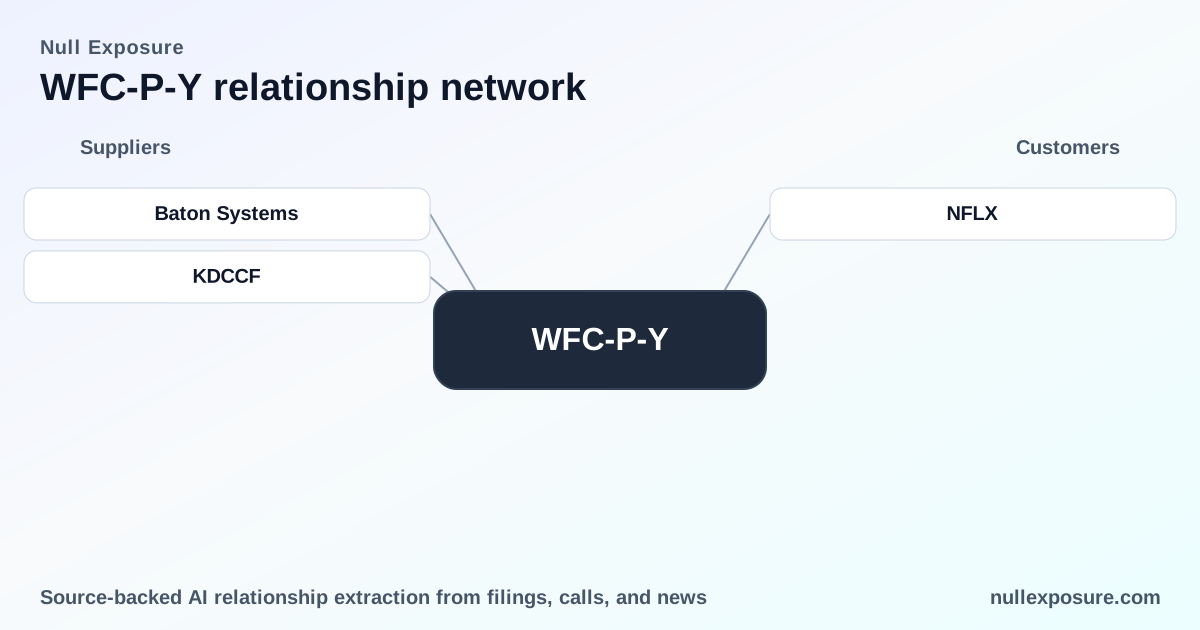
Below I summarize every supplier relationship returned for WFC-P-Y and explain the practical takeaway for investors and operators.
Baton Systems — blockchain-inspired settlement infrastructure (FY2021)
Wells Fargo participated in a shared private ledger initiative built on Baton Systems’ CORE distributed ledger technology to accelerate payment-versus-payment netting and settlement cadence with HSBC and other participants, with ambitions to expand participants and introduce a central infrastructure administrator. According to a MarketsMedia report (FY2021), the platform aims to enable multiple daily netting and settlement windows to reduce bilateral FX settlement exposures.
Source: MarketsMedia coverage of the Baton-Wells Fargo initiative (FY2021).
Why it matters: This is an operational efficiency play—reducing intraday FX settlement exposure and operational costs. For investors, the signal is that Wells Fargo is deploying or trialing technology to lower settlement friction, which supports lower operational capital and counterparty credit risk over time.
KDC — office developer for regional campus expansion (FY2022)
Wells Fargo selected Dallas-based developer KDC for a forthcoming regional campus, with Irving City Council approving $31 million in incentives toward the project located along West Las Colinas Boulevard, per local reporting in FY2022. The development positions Wells Fargo to expand regional office capacity and consolidate staff into a new campus constructed by KDC.
Source: WFAA reporting on the Irving incentives and developer selection (FY2022).
Why it matters: This is a strategic real-estate decision that drives regional cost structure, workforce concentration, and long-term occupancy obligations. The incentives indicate local public-private coordination that reduces upfront capital outlay for Wells Fargo but increases operating lease or landlord relationship complexity.
Operating-model characteristics and company-level signals
With no explicit contractual constraints reported in the supplier data, derive company-level signals from the nature of the relationships and Wells Fargo’s business model:
- Contracting posture: Wells Fargo demonstrates a blend of collaborative strategic partnerships (e.g., with technology innovators like Baton) and conventional commercial contracting for real-estate (e.g., KDC). This suggests a pragmatic posture—piloting innovation while using established developers for physical capacity.
- Concentration: The two disclosed relationships are functionally diverse—payments infrastructure and property development—indicating low supplier concentration in the available sample, but that sample is limited to reported items; the bank’s true concentration profile requires broader supplier mapping.
- Criticality: The Baton engagement is operationally critical for FX settlement efficiency if scaled, while the KDC relationship is critical for regional workforce logistics but less so for immediate liquidity or settlement mechanics.
- Maturity: The Baton relationship is a technology adoption phase (platform pilots and network expansion planning), while the KDC engagement is a traditional, capital projects phase with municipal incentives and development timelines.
These signals collectively suggest a bank that balances innovation-driven operational improvements with conventional investments in physical infrastructure. For preferred investors, the consequences are indirect but material: operational efficiencies support lower loss rates and capital strain; real-estate commitments affect long-term expense and regional concentration.
Risk and opportunity takeaways for investors and operators
- Operational risk reduction is the primary opportunity from the Baton engagement: faster netting and settlement cadence compresses intraday FX exposure and could reduce liquidity buffer needs if adopted broadly.
- Concentration risk in regional staffing is the primary operational risk from the KDC-led campus: greater geographic concentration increases exposure to local labor markets and regulatory environments.
- Regulatory and vendor governance will matter: technology partnerships involving settlement rails invite heightened regulatory scrutiny and require robust third-party risk management.
- Cost-management upside: municipal incentives for real-estate lower near-term capital needs but create longer-term occupancy and contractual obligations that require active lease and balance-sheet oversight.
Practical implications for due diligence and counterparty negotiation
- Demand clarity on adoption timelines, data governance, and contingency arrangements for any shared-ledger settlement system; evaluate whether the platform will materially alter intraday liquidity profiles.
- For real-estate developments, obtain disclosure on incentive conditions, lease terms, and fallback plans in case of workforce redistribution; quantify the present value of incentives against long-term occupancy costs.
- Examine governance structures: who administers the rulebook for any multi-bank settlement platform, and what are exit/continuity clauses in the developer contract.
For deeper counterparty mappings and to benchmark these supplier relationships against peers, visit Null Exposure: https://nullexposure.com/
Closing verdict and next steps
Wells Fargo’s supplier signals in the reported sample show targeted operational modernization paired with conventional capital projects. The Baton Systems engagement is the most consequential for systemic settlement risk and operational capital efficiency; the KDC development is consequential for regional cost structure and workforce concentration. For investors in WFC-P-Y, these relationships do not alter coupon mechanics but they inform medium-term operational resilience and cost trajectories that underpin credit stability.
If you want structured supplier analysis and continuous monitoring to inform capital and counterparty decisions, start here: https://nullexposure.com/
Bold takeaway: Operational partnerships that lower settlement friction materially improve a bank’s counterparty risk profile; property developments materially influence concentration and long-term expense—both are relevant inputs to a disciplined assessment of preferred equity risk.