Where Food Comes From (WFCF): A supplier-profile briefing for investors and operators
Where Food Comes From operates a verification-and-certification business for agricultural and food producers and monetizes through fee-based certification services, program licensing, and ancillary audit/data services to producers and retailers. The company sells trust and traceability credentials that carry recurring revenues from audits, program management, and the licensing of certification marks—businesses that scale by adding programs and converting industry initiatives into fee-generating certifications. For investors this means growth derives from program acquisitions and cross-selling to existing customers, while margins are governed by audit capacity and program integration efficiency.
Explore supplier intelligence and deeper supplier mappings at https://nullexposure.com/
What the record shows about recent supplier relationships
Below I list every relationship result found in the public record and give a concise, investor-ready read on each entry.
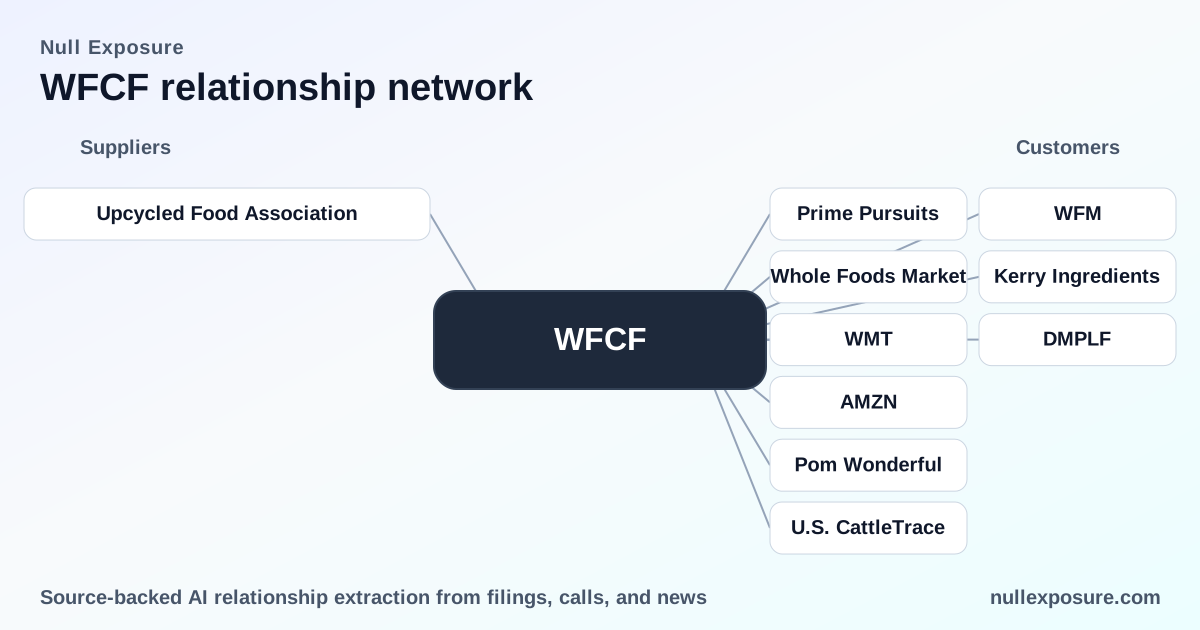
Upcycled Food Association — FY2024 (NewHope report)
Where Food Comes From acquired the Upcycled Certified Program from the Upcycled Food Association; the transaction is presented as an extension of WFCF’s program portfolio that converts recognized food industry initiatives into a fee-bearing certification. According to a NewHope industry note dated March 10, 2026, the acquisition is positioned to broaden WFCF’s addressable market in value‑added food claims. (Source: NewHope, March 10, 2026)
Upcycled Food Association — FY2023 (Bluebook Services coverage)
Bluebook Services reported the same acquisition and framed WFCF as “the most trusted resource for independent, third‑party verification” in North America, emphasizing that the Upcycled Certified Program will be run under WFCF’s existing certification infrastructure and brand. This coverage (published March 10, 2026) highlights the company’s strategic play of buying established programs rather than building origin-to-consumer claims organically. (Source: Bluebook Services, March 10, 2026)
Why these relationship entries matter for valuation and operations
The Upcycled Certified acquisition is a classic inorganic growth move for a certification provider. Acquiring programs that already carry industry recognition reduces customer acquisition cost and accelerates revenue-per-customer by allowing WFCF to sell multiple certifications to the same account base. For operators, integration risk and audit capacity constraints are the primary operational levers: successful cross-selling depends on training auditors, updating technical standards, and embedding the program into client renewal cycles.
Company-level constraints and what they tell buyers and procurement
Several disclosure excerpts give direct signals about WFCF’s operating model and contracting posture. These are company-level signals rather than relationship-specific assertions.
- Long-term contracting posture / lease commitments. A company filing states: “The lease agreement has an initial term of five years plus two renewal periods, which the Company is more likely than not to renew.” This indicates multi-year fixed-cost commitments and a maturity posture consistent with predictable real-estate and operations planning.
- Buyer / reseller orientation. WFCF discloses: “We do not manufacture any of the items in inventory. All items in inventory are finished goods.” This signals a buyer/reseller stance—WFCF sources external goods or services rather than manufacturing, which affects supplier negotiation power and inventory exposure.
- Relationship renewal stage. The lease language (five years + renewals) also signals a renewing or stable relationship stage for core operational contracts, supporting planning but locking in cost structure.
- Spend-band indicative of mid-range fixed costs. The filing reports: “Total rental payments are approximately $47,034 per month as of December 31, 2024.” That places certain operating expenses in the $100k–$1M annual spend band, material enough to require active procurement oversight but not so large as to dominate corporate spending.
Together, these constraints portray WFCF as a mature small-cap operator with stable fixed commitments, a buyer-focused procurement model, and a tolerance for program-level M&A to drive growth.
Discover how these relationship signals affect supplier risk scores at https://nullexposure.com/
Commercial implications: concentration, criticality, and maturity
- Concentration: Insider ownership is high (about 52.5%) with a small public float, so strategic moves such as program acquisitions are controlled decisions that will quickly move the company’s financial profile. This ownership structure compresses market liquidity and amplifies management’s ability to set long-term strategy without short-term public activism.
- Criticality: Certifications are mission-critical to producers and retailers who depend on them for market access. That makes WFCF’s services sticky once integrated into a customer’s compliance and procurement workflows.
- Maturity: Financials show a small but profitable profile—FY metrics include roughly $24.9M revenue and positive net margins (profit margin ~6.17%, EBITDA ~$1.856M), indicating the business is past proof-of-concept and now optimizing scale through program expansion.
Risk and upside for investors and procurement teams
Operators and investors should weigh a compact set of structural risks and opportunities:
- Upside: Program acquisitions like Upcycled Certified accelerate revenue diversification and improve monetization per client through cross-sell of audits and licensing.
- Operational risk: Integration requires audit capacity and standards harmonization; failure increases marginal costs and delays revenue realization.
- Cost structure risk: Multi-year leases and $47k/month rental obligations fix a base operating cost that reduces flexibility in downturns.
- Market structure: Small market cap (~$62M) and low float amplify volatility around material news—both an investor opportunity and an execution risk.
Key takeaways for procurement and partners:
- Prioritize audit capacity and training when negotiating supplier commitments with WFCF; program rollouts depend on scalable audit supply.
- Model revenue upside conservatively: acquisitions deliver upside but require near-term investment to realize cross-sell revenue.
- Monitor contractual fixed costs as a component of counterparty health—lease obligations are explicit and material to cash flow.
Practical next steps for analysts, operators, and buyers
- Review WFCF’s program integration cadence and auditor headcount to validate revenue assumptions tied to the Upcycled Certified acquisition.
- Validate renewal terms on major customers and the cadence of audit renewals—certification revenue is recurring and dependent on renewal conversion rates.
- Evaluate supplier risk with a focus on fixed-cost coverage and the company’s ability to scale audits without significant margin erosion.
If you want tailored supplier risk intelligence or a deeper supplier map for WFCF, start here: https://nullexposure.com/
In summary, Where Food Comes From is expanding its addressable market by acquiring recognized certification programs, converting reputation into recurring fee income. The company’s buyer-oriented supply posture, modest scale, and fixed-cost commitments are the principal operational dynamics investors and procurement leaders must underwrite when evaluating supplier relationships and the potential upside of program-driven growth.