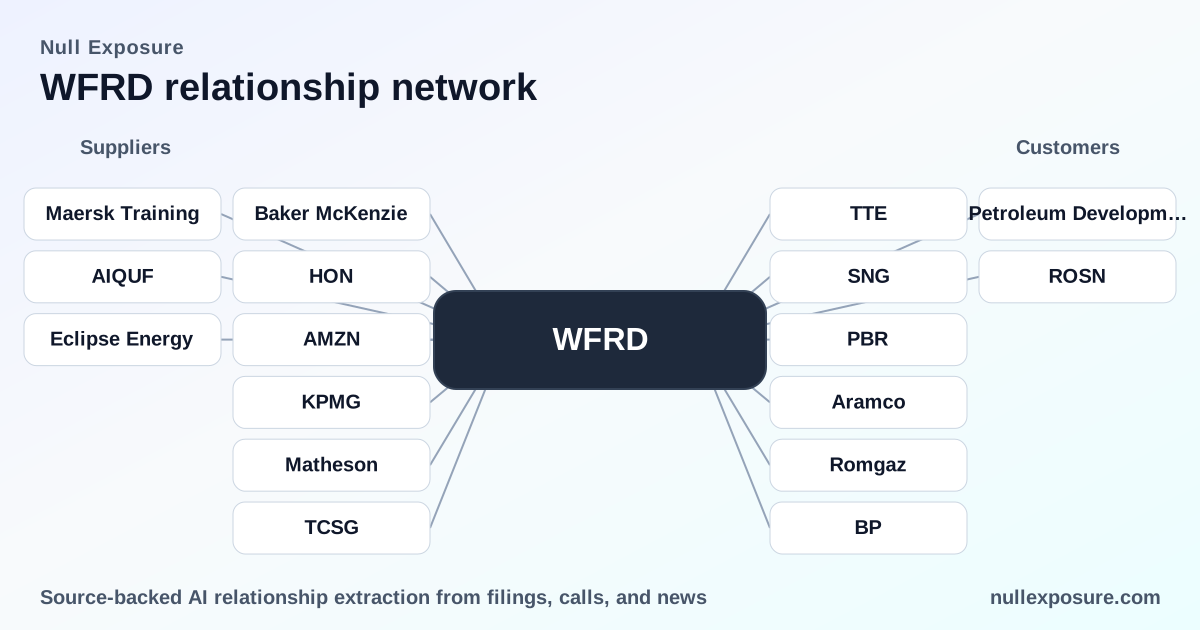
Weatherford (WFRD): A supplier-led partner map and what it means for investors
Weatherford International plc operates as an oilfield services company that monetizes through equipment sales, field services, software and integrated solutions for drilling, evaluation, completion and production. The company generates recurring and project revenue by supplying hardware and consumables, providing field and technical services, and licensing or operating digital platforms that improve well performance. With a market capitalization around $6.2 billion and trailing twelve‑month revenue near $4.9 billion, Weatherford’s supplier and strategic partner relationships are a core input into both its cost structure and its product roadmap. For deeper supplier analytics and counterparty exposure review, visit https://nullexposure.com/.
Operational and commercial posture
Weatherford’s operating model combines capital equipment manufacturing and field service delivery with an accelerating digital transformation agenda. That dual nature produces two simultaneous supplier profiles: (1) a traditional industrial buyer dependent on raw materials, components and field services, and (2) a technology integrator that contracts with cloud, software and AI providers to modernize products. The company’s own disclosures confirm it purchases a wide variety of raw materials, parts and components and integrates third‑party products into its offerings, which signals a buyer contracting posture and reliance on third‑party technical partners (company filing language, FY2025).
Key financial context: Weatherford’s operating margin and EBITDA (operating margin ~16%, EBITDA roughly $1.01 billion TTM) make supplier continuity and scale economics material to profitability. The firm’s capital markets activity—notably a large notes issuance and tender offering—also changes the risk profile for supplier payment and contracting flexibility.
Supplier and partner map: the relationships that shape delivery and risk
Below are concise, sourced summaries of every relationship in the available results; each entry shows the partner role and the public disclosure that established it.
Baker McKenzie — debt issuance counsel
Baker McKenzie acted as Australian counsel for Weatherford’s USD 1.2 billion Senior Notes offering due 2033 and the concurrent upsized USD 1.3 billion cash tender offering, demonstrating Weatherford’s active capital markets program to refinance and optimize its debt profile. This engagement was publicized in Baker McKenzie’s newsroom (October 2025) and covered in legal press (May–October 2025).
Source: Baker McKenzie newsroom and contemporaneous legal reporting in 2025.
Honeywell — emissions management and SCADA integration
Weatherford signed a memorandum of understanding with Honeywell to integrate CygNet SCADA with Honeywell’s Emissions Management suite to deliver advanced emissions monitoring and accelerate customer decarbonization initiatives. The tie‑up is positioned as a commercial go‑to‑market collaboration for environmental offerings.
Source: WorldOil report on the Honeywell MOU (December 2023).
Amazon Web Services (AWS) — preferred cloud provider and platform migration
Weatherford selected AWS as its preferred cloud partner to migrate and modernize its software and hardware suite, signaling a strategic shift to cloud‑native operations for telemetry, analytics and software delivery that underpin higher‑margin services.
Source: Weatherford press release via GlobeNewswire (May 2025).
KPMG — Irish auditor; reputational and assurance exposure
KPMG, identified as Weatherford’s Irish auditors, declined comment regarding its work with the company in a public report, a matter that surfaces in press coverage tied to geopolitical scrutiny and governance questions.
Source: The Ditch coverage referencing KPMG’s role (FY2024 reporting).
Matheson — Irish counsel / registered office relationship
Weatherford shares its registered office address with Irish counsel Matheson, which also declined comment in the same coverage that raised governance and sanctions list concerns; this underscores the importance of local legal and compliance counsel for multinational operations.
Source: The Ditch article referencing Matheson (FY2024).
Tata Consultancy Services (TCS) — AI implementation partner
TCS is listed among Weatherford’s partners for AI implementation work, indicating Weatherford’s strategy to embed advanced analytics and machine learning into subsurface and operations workflows.
Source: Market commentary and company analysis piece (PredictStreet/FinancialContent, December 2025).
Maersk Training — managed pressure drilling (MPD) training partner
Maersk Training is cited as the provider for MPD training, a tactical partnership that supports Weatherford’s field operations and competency development for advanced drilling services.
Source: PredictStreet/FinancialContent coverage (December 2025).
AIQ — Abu Dhabi‑based AI collaboration
Weatherford signed an MOU with AIQ (an Abu Dhabi AI firm) to integrate AI‑driven solutions into energy production workflows, reflecting a regional partnership strategy for innovation in subsurface analytics.
Source: PredictStreet/FinancialContent and company announcements (April 2025).
Eclipse Energy — subsurface biotechnology and capital investment
Weatherford announced a collaborative partnership and a capital investment in Eclipse Energy to deploy subsurface biotechnology for clean hydrogen and other fuels, with joint projects slated to begin in January 2026; this represents a strategic pivot into lower‑carbon service offerings and adjacent fuel technologies.
Source: Sahm Capital analysis and Eclipse Energy/Weatherford announcements (December 2025).
What these relationships reveal about Weatherford’s operating constraints and strategy
- Buyer contracting posture and supplier dependence: The company explicitly buys raw materials and integrates third‑party components into its systems, confirming that supplier performance and cost control are core operational constraints (company disclosure, FY2025).
- Digital and technology concentration is material: Selecting AWS as preferred cloud provider and engagements with TCS and AIQ show Weatherford is centralizing cloud and AI suppliers to scale software‑enabled services; this increases vendor concentration risk on a small number of strategic tech partners.
- Criticality of professional services and legal counsel: Engagements with Baker McKenzie, Matheson and KPMG highlight dependence on external legal and audit providers for capital markets transactions and cross‑jurisdictional compliance. These relationships are operationally and reputationally critical.
- Maturity and diversification in low‑carbon pivot: Partnerships with Honeywell, Eclipse Energy and training arrangements with Maersk demonstrate Weatherford is maturing non‑traditional revenue streams—from emissions monitoring to biotechnology for hydrogen—but these remain nascent relative to legacy product lines.
Risk and opportunity synthesis
Weatherford’s supplier map reveals a deliberate two‑track model: sustain and optimize legacy field services while migrating to software, AI, and low‑carbon offerings. That creates upside from higher‑margin digital services but increases exposure to tech vendor concentration and to reputational/legal risk in complex jurisdictions. The USD 1.2bn notes and USD 1.3bn tender offering—supported by Baker McKenzie—also change the funding and covenant landscape, which investors should monitor for implications on working capital and supplier payment terms (Baker McKenzie, 2025).
Key takeaways for investors and operators:
- Supplier performance and continuity are strategic: Weatherford’s buyer role for components and its cloud/AI partner concentration are primary operational levers.
- Regulatory and reputational oversight matters: Auditor and counsel relationships (KPMG, Matheson) are not just compliance line items; they affect cross‑border operations and stakeholder trust.
- Digital partnerships underpin the next wave of margin expansion: AWS/TCS/AIQ are enablers of higher‑value services but also single points of failure if not diversified.
For a structured counterparty exposure report or deeper supplier risk scoring on Weatherford and its partners, start here: https://nullexposure.com/.
Conclusion
Weatherford’s supplier ecosystem is deliberately mixed—industrial suppliers and field partners underpin day‑to‑day delivery while marquee tech and innovation partners enable strategic repositioning toward digital and low‑carbon services. Monitoring capital markets activity, vendor concentration with cloud and AI providers, and counsel/auditor relationships is essential for assessing operational resilience and the path to higher margins.
Want a tailored supplier risk brief or a dashboard of these relationships for portfolio due diligence? Request a bespoke analysis at https://nullexposure.com/.