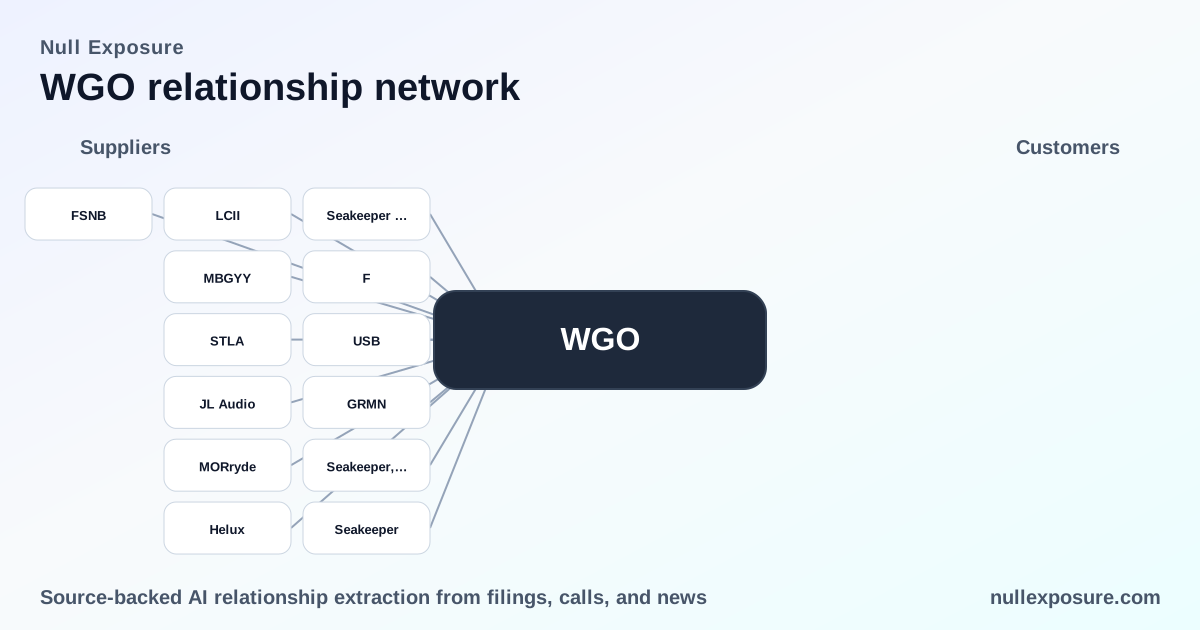
Winnebago (WGO) supplier map: who supplies the winners — and where risk lives
Winnebago Industries manufactures and sells recreational vehicles and marine products through a mix of in-house brands and OEM partnerships, monetizing via vehicle and boat sales, aftermarket accessories, and branded premium options. Revenue is driven by product refreshes, chassis and component partnerships, and higher-margin accessories, while cash flow and credit metrics are sensitive to supply concentration and commodity-driven cost swings (Revenue TTM $2.875B; Gross Profit TTM $377.3M). This note maps every supplier relationship surfaced in recent public reporting and news, highlights the operational constraints that matter to investors, and distills the risk/reward for operator and investor counterparties.
Interested in deeper supplier intelligence? Visit https://nullexposure.com/ for full-coverage supplier profiles and alerts.
What Winnebago’s supplier footprint looks like in practice
Winnebago runs a hybrid sourcing model: it manufactures core products and integrates third-party chassis, suspension, electronics, audio, and marine stabilization systems to broaden its product range. That operating posture produces two structural features investors care about: supplier concentration and strategic OEM dependence — Winnebago relies on large, recognizable suppliers for critical subsystems that directly influence product differentiation and warranty exposure.
- Concentration signal: Winnebago disclosed that in Fiscal 2025 a single supplier accounted for approximately 14% of consolidated raw material purchases, signaling material concentration in the supply chain.
- Manufacturing concentration: The company also noted that certain parts, especially motors, are available from a small group of suppliers, implying limited redundancy for critical components.
Those constraints increase bargaining leverage for key suppliers and raise replacement cost and continuity risks for operators and insurers underwriting inventory or dealer-finance exposure.
Supplier-by-supplier: what the relationships are and why they matter
Seakeeper / Seakeeper Ride™ — stabilization technology for Barletta pontoons
Winnebago’s Barletta Boats partnered with Seakeeper to introduce industry-first stabilization technology for pontoons, earning a 2026 Minneapolis Boat Show Innovation Award. This partnership elevates product differentiation in Barletta’s premium line and opens aftermarket upsell potential. According to GlobeNewswire and event coverage in Jan 2026, Seakeeper Ride™ is the named partner behind the stabilization system for Barletta. (GlobeNewswire, Jan 2026; Yahoo Finance coverage, Mar 2026)
Ford — chassis supply for Class C vans (Sunflyer)
Winnebago built new Class C models on a Ford chassis, including the Sunflyer, leveraging Ford’s proven commercial van platform to accelerate time-to-market. OEM chassis partnerships reduce development expense and concentrate vehicle-level supply risk on Ford’s production cadence. (Sahm Capital press release, Jan 14, 2026; Intellectia.ai coverage, Jan 2026)
U.S. Bank Trust Company, N.A. — indenture trustee for outstanding notes
U.S. Bank Trust Company serves as trustee for Winnebago’s 6.25% senior secured notes due 2028; the trustee handled notice of a $100 million redemption announced in Feb 2026. This is a standard capital markets relationship that affects bondholder communications and execution of redemptions. (Sahm Capital release, Feb 6, 2026; GlobeNewswire release, Feb 5, 2026)
Garmin — integrated helm electronics on Chris‑Craft models
Chris‑Craft’s Launch 27 and other models include an integrated Garmin 1543 XSV ultrawide display, consolidating navigation, sonar and engine data. Garmin provides a visible, premium electronics bundle that supports product pricing and dealer-installed options. (GlobeNewswire, Feb 9, 2026; Bitget coverage, Feb 2026)
Lippert Components — structural and fifth‑wheel framing
Winnebago standardized the Omega Fifth‑Wheel Frame from Lippert Components across its fifth-wheel line. Lippert supplies a structural, safety‑critical component — a relationship that cuts directly into manufacturing reliability and warranty exposure. (Sahm Capital, Jan 14, 2026)
Mercedes‑Benz — chassis for compact luxury Freedom Aire
The Freedom Aire is built on a Mercedes‑Benz 4500 chassis, enabling a compact luxury layout and premium fit/finish. Using Mercedes‑Benz chassis positions Winnebago in a higher-value segment but creates single‑source scheduling exposure. (Sahm Capital, Jan 14, 2026)
Ram (Stellantis*) — chassis for the Lineage LVP1
The Lineage LVP1 debuts on a high-roof Ram Promaster chassis, targeting family and group travel use cases. Stellantis (Ram) chassis supply supports diversification across chassis platforms but still concentrates dependence on OEM manufacturing runs. (Sahm Capital, Jan 14, 2026)
JL Audio — premium audio systems for marine craft
Chris‑Craft models offer custom-tuned JL Audio speakers as an available premium audio system. Premium audio partners enhance perceived value and add a dealer-installable revenue stream. (GlobeNewswire, Feb 9, 2026)
Fusion — standard audio source unit on some boats
Certain Chris‑Craft boats ship with a Fusion source unit and JL Sport speakers as standard equipment. Fusion supplies a cost-to-spec audio baseline that supports consistent build standards across SKUs. (GlobeNewswire, Feb 9, 2026)
MORryde — suspension and performance components
Winnebago lists MORryde independent suspension as a performance feature in select models. Suspension suppliers impact ride quality, warranty claims, and repair networks — a direct operational exposure for owners and insurers. (Sahm Capital, Jan 14, 2026)
Helux — pinbox component supplier
A Helux pinbox is identified as part of Winnebago’s towing interface in some fifth-wheel models. Pinbox suppliers are functional safety components that, if constrained, can halt production of specific towable SKUs. (Sahm Capital, Jan 14, 2026)
What this supplier map implies for investors and operators
The relationships show a deliberate strategy: Winnebago uses marquee OEM partners and specialty suppliers to add premium features while avoiding full verticalization. That strategy supports faster product cycles and keeps capital intensity lower than full in‑house development. However, the FY2025 disclosure that a single supplier represented ~14% of raw material purchases is a material concentration risk for manufacturers and creditors alike; it translates into potential procurement leverage for suppliers and inventory or production shocks for Winnebago.
Operationally, expect:
- Contracting posture: mixture of long-term OEM chassis supply and component-level vendor contracts; bargaining power shifts toward large OEMs and specialized suppliers for critical parts.
- Concentration: material — at least one supplier drives a high share of raw purchases.
- Criticality: many partners supply safety- or performance-critical subsystems (chassis, frames, motors, suspension, stabilization, electronics).
- Maturity: relationships range from mature OEM chassis deals (Ford, Mercedes‑Benz, Ram) to newer tech partnerships (Seakeeper), so short-term continuity risk varies by supplier.
For counterparties underwriting receivables, inventory, or providing supplier financing, these signals justify tighter covenant structures around supplier continuity and inventory concentration. Operators should prioritize multi-sourcing or validated second-source clauses for motors and other limited-supplier components.
Explore contractual risk scoring and supplier concentration dashboards at https://nullexposure.com/ to quantify exposure across counterparties.
Investment and operational takeaways — what to watch next
- Monitor OEM production backlogs at Ford, Mercedes‑Benz, and Stellantis — chassis bottlenecks will transmit to Winnebago lead times and margin pressure.
- Track supplier concentration remediation: any disclosure from Winnebago that reduces single-supplier reliance materially lowers operational risk.
- Assess warranty and repair cost trends tied to electronic and stabilization partners (Garmin, Seakeeper, JL Audio) as these influence aftermarket revenue and service cost curves.
For operator diligence, include supplier substitution clauses for motors and structural components and require proof of multi-year supply commitments from single-source partners.
For deeper, subscription-grade supplier mapping and alerts on changes to these relationships, visit https://nullexposure.com/ — the resource investors use to convert supplier intelligence into actionable portfolio and underwriting decisions.
Bottom line: Winnebago leverages high-profile OEMs and specialty suppliers to differentiate products, but supplier concentration and limited-supplier components are structural risks that investors and operators must price and contract against.