Cactus (WHD): supplier posture, strategic ties, and what investors should price in
Cactus, Inc. designs, manufactures, sells and leases wellheads and pressure-control equipment and monetizes through a mixed model of equipment sales, long-lived leases and aftermarket services. The company generates roughly $1.08 billion in trailing revenue and $330 million of EBITDA, while its equipment-leasing and aftermarket streams provide margin durability alongside cyclical sales—an important hedge when raw-material and supplier conditions fluctuate. For investors evaluating supplier relationships and operational resilience, the core question is how Cactus’s procurement posture and recent strategic moves change cost volatility and supply continuity for that revenue base.
Discover more supplier intelligence at Null Exposure.
What the supplier footprint tells you about procurement strategy and cost exposure
Cactus’s procurement disclosures and public details produce a clear, actionable profile: procurement is short-duration, geographically diversified, and buyer-driven. Company disclosures state that forward purchase contracts for certain items are typically 30 days in duration and are settled and renewed monthly, which establishes a transactional, high-frequency contracting posture. That structure buys flexibility but increases exposure to spot-price swings and short-term logistics disruption.
The vendor base is concentrated across two broad regions: North America and the Asia–Pacific corridor (United States, China, India, Australia and Vietnam). This split delivers both diversification and correlated risk: diversification reduces single-country supply shocks, but Asia exposure creates sensitivity to container capacity, tariffs and supplier margin compression if commodity feedstocks or labor costs rise in those markets.
Finally, Cactus’s own language frames the company as a buyer in these flows—procurement-led, not vertically integrated into raw-material production—so operational continuity relies on external suppliers for certain components and subassemblies. That buyer posture confers negotiating flexibility for volumes and price resets, but it also leaves Cactus exposed to supplier capacity constraints for specialized pressure-control parts.
Key operating signals:
- Short-term contracting: gives flexibility, increases exposure to price volatility.
- Geographic split (NA / APAC): reduces single-point failure risk but increases logistics and trade-policy sensitivity.
- Buyer role: procurement-driven cost control is critical to margin preservation.
Where those procurement signals hit the P&L
The procurement profile translates directly into measurable financial risk and opportunity. Cactus’s operating margin (22.9% TTM) and profit margin (15.4% TTM) reflect both product mix (sales vs. leases) and the company’s ability to manage input costs. Short-term contracts mean that upward swings in steel or freight costs can compress margins quickly, but the company’s leasing and aftermarket revenue provide higher-margin, recurring cash flow that dampens volatility.
Valuation context reinforces the operational picture: EV/EBITDA of 9.5 and a trailing P/E near 18.9 imply investors price in moderate cyclical risk but expect steady earnings conversion of revenues to cash. Supplier-driven cost spikes would surface quickly in quarterly results because procurement terms reset on a monthly cadence.
If you’re modeling downside scenarios, assume two channels of margin pressure: input-price pass-through lag for sold units, and increased capex or inventory days to buffer APAC-origin supply constraints. Conversely, the buyer posture and diversified sourcing create tactical opportunities to renegotiate or shift sourcing rapidly when markets dislocate.
Explore supplier relationship maps and playbooks at Null Exposure.
Strategic tie: Baker Hughes — what changed and why it matters
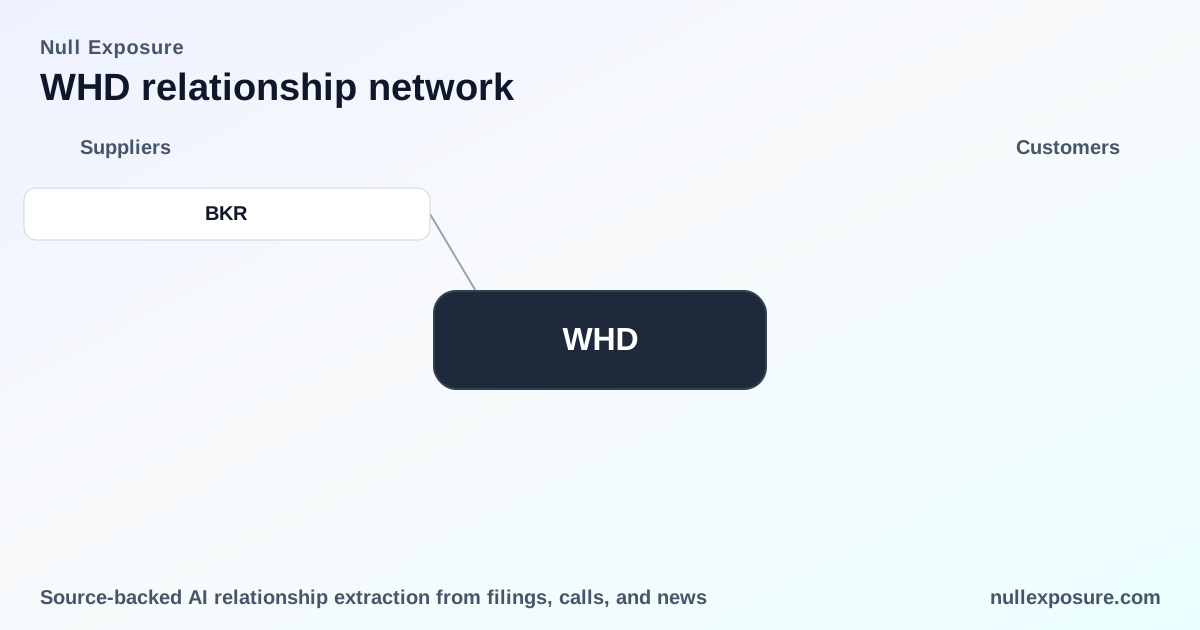
Cactus completed the acquisition of a 65% controlling interest in the Baker Hughes surface pressure control business, transitioning part of Baker Hughes’s surface pressure-control portfolio into Cactus’s control and likely expanding Cactus’s product breadth and direct customer access in pressure-control equipment. This deal is a supply-and-capability play: Cactus is acquiring production and technology depth that reduces dependence on third-party pressure-control suppliers and accelerates aftermarket reach. (MarketScreener report, citing the January announcement and published March 2026: https://www.marketscreener.com/news/cactus-announces-timing-of-fourth-quarter-and-full-year-2025-earnings-release-and-conference-call-an-ce7e5bd3dc81f625)
This transaction transforms a prior external relationship into partial ownership, shifting the risk profile from counterparty dependency toward integration execution risk and potential synergies capture.
How the Baker Hughes tie interacts with procurement constraints
The Baker Hughes acquisition reduces Cactus’s exposure in one critical component area—surface pressure-control equipment—by internalizing a substantial share of supply and capability. That move aligns with the broader procurement signals: while most inputs remain sourced from US and APAC suppliers on 30-day forward arrangements, the acquired business provides internal manufacturing capacity and aftermarket control, which increases resilience for a key product line and decreases near-term spot vulnerability in that category.
Investors should monitor integration milestones and any statements on supplier rationalization: ownership of manufacturing capacity tends to change bargaining power with external vendors and affects capex and working-capital profiles in the near term.
Risks, concentration and maturity — what to watch next
Investors should weigh these points when assessing WHD as a supplier-dependent industrial:
- Risk of short-term price shocks: monthly contract renewal cadence transmits commodity and freight volatility to margins rapidly; hedging options are limited at such short tenors.
- Geographic trade exposure: APAC sourcing is a practical diversification, but it concentrates exposure to regional logistics and policy risk (tariffs, labor disruptions).
- Concentration versus maturity: the mix of established suppliers in the US and APAC suggests a mature procurement network, but the company’s buyer posture indicates operational dependence rather than vertical insulation—recent M&A (Baker Hughes stake) is the primary countermeasure to that dependence.
- Integration execution: the Baker Hughes acquisition shifts risk from supplier continuity to integration and synergy realization.
These are not theoretical issues; they feed directly into working capital, gross margin, and capex cadence, all of which matter to near-term earnings and medium-term return on invested capital.
Investment takeaway and next steps
Cactus combines diversified revenue streams (sales, leases, aftermarket) and a procurement model that favors flexibility over long-term supplier lock-ins. The acquisition of Baker Hughes’s surface pressure-control business is a structural enhancement reducing external supplier dependence on a critical product family. For investors, the key balancing act is between the flexibility and agility of short-term contracts and the margin and supply security benefits of onshore or in-house production.
If your thesis emphasizes margin stability and operational control, factor accelerated integration benefits from the Baker Hughes stake into medium-term margin upside. If your thesis focuses on downside to commodity and freight costs, stress-test earnings on sustained input-price increases given the 30-day contracting reality.
For a deeper look at supplier linkages, procurement signals, and scenario modeling for WHD, visit Null Exposure — use the platform to map supplier exposure into valuation scenarios and track integration milestones for the Baker Hughes transaction.