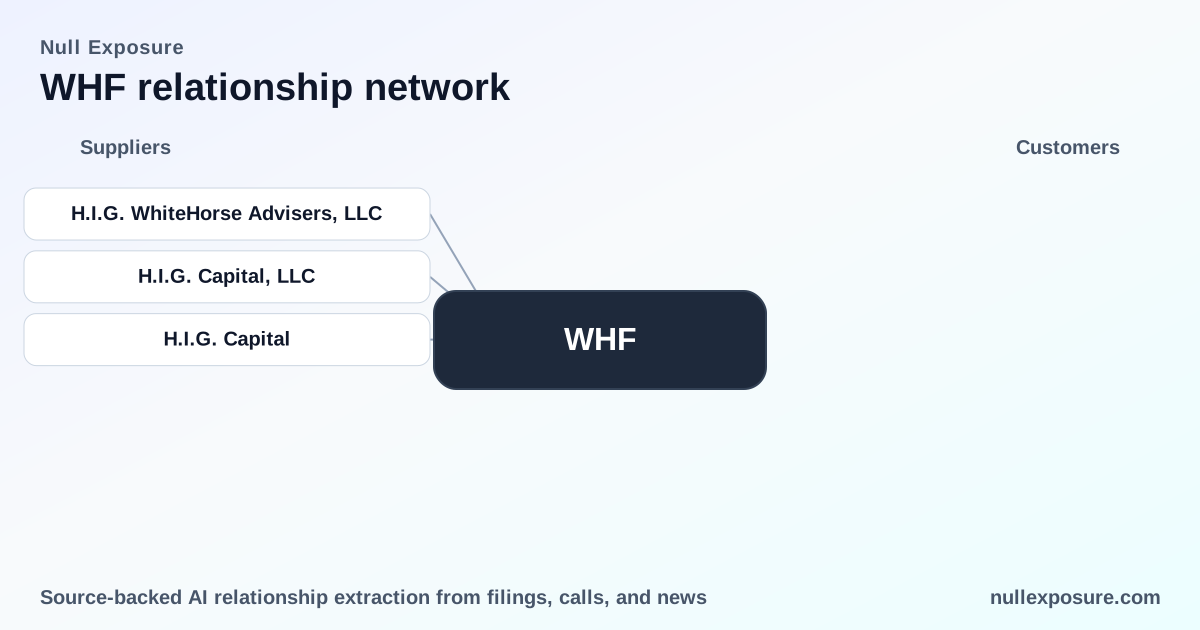
WhiteHorse Finance (WHF): The H.I.G. axis that runs the portfolio engine
WhiteHorse Finance is a closed‑end Business Development Company that earns recurring management and incentive income by originating and holding secured first‑ and second‑lien loans to middle‑market companies, while outsourcing day‑to‑day portfolio management and administrative capacity to H.I.G. affiliates. The company monetizes through base management fees, incentive fees and interest income from its credit portfolio; its operating leverage is therefore tightly coupled to the contractual relationship with its investment adviser and administrator. For investors evaluating supplier risk, the governance and operational arrangements with H.I.G.‑affiliated entities are the single most consequential factor for credit performance and operational continuity.
Discover supplier risk profiles and relationship maps at https://nullexposure.com/.
How WhiteHorse runs and gets paid
WhiteHorse’s model is straightforward: capital from public equity and debt funds is allocated into privately negotiated loans to mid‑market borrowers; revenue flows come from interest on those loans and management fees paid to the adviser, while distributions to shareholders are supported by realized gains and recurring interest. The company contracts key functions—investment decisioning, credit monitoring, restructuring support and back‑office administration—to H.I.G. affiliates under explicit advisory and administration agreements, so operational control is outsourced while strategic oversight remains with the board.
This contracting posture creates a classic BDC structure: low operational headcount at the corporate level, concentrated third‑party reliance on a small number of related entities, and fee‑based economics that scale with portfolio size and performance. That dynamic is evident in WhiteHorse’s reported base management fees and its low incremental administrative expense line items in recent filings.
Supplier relationships in primary reporting — what the sources say
Below are concise, source‑linked summaries for every relationship mention in the supplied results. Each entry is one to two sentences with the originating reference.
H.I.G. WhiteHorse Advisers, LLC — Yahoo Finance (FY2026)
WhiteHorse’s investment activities are managed by H.I.G. WhiteHorse Advisers, LLC, an affiliate of H.I.G. Capital, which serves as the company’s investment adviser and runs day‑to‑day portfolio management. Source: Company announcement reported on Yahoo Finance (March 2026, FY2026 disclosure).
H.I.G. WhiteHorse Advisers, LLC — Yahoo Finance Singapore (FY2026)
The same disclosure was syndicated to international outlets; the Singapore Yahoo Finance listing reiterates that H.I.G. WhiteHorse Advisers is the designated investment manager for the period ending FY2026. Source: SG.Finance.Yahoo.com (March 2026, FY2026).
H.I.G. WhiteHorse Advisers, LLC — MarketScreener (FY2025)
MarketScreener’s coverage of a FY2025 update and a special distribution announcement repeats that investment activities are managed by H.I.G. WhiteHorse Advisers, confirming continuity of the advisory mandate through 2025 filings. Source: MarketScreener (FY2025 corporate release).
H.I.G. Capital, LLC — SG.Finance.Yahoo.com (FY2026)
Public filings and press releases identify H.I.G. Capital as the ultimate affiliate group tied to WhiteHorse’s advisory arrangement, underscoring the parent‑group relationship that supplies resources and brand licensing. Source: SG.Finance.Yahoo.com (March 2026, FY2026).
H.I.G. WhiteHorse Advisers, LLC — MarketScreener (equity buyback, FY2025)
A MarketScreener note on the company’s $15 million buyback and other corporate actions again specifies H.I.G. WhiteHorse Advisers as the investment adviser, tying corporate capital allocation decisions to the adviser’s operational role. Source: MarketScreener (FY2025 corporate action).
H.I.G. Capital — InsiderMonkey (FY2025 earnings call transcript)
Earnings‑call commentary records WhiteHorse using the H.I.G. Capital platform and restructuring resources—including a dedicated WhiteHorse restructuring team and access to H.I.G.’s broader capabilities—to remediate nonaccrual credits. Source: InsiderMonkey earnings call transcript (Q3 2025 / FY2025 discussion).
What the contract language and constraints reveal about operating risk
The filings and press coverage produce a consistent picture of WhiteHorse’s operating model and risk posture:
- Contracting posture: WhiteHorse uses long‑dated, active investment advisory and administration agreements with H.I.G. affiliates (the Investment Advisory Agreement was originally executed in 2012 and last amended and restated in February 2024), which means the company is structurally dependent on incumbent adviser relationships for execution, compliance and brand rights.
- Concentration and criticality: Filings explicitly acknowledge dependence on the communications and information systems of WhiteHorse Advisers and its affiliates to monitor cybersecurity and operations—this is annotated as critical in corporate disclosures, making the adviser relationship operationally indispensable. (Company filing excerpts, FY2024–FY2026 disclosures.)
- Role definitions and maturity: The adviser relationship is labeled both service provider and licensee in disclosure language — the company holds a trademark license to use the WhiteHorse name so long as the adviser or its affiliate remains the investment adviser, which codifies a long‑term commercial alignment with the H.I.G. group.
- Spend and fee structure: Public figures show two spend bands at work: a de minimis administrative allocation item (reported allocated administrative service fees of $683 in multiple years) alongside material base management fees (line item: base management fees $12,127 in the reported periodic schedules), indicating fees for advisory services are a material recurring cost while day‑to‑day admin allocations are relatively small.
These disclosures frame WhiteHorse as a company whose operational continuity, brand rights and investment execution are deeply integrated with H.I.G. affiliates—a positive for access to sourcing and workout capability, and a risk if the adviser relationship is disrupted.
Explore supplier concentration and operational mappings at https://nullexposure.com/ to see live relationship visualizations.
Investment implications: what investors should price in
- Positive: Access to the H.I.G. platform delivers sourcing, restructuring capability and operational scale that support credit recovery and deal flow; the adviser arrangement aligns incentives through management and incentive fees.
- Negative: Single‑group concentration is the key operational risk — administrative continuity, IP (trademark) licensing and cybersecurity are all tied to the same related parties, creating a single point of failure if governance or contractual alignment changes.
- Valuation sensitivity: With a price‑to‑book below 1 and a forward P/E that compresses around management fee assumptions, changes in fee rates, adviser performance or material adverse adviser events will move the multiple and dividend capacity more than sector‑level credit performance alone.
Bottom line and next steps
WhiteHorse’s economics are underpinned by H.I.G.‑affiliated adviser and administration arrangements that provide both scale and a concentration risk. For investors focused on supplier and operational exposures, the adviser relationship is the primary axis to underwrite: it is active, contractually embedded, operationally critical and fee‑driving.
For a deeper view of supplier dependencies and comparable relationship risk across alternative managers, visit https://nullexposure.com/ for independent relationship intelligence and visualization tools.