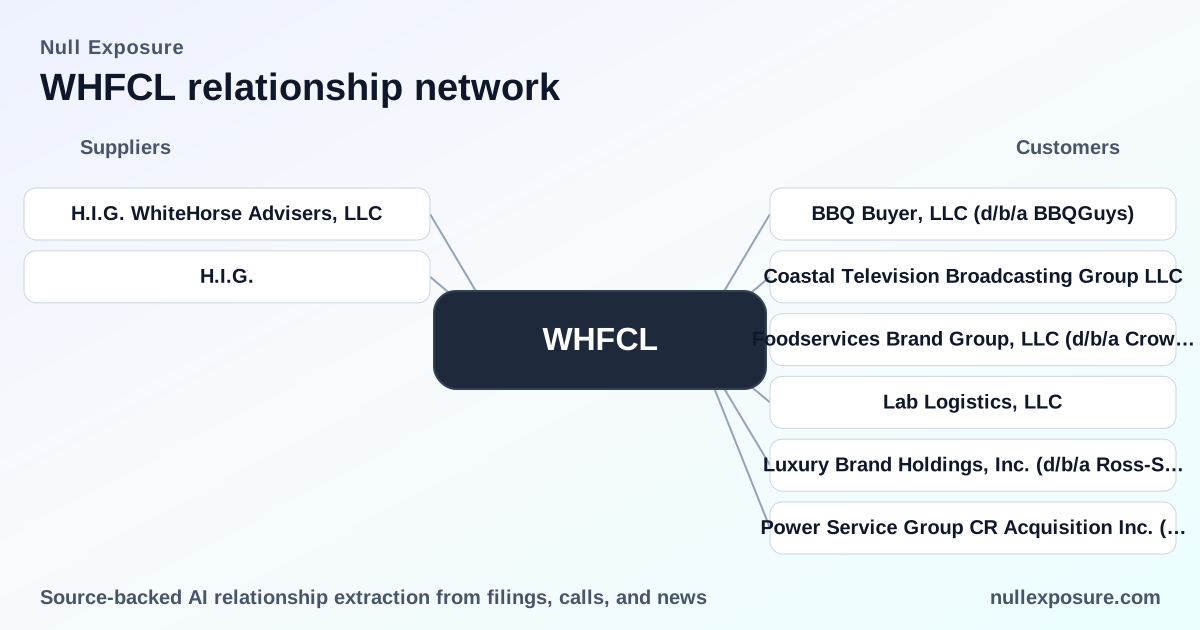
WhiteHorse Finance (WHFCL) — Supplier relationships and operational implications for investors
WhiteHorse Finance issues corporate notes and operates as a business development company (BDC) that monetizes a middle‑market credit portfolio through interest income and spread capture while funding via capital markets (including the 7.875% Notes due 2028). The company outsources core investment management and administrative functions to affiliated firms within the H.I.G. network and uses a secured credit facility for liquidity — an operating model that concentrates execution risk in a small set of service relationships and in its funding counterparties. For a practical, investor-focused primer and relationship mapping, visit https://nullexposure.com/.
Why supplier relationships matter for a BDC note investor
WhiteHorse is not a vertically integrated asset manager; it relies on related-party advisers and administrators to run investment decisions, compliance, and back office operations, and it funds positions both with equity/dividends and with debt markets. That outsourcing pattern influences governance, counterparty risk, and operational resiliency. Investors in WHFCL notes should be focused on three vectors: (1) the quality and continuity of the investment adviser, (2) the administrative and cybersecurity posture of service providers, and (3) funding and liquidity arrangements with banks.
A short review of the publicly observed supplier relationships and company-level constraints follows. If you want a structured supplier map and ongoing monitoring for credit and operational due diligence, see the research tools at https://nullexposure.com/.
Relationship-by-relationship breakdown (plain-English, sourced)
H.I.G. WhiteHorse Advisers, LLC — confirmed investment adviser (MarketScreener, FY2026)
WhiteHorse confirms that H.I.G. WhiteHorse Advisers, LLC is the Company’s investment adviser and is responsible for day‑to‑day portfolio management under the Investment Advisory Agreement. This positioning is explicitly stated in a MarketScreener press release reporting FY2026 results (March 2026).
H.I.G. WhiteHorse Advisers, LLC — adviser affiliation cited in prior reporting (Yahoo Finance, FY2025)
Company filings and investor releases note that investment activities are managed by H.I.G. WhiteHorse Advisers, LLC, an affiliate of H.I.G. Capital, making the adviser both operationally central and affiliated with a broader alternative‑asset platform; this was described in the company’s FY2025 announcement on Yahoo Finance (reported March 2026).
H.I.G. — access to restructuring and broader platform capabilities (InsiderMonkey transcript, FY2026)
Management states that the firm leverages H.I.G.’s restructuring resources and broader platform capabilities to actively manage underperforming credits, a strategic advantage for stressed situations reported in the FY2026 earnings call transcript published by InsiderMonkey (March 2026).
H.I.G. WhiteHorse Advisers, LLC — repeated public confirmation of management role (The Globe and Mail, FY2026)
Press coverage for FY2026 reiterates that investment activities are managed by H.I.G. WhiteHorse Advisers and that the affiliate focuses on small/mid‑cap markets, as noted in The Globe and Mail’s FY2026 reporting (March 2026).
Company‑level constraints and what they signal for investors
The public disclosures produce several consistent, actionable signals about WhiteHorse’s operating model:
- Licensing and brand dependency: The company has a trademark license agreement with an affiliate of H.I.G. Capital granting a non‑exclusive, royalty‑free right to use the “WhiteHorse” name. This is a corporate‑level arrangement affecting identity and marketing, not a fee‑based dependency.
- Service provider posture and concentration: WhiteHorse delegates investment management and core administrative functions to affiliated entities (WhiteHorse Advisers and WhiteHorse Administration). The Administration Agreement supplies office facilities, CFO/CRO resources and other overhead allocations — an explicit outsourcing model that centralizes operational responsibility with related parties.
- Contract lifecycle and renewal: The Investment Advisory Agreement is an ongoing, re‑approved contract (most recently amended and restated through 2024 and re‑approved October 30, 2024). The relationship is active and renewing annually, which supports continuity but increases governance importance.
- Funding and liquidity signals: The firm operates a credit facility originated with JPMorgan as administrative agent; the disclosure shows $161,493 outstanding borrowings and $173,507 undrawn as of December 31, 2024, indicating the presence of a committed bank line as a liquidity backstop for portfolio and corporate needs.
- Operational risk and cybersecurity dependence: The company depends on the communications and information systems of WhiteHorse Advisers and affiliates and conducts periodic board and management reviews, signaling that cybersecurity and third‑party operational resilience are material to investor outcomes.
Note: one internal signal flagged a large spend band, but publicly disclosed borrowings under the credit facility are modest by dollar amount as of Dec 31, 2024 — treat inferred spend bands cautiously and rely on the explicit facility disclosures above.
Operational implications — what investors should prioritize
- Governance and oversight: Because the adviser and administrator are affiliated and provide a wide range of services, board independence and the annual approval process for the advisory agreement are critical governance checkpoints. Confirm whether a majority of independent directors regularly review adviser performance and fees.
- Concentration risk: Outsourcing core functions to a small set of H.I.G. affiliates concentrates operational and reputational risk; a disruption at the adviser or a deterioration in H.I.G.’s platform capabilities would be directly material to credit and cash collection.
- Restructuring capabilities: The link to H.I.G.’s restructuring resources is a competitive advantage when credits underperform, and investors should value that capability when stress‑testing the portfolio. InsiderMonkey’s FY2026 transcript highlights active management of underperforming credits through those resources.
- Liquidity profile: The JPMorgan credit facility provides a committed bank line, but current reported utilization is low; monitor covenant language, commitment fees, and the facility’s amendment history as potential risk levers for funding cost and availability.
If you need a tailored supplier risk memo or a counterparty map for WHFCL holdings, our platform offers investor-grade research and monitoring — learn more at https://nullexposure.com/.
Bottom line for note holders and credit analysts
WhiteHorse Finance operates a classic BDC outsourcing model: it monetizes through credit interest and distributes returns while delegating portfolio management and administration to H.I.G. affiliates. That structure delivers scalability and access to restructuring expertise, but also places operational, governance, and vendor concentration risks squarely on investors’ due diligence checklist. Keep attention on the adviser approval cadence, the administration agreement’s cost allocation mechanics, and the health of the JPMorgan credit facility.
For ongoing supplier monitoring and alerts tied to WHFCL counterparties, visit https://nullexposure.com/ and subscribe for analyst updates.