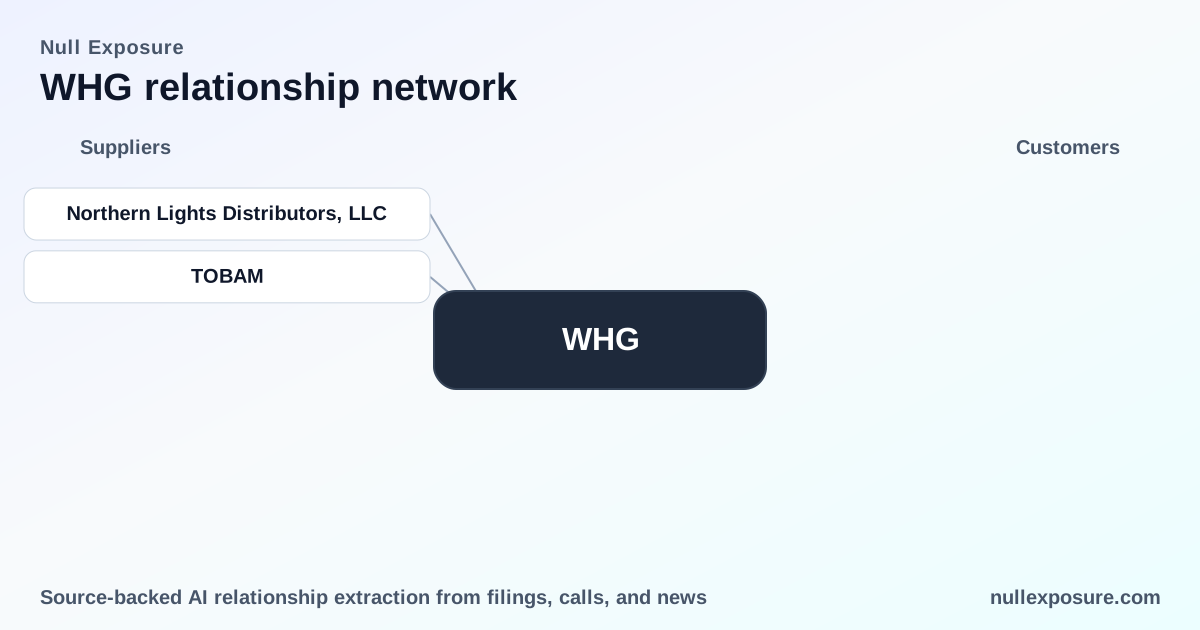
Westwood Holdings Group (WHG): supplier map, operating constraints, and what investors should watch
Westwood Holdings Group runs a fee-driven asset management business focused on institutional and ETF products and monetizes primarily through asset-based management fees and product-level distribution channels. The firm's ETFs and mutual funds rely on a small set of third-party service providers for distribution, index licensing, technology and research tools—an arrangement that concentrates operational risk but keeps fixed overhead relatively controllable. For an actionable supplier view of WHG and peer comparisons, visit Null Exposure.
Why suppliers matter for an asset manager's economics
Westwood's profitability depends on scale and low marginal operating cost: management fees scale with AUM while outsourced suppliers convert fixed costs into variable support that enables product distribution and research. When a boutique manager outsources distribution, index licensing and IT, those suppliers become de facto extensions of the firm's go-to-market and operations—so supplier performance and contractual terms directly influence client acquisition, product continuity, and margin stability.
Who distributes and benchmarks Westwood’s ETFs (and why that matters)
Northern Lights Distributors, LLC — the distribution partner
Multiple March 2026 press releases and media reports state that Westwood’s ETFs are distributed by Northern Lights Distributors, LLC (Member FINRA), identifying Northern Lights as the primary sales/distribution intermediary for Westwood ETF products. See reporting in Yahoo Finance (March 10, 2026), GlobeNewswire (March 9, 2026) and a QuiverQuant notice (March 10, 2026) for the public filings and press releases that reference this distributor.
TOBAM — index methodology provider for at least one product
Westwood’s BFRE ETF references a third‑party benchmark: the fund tracks the TOBAM LBRTY All World Equity Index, a rules-based index that uses democracy metrics as part of its exclusionary methodology. The Wealth Advisor covered the BFRE product structure and its use of the TOBAM benchmark in a FY2025 story.
Relationship-by-relationship summary (every relationship in the record)
-
Northern Lights Distributors, LLC — Westwood’s ETF lineup is distributed through Northern Lights, which acts as the public-facing intermediary for product distribution and subscriber handling; this distributor relationship is documented across multiple March 2026 press releases and news articles. (Sources: Yahoo Finance, March 10, 2026; GlobeNewswire, March 9, 2026; QuiverQuant, March 10, 2026.)
-
TOBAM — Westwood’s BFRE strategy uses the TOBAM LBRTY All World Equity Index as its benchmark, embedding an externally governed index methodology into product construction and marketing. (Source: The Wealth Advisor, FY2025.)
What the disclosed supplier constraints reveal about contract posture and concentration
Westwood’s own purchase-commitment disclosures (as of December 31, 2024) show that purchase obligations are concentrated in outsourced IT/services, software licenses and financial research tools, indicating a deliberate operating posture of outsourcing non-core capabilities rather than building them in-house. The firm reports purchase obligations of $15,685 (thousands) for the next five years (i.e., roughly $15.7 million), with payments due: $7.102M within 1 year, $6.307M in years 1–3 and $2.276M in years 4–5.
- Contracting posture: short- to medium-term commitments dominate (most obligations fall inside three years), which gives Westwood flexibility to reset vendor relationships as products and distribution needs change.
- Concentration: distribution and indexing are handled by named third parties; while the record does not show many unique vendor names, distribution is a single clear dependency and index licensing creates product-level coupling.
- Criticality and maturity: distribution and index relationships are operationally critical for ETF continuity; software/IT spend is material but not lock‑in heavy based on the maturity ladder.
- Spend scale relative to the business: with TTM revenue of $96.2M, the five‑year purchase obligations (~$15.7M) equal roughly 16% of annual revenue, which is meaningful but not destabilizing for an asset manager of Westwood’s size.
These are company-level signals derived from Westwood’s purchase-commitment disclosure rather than a vendor-specific contract dump; the disclosures show a deliberate trade-off between scalability and third-party dependency.
Investment implications: risks that matter and where to focus diligence
- Distributor dependence is an operational lever. Northern Lights carries distribution responsibilities; any change in that relationship would affect marketing touchpoints and ETF flows. Monitor distributor agreements and any notice of termination or re-negotiation in future filings or press releases.
- Third-party index licensing constrains product agility. Using TOBAM’s LBRTY index for BFRE embeds an external methodology and governance framework into the product; changes in index methodology or licensing economics will affect product attractiveness and compliance.
- IT/software and research commitments are material but manageable. The purchase obligations schedule shows the firm can renegotiate or re-platform within a few years, limiting long-term vendor lock-in; however, near-term renewal windows (a majority of spend inside three years) create concentrated negotiation events that investors should monitor.
- Relative spend concentration is within a mid-range band. The disclosed obligations place Westwood in a $10M–$100M spend band for purchase commitments—substantial enough to matter to vendor economics but not so large that suppliers alone dominate strategic outcomes.
For a focused supplier risk scorecard and ongoing monitoring, visit Null Exposure to see how these relationships compare across asset managers.
Actionable checklist for investors and operators
- Track distribution announcements and fund flow trends tied to Northern Lights references in press releases and regulatory filings.
- Monitor index licensing terms and any methodology changes from TOBAM for products that reference third‑party benchmarks.
- Review annual filing tables for vendor renewal buckets—the next three years contain the bulk of spend and will be decisive for margin and operational continuity.
- Incorporate supplier renewal timing into scenario analysis for revenue persistence and product rollouts.
For bespoke supplier intelligence and comparative benchmarking across asset managers, see Null Exposure.
Bottom line
Westwood operates a lean asset-management model that outsources distribution, indexing and technology, concentrating operational dependencies in a handful of external partners. The firm’s purchase commitments (~$15.7M) are material relative to revenue but structured with near-term flexibility, which reduces lock‑in risk while creating discrete renewal events investors should watch. Maintain focus on distribution continuity (Northern Lights), index governance (TOBAM), and upcoming vendor renewals as the most actionable supplier signals for WHG performance going forward.